Commercial Lunar Payload Services
53
MENTIONS
20
EPISODES
16
PODCASTS
Search complete. 53 mentions across 20 episodes found for "Commercial Lunar Payload Services".
Nov 2, 2026

Kristin HoustonGUEST
We're also working, you know, with some of...
Kristin HoustonGUEST
Some of the CLPS providers on propulsion systems for land, for some of these CLPS cargo landers.
Kristin HoustonGUEST
We are working with others on some of the habitats in terms of power systems and power management on habitats.
Kristin HoustonGUEST
And then again, kind of things around in-space and getting there as well.

Scott ManleyHOST
In Japan, I-Space, they have announced their next target is Schrodinger Basin, which is a region near the South Pole, and it's actually on the far side of the moon.
Scott ManleyHOST
This is going to be a mission for NASA's CLPS program.
Scott ManleyHOST
It's in collaboration with Draper Labs and others, and it's scheduled for no earlier than 2027.
Scott ManleyHOST
Now, because this mission is gonna be on the far side of the moon, although at the pole, they're gonna need to deploy a couple of relay satellites.
Scott ManleyHOST
And while Jared Isaacman has come in and made a bunch of changes and laid forth an ambitious vision for the coming years, The biggest question for me is, what happens next? And the logical answer for the Artemis program would be Artemis III, and that is indeed expected to happen next year.
Scott ManleyHOST
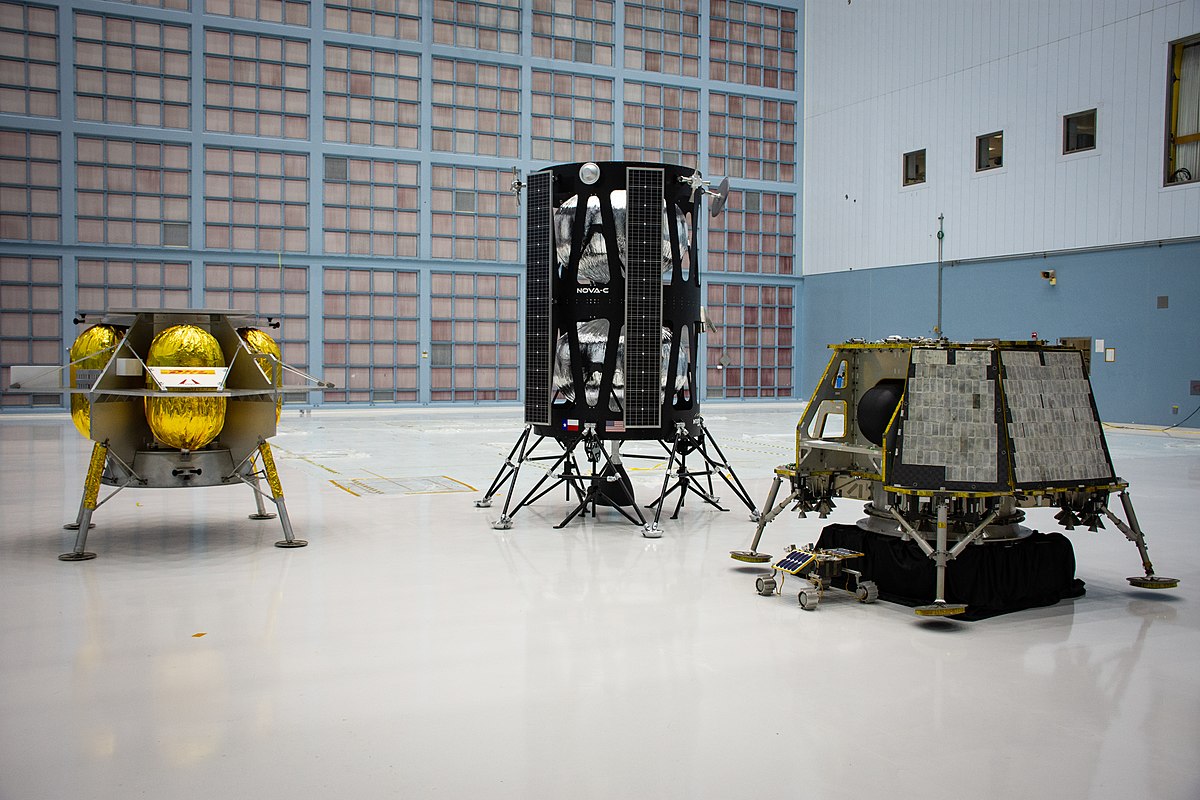
But actually, before then, we are expected to have maybe as many as four different uncrewed missions landing on the lunar surface carrying payload as part of NASA's Commercial Lunar Payload Services program.
Scott ManleyHOST
And we'll talk about those.
Scott ManleyHOST
What I really want to focus on first is, what will it take to get SLS flying again? Does NASA and its partners have everything in place so that they can stick to their timeline and launch Artemis III next year? The plan being that Artemis III will fly into Earth orbit and rendezvous with the human landing system prototypes to verify some of the control capabilities, to verify the life support.
14 MINS LATER
Scott ManleyHOST
There's a lot of work for the HLS providers to do if they are aiming for this 2028 landing.
Scott ManleyHOST
And in the meantime, we do expect a number of unmanned payloads landing on the moon.
Scott ManleyHOST
So the next one we expect as part of the commercial lunar payload services should be Blue Moon Mark 1.
Scott ManleyHOST
We don't know when that is.

Anthony ColangeloHOST
They have to build the other cabin for the lander in Artemis III.
Anthony ColangeloHOST
They still have to fly all their commitments that they have for Amazon, for the lunar lander that they want to fly, the Blue Moon Mark I, for the CLPS missions, the other lunar landing missions that they have on their books, because right before New Glenn blew up, they were landing a lot of them on their contract list.
Anthony ColangeloHOST
So trying to fit all that in between early 2027 and even late 2028, is a tremendous amount of activity for a company that has not the best track record in getting things done.
Anthony ColangeloHOST
So is what we're seeing right now, is what happened after the New Glenn explosion, this invigoration that it looks like from the outside, that's what it looks like to us, right? Is that they are progressing on the launchpad rebuild and the simplification of that as well.
Scott ManleyHOST
So anyway, Blue Moon Mark 1 ended up winning two contracts that were announced at this Moonbase press conference.
Scott ManleyHOST
But the press conference basically started out with taking a number of CLPS missions, Commercial Lunar Payload Services missions, that were already paid for and were already planning, and said, these are now Moonbase missions.
Scott ManleyHOST
Because Moonbase is much more exciting, right? We have this vision of astronauts in there like Moonbase, hanging out.
Scott ManleyHOST
And you're saying, hey, Bob, or whatever, right? But the moon base that NASA is planning is, well, it's practical, right? It's built around what is possible rather than what script writers imagine.
6 MINS LATER
Scott ManleyHOST
And I'm presuming that Griffin and Trinity are both going to remain on schedule for now.
Scott ManleyHOST
And yeah, Blue Moon Mark I, we don't know when that's going to happen.
Scott ManleyHOST
Now, there are a number of other CLPS missions which have not been rebranded to moon-based just yet.
Scott ManleyHOST
For example, Firefly's Blue Ghost Mission 2 going to the far side of the moon.
Scott ManleyHOST
They'd like to land them vertically, but regardless, they would like to be able to talk to them without having to buy time on NASA's deep space network.
Scott ManleyHOST
Or maybe they think that they can sell this network capacity to other CLPS participants.
Scott ManleyHOST
So again, I think this is interesting because, of course, NASA has issues with deep space network overuse.
Scott ManleyHOST
So being able to have a private capability would definitely help and would definitely enhance moon-based capabilities.

Will RogersHOST
And finally, the Australian Space Agency and the Ruver Consortium unveiled the latest design model of Ruver, Australia's first lunar rover, at the Queensland University of Technology's Lunar Testbed and Space Lab during World Space Week on October 7, 2026.
Will RogersHOST
Scheduled to land at the Lunar South Pole in 2030 aboard an Intuitive Machines lander under NASA's Commercial Lunar Payload Services program, the semi-autonomous rover will collect and analyze regolith to support sustainable human exploration through the Artemis program.
Will RogersHOST
Designed to withstand extreme lunar temperature swings from minus 246 degrees centigrade to plus 121 degrees centigrade, the vehicle features homegrown Australian technology, including specialized treaded wheels, thermal management systems, and tools to mitigate against lunar dust and radiation.
speaker_7NARRATOR
You are listening to This Week in Amateur Radio, available to download as a podcast from anywhere on the web.
21 MINS LATER
George LamaHOST
Australia's first lunar rover, that would be the rover, met the public recently during World Space Week at the Queensland University of Technology's Lunar Testbed and Space Lab.
George LamaHOST
Plans are to land the semi-autonomous vehicle at the lunar South Pole in 2030.
George LamaHOST
The trip will take place under NASA's Commercial Lunar Payload Services program.
George LamaHOST
Ruver will make its journey aboard an intuitive machines lander and then conduct studies relevant to eventual human exploration under the Artemis program.

Will RogersHOST
And finally, the Australian Space Agency and the Ruver Consortium unveiled the latest design model of Ruver, Australia's first lunar rover, at the Queensland University of Technology's Lunar Testbed and Space Lab during World Space Week on October 7, 2026.
Will RogersHOST
Scheduled to land at the Lunar South Pole in 2030 aboard an Intuitive Machines lander under NASA's Commercial Lunar Payload Services program, the semi-autonomous rover will collect and analyze regolith to support sustainable human exploration through the Artemis program.
Will RogersHOST
Designed to withstand extreme lunar temperature swings from minus 246 degrees centigrade to plus 121 degrees centigrade, the vehicle features homegrown Australian technology, including specialized treaded wheels, thermal management systems, and tools to mitigate against lunar dust and radiation.
speaker_7NARRATOR
You are listening to This Week in Amateur Radio, available to download as a podcast from anywhere on the web.
21 MINS LATER
George LamaHOST
Australia's first lunar rover, that would be the rover, met the public recently during World Space Week at the Queensland University of Technology's Lunar Testbed and Space Lab.
George LamaHOST
Plans are to land the semi-autonomous vehicle at the lunar South Pole in 2030.
George LamaHOST
The trip will take place under NASA's Commercial Lunar Payload Services program.
George LamaHOST
Ruver will make its journey aboard an intuitive machines lander and then conduct studies relevant to eventual human exploration under the Artemis program.

Will RogersCORRESPONDENT
And finally, the Australian Space Agency and the Ruver Consortium unveiled the latest design model of Ruver, Australia's first lunar rover, at the Queensland University of Technology's Lunar Testbed and Space Lab during World Space Week on October 7, 2026.
Will RogersCORRESPONDENT
Scheduled to land at the Lunar South Pole in 2030 aboard an Intuitive Machines lander under NASA's Commercial Lunar Payload Services program, the semi-autonomous rover will collect and analyze regolith to support sustainable human exploration through the Artemis program.
Will RogersCORRESPONDENT
Designed to withstand extreme lunar temperature swings from minus 246 degrees centigrade to plus 121 degrees centigrade, the vehicle features homegrown Australian technology, including specialized treaded wheels, thermal management systems, and tools to mitigate against lunar dust and radiation.
George BowenHOST
produced by amateurs for amateurs and originating from Albany, New York.

Graham KempCORRESPONDENT
Plans are to land the semi-autonomous vehicle at the lunar South Pole in 2030.
Graham KempCORRESPONDENT
The trip will take place under NASA's Commercial Lunar Payload Services Program.
Graham KempCORRESPONDENT
Ruva will make its journey aboard an intuitive machines lander and then conduct studies relevant to eventual human exploration under the Artemis program.
Graham KempCORRESPONDENT
It is being designed and created by an industry consortium comprising universities, researchers, major companies and start-ups.
10 more episodes mention Commercial Lunar Payload Services.
Create an account to see the whole feed, search across every transcript, and follow the entities you care about.