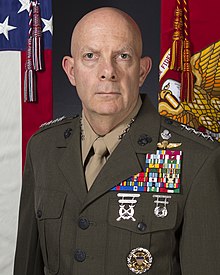
Commandant of the United States Marine Corps
Job titleWikipedia
21
MENTIONS
9
EPISODES
9
PODCASTS
Search complete. 21 mentions across 9 episodes found for "Commandant of the United States Marine Corps".
Oct 9, 2026

Larry ElderHOST
General Frank J. Grass, USA Retired.
Larry ElderHOST
General W.L. Spider Nyland, U.S. Military Marine, Assistant Commandant of the Marine Corps.
Larry ElderHOST
General Philip M. Breedlove, U.S. Air Force Retired, Supreme Allied Commander Europe.
Larry ElderHOST
General Kevin P. Chilton, U.S. Air Force, Commander U.S. Strategic Command, and on and on and on.

Bob DruryGUEST
So, so Donovan hears about this Marine, who speaks six languages, by the way, fluent French, fluent German, fluent Arabic, Russian, Spanish, and he says, "I want this guy." The Marines, of course, didn't wanna give him up, but Donovan goes to Roosevelt.
Bob DruryGUEST
President Roosevelt puts some pressure on the Marine Corps Commandant.
Bob DruryGUEST
Next thing you know, he's parachuting, uh, Reup- uh, Pete Ortiz behind the lines into Nazi Germany.
Bob DruryGUEST
Now, Pete wore his uniform.

Aaron BennettNARRATOR
And the doctrine tested was both new and important.
Aaron BennettNARRATOR
Throughout the 1920s, when Major General Commandant John A. Lejeune led the Corps, the doughty World War I commander of, briefly, the renowned 4th Marine Brigade, and then its parent 2nd Infantry Division, had steadfastly emphasized the expeditionary role of the Marines.
Aaron BennettNARRATOR
Speaking to the students and faculty of the Naval War College in 1923, Lejeune said, "The maintenance, equipping, and training of its expeditionary force so it will be in instant readiness to support the fleet in the event of war, I deem to be the most important Marine Corps duty in time of peace." But the demands of that same expeditionary duty, with Marines deployed in the Caribbean, in Central America, in the Philippines, and in China, stretched the Corps thin.
Aaron BennettNARRATOR
Existing doctrine for amphibious operations, both in assault and defense, the focal point of wartime service by the Marines, was recognized as inadequate.
Aaron BennettNARRATOR
All sorts of deficiencies existed, in amphibious purpose, in shipping, in landing craft, in the areas of air and naval gunfire support, and particularly in the methodology and logistics of the highly complicated ship-to-shore movement of troops and their supplies once ashore.
Aaron BennettNARRATOR
The men who succeeded Lejeune as Major General Commandant upon his retirement after two terms in office, eight years, at the Corps' helm, Wendell C. Buck Neville, also a wartime commander of the 4th Marine Brigade, Ben M. Fuller, who commanded a brigade in Santo Domingo during the war, and John H. Russell Jr., a brigade commander in Haiti who then became America's High Commissioner in that country for eight years, all shared Lejeune's determination that the Marine Corps would have a meaningful role as an amphibious force trained for expeditionary use by the Navy.
Aaron BennettNARRATOR
Each man left his own mark upon the Corps in an era of reduced appropriations and manpower as a result of the Depression that plagued the United States during their tenure.
Aaron BennettNARRATOR
Neville, who had been awarded the Medal of Honor for his part in the fighting at Veracruz in 1914, unfortunately died after serving little more than a year, 1929 to 1930, as Commandant.

Aaron BennettNARRATOR
The British Commandos had already conducted numerous forays against the European coastline, and Prime Minister Winston S. Churchill enthusiastically endorsed the concept to President Roosevelt.
Aaron BennettNARRATOR
The Marine Commandant, Major General Thomas Holcomb, allegedly succumbed to this high-level pressure and organized the Raider Battalions, though he himself thought that any properly trained Marine unit could perform amphibious raids.
Aaron BennettNARRATOR
That scenario is mostly accurate, but it tells only half of the story.
Aaron BennettNARRATOR
Two other men were also responsible for the genesis of the Raiders.

Luke LamanaHOST
It seemed to help, except this one time on my last mission in country when things got a little hairy.
Luke LamanaHOST
We were tasked with flying the USMC Commandant, General Conway, the Sergeant Major of the Marine Corps, and a random three-star on an area of operations tour of Helmand Province, visiting multiple forward operating bases.
Luke LamanaHOST
It was as we were approaching Fop Rankle that it happened.
speaker_1VOICE_ACTOR
We've got brownout.

Tony CrescenzoGUEST
How individualized can we make this treatment? Because while trauma is trauma and it affects the brain and the heart and the gut in very similar ways, unwinding trauma is a uniquely individual exercise.
Tony CrescenzoGUEST
I'm reminded of a conversation I had very recently with a Joe Dunford, who is the retired Chairman of the Joint Chiefs of Staff, retired Commandant of the Marine Corps.
Tony CrescenzoGUEST
He's now the President and CEO of Center for Strategic and International Studies.
Tony CrescenzoGUEST
And I was telling him a story about a conversation I had had with some very senior people in a military service that wasn't the Marine Corps.
13 MINS LATER
Tony CrescenzoGUEST
I had just come from a unit where almost everybody in the damn place was court-martialed.
Matt BennettHOST
And eight
Tony CrescenzoGUEST
months to the day later, in walks the aide-de-camp to the then-commandant of the Marine Corps, P.X. Kelly.
Tony CrescenzoGUEST
with a medal, a certificate of commendation from the commandant, a check for $20, because they overturned my court martial, and a copy of the four-page letter of apology wrote to my mother, which then enabled me to go back to counterintelligence work.

Larry WilkersonGUEST
And we have some service chiefs who are alarming, even though Hegseth has moved most of them out.
Larry WilkersonGUEST
And I can just sit there and tell you that the Marine Corps Commandant is probably just wrestling with himself because he wants to do something, and he wants to do something in the vein that Marines are most competent in, and that's amphibious operations.
Larry WilkersonGUEST
You put all that together, and you might see some real insanity come out of this Pentagon, even though you and I both know that we ain't anywhere near the military establishment we were in 1990-91.
Larry WilkersonGUEST
In fact, we are a faint shadow of our former self.

Peter WilsonGUEST
Obviously, there was a pop and a rock and a film music element to all of that, certainly at the White House.
Peter WilsonGUEST
And then I found myself playing fiddle in the country band that was formed because one of the Marine Commandants wanted this.
Peter WilsonGUEST
And just one thing led to another, and many called me the utility violinist of the Marine because I was the one guy that was willing to go down that rabbit hole with whatever style of music there was to learn.
Peter WilsonGUEST
So I played fiddle in the Irish band that we had and a mariachi band.