Command Query Responsibility Segregation
9
MENTIONS
3
EPISODES
2
PODCASTS
Search complete. 9 mentions across 3 episodes found for "Command Query Responsibility Segregation".
Oct 3, 2026

speaker_0HOST
That is a brilliant mitigation strategy.
speaker_0HOST
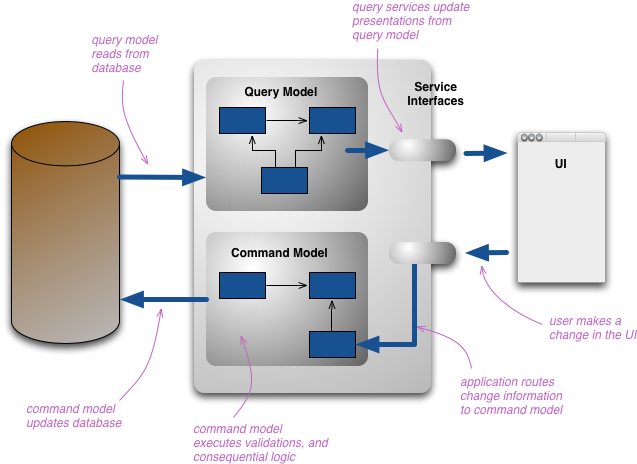
Now, the text introduces CQRS, Command Query Responsibility Segregation.
speaker_0HOST
This pattern feels like opening Pandora's box.
speaker_1HOST
It is profound architectural shift.
speaker_1HOST
CQRS acknowledges that at an extreme scale, the data model optimized for complex transactional writes, the commands, is fundamentally incompatible with the data model optimized for blazing fast reads, the queries.
speaker_0HOST
Give me a concrete scenario where this is necessary, because maintaining two entirely separate data models sounds like an operational nightmare.
speaker_1HOST
Think about a massive e-commerce platform's order system.
speaker_1HOST
But what about the user's order history page or the customer support dashboard? Those are read-heavy operations that just need a flat, denormalized view of the order.

Ben CrokerHOST
Okay.
Ben CrokerHOST
CQRS, I didn't know much about this a year ago, so I don't expect you to.
Ben CrokerHOST
Let me break this down for you because it's quite a mouthful.
Ben CrokerHOST
CQRS is when you segregate the responsibility between your queries... which are your reads and your command, so your writes.
Ben CrokerHOST
So in a traditional request, request goes to the server, server processes it, generates some HTML or output, sends that back, browser does something with it, request is done.
Ben CrokerHOST
With CQRS, we tend to open a connection on page load.
Ben CrokerHOST
And that connection is going to remain open for a longer amount of time.
Ben CrokerHOST
That's going to be our read or our query.
BenHOST
So it should be a query, a read.
BenHOST
So it makes sense in terms of like CQRS where you're querying as opposed to making any changes or running any commands.
BenHOST
And somebody brought it up in terms of an inline validation example.
BenHOST
We were using post.
34 MINS LATER
BenHOST
So from your application, you just say query 42, run that and you can get the result back or you can stream the result back as well.
BenHOST
So you can open a live query, which remains open for the duration of that request, which means you can just listen to stuff going on in the database and So anybody who's familiar with using long-lived SSE connections in Datastar will well know that this is going to be a perfect match for those types of applications.
BenHOST
Anyone who's using CQRS and doing Fatmort, for example.
BenHOST
everything becomes much, much easier.