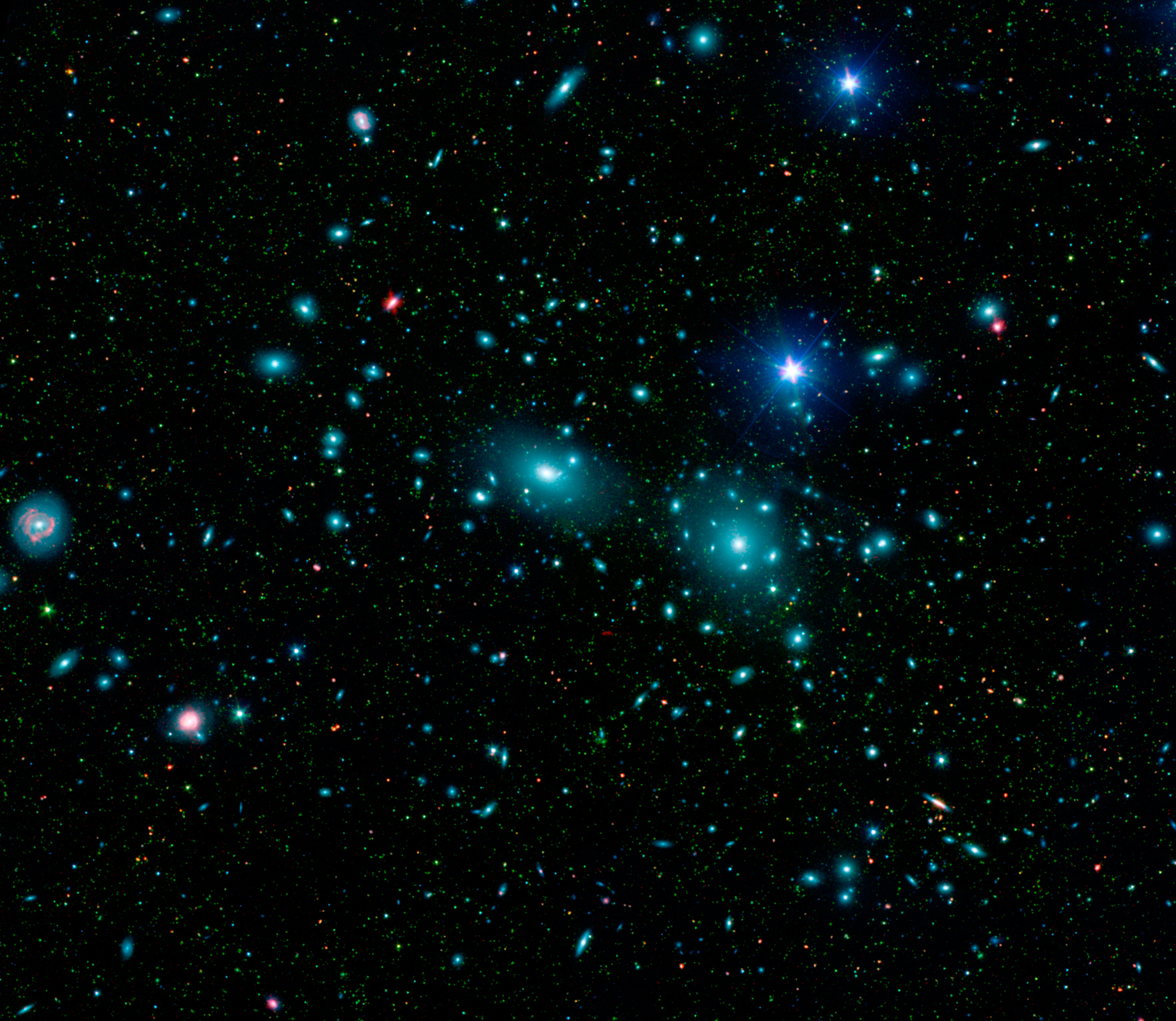
Coma Cluster

Coma Cluster

Search complete. 37 mentions across 19 episodes found for "Coma Cluster".

Sep 11, 2026

Beth JohnsonHOST
12:56
In one of the few examples of good naming in astronomy, this process is called ram pressure stripping.
Beth JohnsonHOST
13:03
In a new paper published in The Astrophysical Journal, a team led by William Kramer looked at one particularly striking example of this process, Galaxy D100 in the Coma Cluster.
Beth JohnsonHOST
13:15
As this galaxy has fallen into the cluster, dust and gas were systematically stripped, working from the outside of the galaxy, and that stripped-out material was left trailing behind the galaxy like a tail.
Beth JohnsonHOST
13:28
This kind of galaxy with trailing material is called a jellyfish galaxy.
Grandpa CohenHOST
48:42
and who was, for many years, quietly kept at arm's length by the astronomical establishment.
Grandpa CohenHOST
48:50
But he had eyes and he had mathematics, and in 1933 he turned both to a rich swarm of galaxies known as the Coma Cluster.
Grandpa CohenHOST
49:03
The Coma Cluster lies in the direction of the constellation Coma Berenice , about 320 million light-years from us.
Grandpa CohenHOST
49:16
It is a great gathering, perhaps a thousand or more galaxies, moving about one another in a slow gravitational dance, bound together by the mutual pull of their combined mass.
Grandpa CohenHOST
49:32
Zwicky measured their velocities.
Grandpa CohenHOST
51:10
They did not agree quietly or by a small margin in a way that might have been explained by a measurement error or a minor correction.
Grandpa CohenHOST
51:22
They disagreed by a factor of hundreds.
Grandpa CohenHOST
51:25
The galaxies of the Coma Cluster were moving much too fast to be held together by the gravity of their visible matter alone.

Unknown podcast

We Can Travel at Light Speed... And It Still Won_t Be Fast Enough

Sep 5 · 4 Mentions

speaker_4NARRATOR
49:50
It is fossilised before it arrives.
speaker_4NARRATOR
49:52
Push further to the Coma Cluster and the absurdity deepens.
speaker_4NARRATOR
49:57
Coma is one of the densest and most well-studied galaxy clusters in the observable universe, containing over 1,000 major galaxies dominated by two supergiant ellipticals at its core.
speaker_4NARRATOR
50:09
The cluster is bound together by dark matter so massive that the visible galaxies account for less than 5% of its total gravitational budget.
speaker_4NARRATOR
50:57
Every animal that has ever lived on Earth fits inside that waiting period.
speaker_4NARRATOR
51:03
Push further.
speaker_4NARRATOR
51:05
The Coma Cluster, a dense knot of galaxies bound together by dark matter and superheated intracluster gas, lies roughly 320 million light years from Earth.
speaker_4NARRATOR
51:16
At light speed, the journey requires 320 million years.

Unknown podcast

The Void Linked to the Cold Spot... and Why It Terrifies Scientists

Sep 5 · 1 Mention

speaker_5UNKNOWN
39:21
Galaxy clusters, for instance, are gravitationally bound systems that hold themselves together despite the universe expanding around them.
speaker_5UNKNOWN
39:29
The Virgo Cluster, the Coma Cluster, the Perseus Cluster, These massive concentrations of galaxies collapsed out of the expanding background billions of years ago and have maintained their structural integrity ever since.
speaker_5UNKNOWN
39:43
Gravity wins the local tug of war against cosmic expansion in these dense environments.
speaker_5UNKNOWN
39:49
But inside voids, Gravity has little ammunition to fight back.

Unknown podcast

The Distance Between Galaxies Is Worse Than You Think

Sep 4 · 2 Mentions

speaker_3NARRATOR
69:50
At 90% of light speed, the journey would take 60 million years as measured from Earth and roughly 26 million years on board.
speaker_3NARRATOR
69:59
The Coma Cluster, a rich concentration of galaxies, lies 320 million light years distant.
speaker_3NARRATOR
70:07
The trip would consume over 350 million years.
speaker_3NARRATOR
70:11
a duration stretching back to the early Carboniferous period on Earth, an era when shallow seas covered much of the continents and the earliest four-limbed creatures were still adapting to life beyond the water's edge.

10 MINS LATER

speaker_3NARRATOR
80:32
A message sent to the Virgo Cluster would take 54 million years to arrive.
speaker_3NARRATOR
80:38
By the time a reply could return, 108 million years would have elapsed.
speaker_3NARRATOR
80:43
A message to the Coma Cluster would take over 600 million years for a round trip.
speaker_3NARRATOR
80:49
These are not communication timescales.

Unknown podcast

The Void So Large It Shouldn_t Exist

Sep 4 · 1 Mention

speaker_4NARRATOR
7:44
The Virgo Cluster, the nearest major cluster to our own galaxy, contains more than 1,300 galaxies and sits roughly 54 million light years away.
speaker_4NARRATOR
7:56
The Coma Cluster, farther out at about 320 million light years, is even richer and denser.
speaker_4NARRATOR
8:04
These clusters mark the densest concentrations of matter in the cosmic web, the places where the universe is at its most crowded, its most violent, its most active.
speaker_4NARRATOR
8:15
Stretching between these nodes run filaments, long sinuous chains of galaxy groups that can extend for hundreds of millions of light years.

Unknown podcast

What_s Really Above And Below The Sun_

Sep 4 · 1 Mention

speaker_4NARRATOR
82:40
precisely because the Milky Way steps aside.
speaker_4NARRATOR
82:43
The Coma Cluster, one of the nearest rich galaxy clusters, lies in this general direction, roughly 320 million light years away, containing over a thousand large galaxies and countless dwarfs bound together by gravity and embedded in superheated gas visible in X-rays.
speaker_4NARRATOR
83:01
The South Galactic Pole in the constellation Sculptor offers a similar window, Sculptor is known among astronomers for its clean, uncluttered view into deep space.
speaker_4NARRATOR
83:11
The Sculptor dwarf galaxy, a satellite of the Milky Way, sits in this direction, as do numerous background galaxy groups visible through the sparse foreground.

Unknown podcast

The Largest Void Ever Found... and Why It_s Terrifying

Sep 4 · 1 Mention

speaker_4NARRATOR
5:29
In 1978, two teams working independently began publishing the first results, and both found something that defied expectation.
speaker_4NARRATOR
5:38
Stephen Gregory and Laird Thompson mapped a wedge of the sky in the direction of the Coma Galaxy Cluster, plotting the three-dimensional positions of galaxies across hundreds of millions of light years.
speaker_4NARRATOR
5:50
The distribution was not smooth.
speaker_4NARRATOR
5:52
It was not even close to smooth.

Unknown podcast

The Terrifying Size of the Largest Galaxy We_ve Ever Found

Sep 3 · 1 Mention

speaker_4NARRATOR
14:08
The Virgo Cluster, the nearest major cluster to our local group, contains over 1,300 galaxies and lies roughly 54 million light-years away.
speaker_4NARRATOR
14:20
Larger clusters, like the Coma Cluster, contain thousands of galaxies and span tens of millions of light years.
speaker_4NARRATOR
14:28
At the centre of nearly every large galaxy cluster sits a special type of galaxy.
speaker_4NARRATOR
14:33
Astronomers call these Brightest Cluster Galaxies, or BCGs.

Unknown podcast

James Webb Found a Structure So Early_ It Raises Troubling Questions

Sep 2 · 3 Mentions

speaker_4NARRATOR
35:24
The visible galaxies move too fast to be held together by their own gravity alone.
speaker_4NARRATOR
35:29
This was one of the earliest lines of evidence for dark matter's existence, identified by the astronomer Fritz Zwicky in the 1930s when he noticed that galaxies in the Coma Cluster were moving so rapidly that the cluster should have flown apart long ago unless it contained far more mass than its visible matter could provide.
speaker_4NARRATOR
35:47
The second most massive component is hot gas, the intracluster medium, and this is the component that will become most important for our story.
speaker_4NARRATOR
35:55
The intracluster medium is a vast atmosphere of ionized hydrogen and helium, heated to temperatures of tens of millions of degrees, sometimes exceeding 100 million degrees in the most massive clusters.
speaker_4NARRATOR
38:41
A massive galaxy cluster can have a total mass exceeding 1 quadrillion solar masses, or 10 to the 15th power solar masses.
speaker_4NARRATOR
38:49
That is more than a million billion times the mass of our Sun.
speaker_4NARRATOR
38:53
The Coma Cluster, one of the best studied examples, contains over a thousand large galaxies and sits at the centre of the Coma Supercluster, roughly 320 million light years from Earth.
speaker_4NARRATOR
39:04
Galaxy clusters are the most massive gravitationally bound structures in the universe.

9 more episodes mention Coma Cluster.

Create an account to see the whole feed, search across every transcript, and follow the entities you care about.

We value your privacy

We use cookies to understand how you use our platform and to improve your experience. Click “Accept All” to consent, or “Decline non-essential” to opt out of non-essential cookies. Read our Privacy Policy.