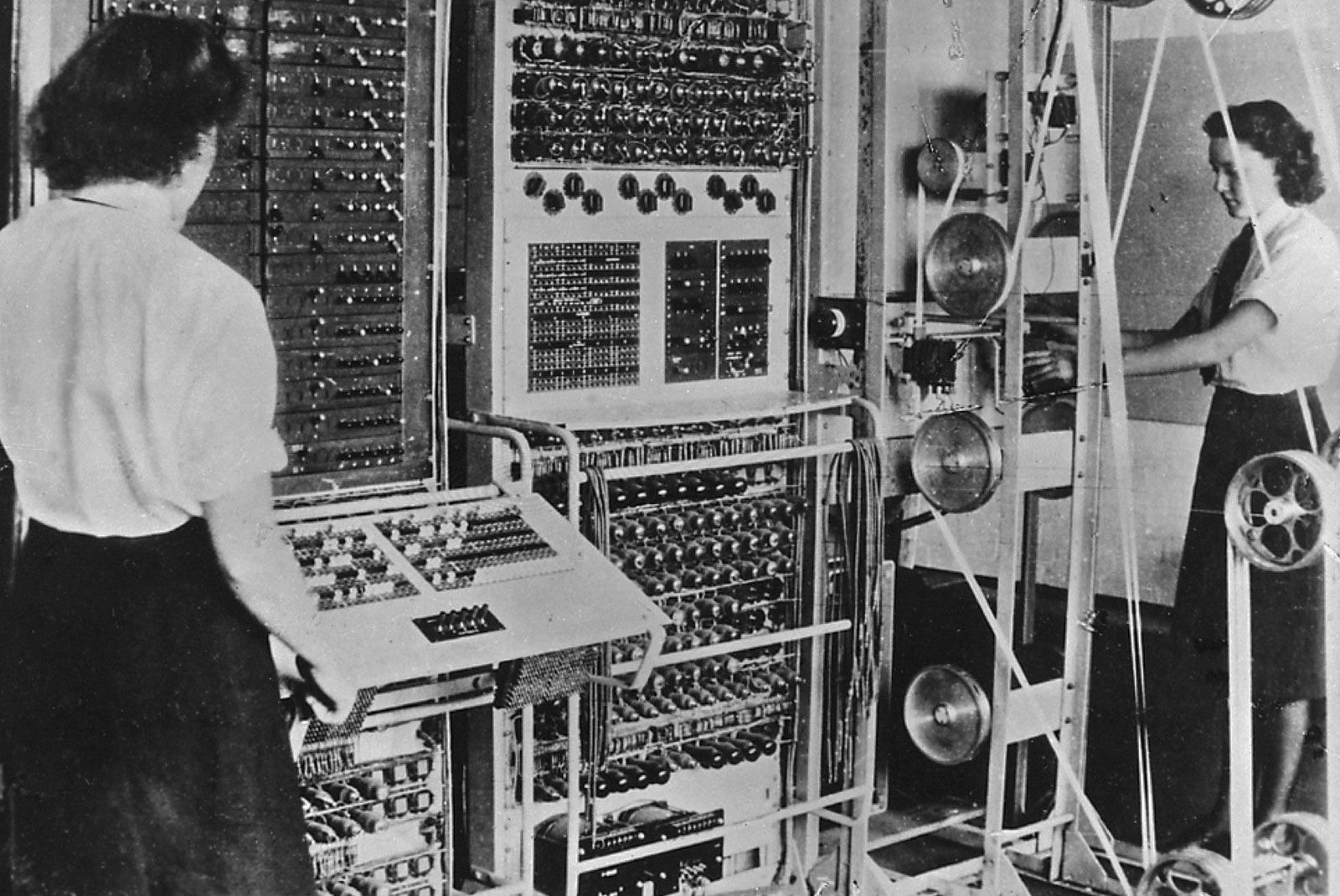
Colossus computer
ComputerWikipedia
16
MENTIONS
6
EPISODES
6
PODCASTS
Search complete. 16 mentions across 6 episodes found for "Colossus computer".
Sep 18, 2026

Megan SmithGUEST
This is Bletchley Park up here.
Megan SmithGUEST
That's the Colossus.
Megan SmithGUEST
It comes from the movie Imitation Game.
Megan SmithGUEST
Joan Clark was there.

Anish CharyanHOST
Women also operated one of the most advanced machines of the
AKCHOST
era, including Colossus.
AKCHOST
Think about that for a moment.
AKCHOST
The references are from national archives working on Colossian, you know.
9 MINS LATER
AKCHOST
The bomb was designed to help attack Enigma.
AKCHOST
There came something even more extraordinary.
AKCHOST
Colossus.
Anish CharyanHOST
Colossus was developed to help process encrypted german teleprinted printer communication you know the national archives describe woman's work with colossus at brooklyn spark in 1943 and notices that woman formed the majority of the workforce involved with these technologies references are from national archives And GCHQ record that women operate in

Tom BonnerGUEST
My gut feeling is we've passed that point.
Tom BonnerGUEST
The work that the guys did on the Enigma machine and Colossus and some of the early electronic computers, I don't think we'll ever see anything quite like that again.
Tom BonnerGUEST
When the first step of your task is invent the electronic computer...
Tom BonnerGUEST
You know, it's very, very difficult.

speaker_1NARRATOR
In 1943, a post office engineer called Tommy Flowers built a code-breaking machine out of 1,500 thermionic valves, partly out of his own pocket.
speaker_1NARRATOR
Within a year, Colossus, the world's first programmable electronic computer, was cracking Nazi high command ciphers at Bletchley Park.
speaker_1NARRATOR
Britain had invented the data center in a large shed and chock full of hot electronics that quietly helped us win the war.
speaker_1NARRATOR
Alongside the Town and Country Planning Act and the squandering of the Marshall Plan money, Britain shot itself in the foot in this regard after the war.
speaker_1NARRATOR
We destroyed Colossus in a colossal act of self-harm.
speaker_1NARRATOR
The machines were broken up, the blueprints burned and Tommy Flowers was sworn to silence for 30 years.
speaker_1NARRATOR
We are at it again.
speaker_1NARRATOR
In Britain, we can force £100 million to be spent on a bat tunnel.

DavidHOST
It took two hundred and sixty-five years for his dream to become a physical reality during World War II at Bletchley Park.
speaker_1HOST
Faced with the impossible task of cracking German Enigma codes, allied scientists built Colossus, the world's first electronic binary computer.
speaker_1HOST
It utilized twelve hundred glowing vacuum valves.
speaker_1HOST
They replaced Leibniz's physical metal balls with electrical currents.
speaker_1HOST
A valve switched on represented a one.
speaker_1HOST
A valve switched off represented a zero.
DavidHOST
Colossus crunched those ones and zeros millions of times a second, cracking the codes and arguably shortening the war by two years.
DavidHOST
And in doing so, it birthed the modern world.