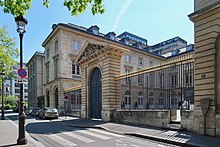
Collège de France
College in Paris, FranceWikipedia
17
MENTIONS
15
EPISODES
15
PODCASTS
Search complete. 17 mentions across 15 episodes found for "Collège de France".
Nov 3, 2026

Beth ThomasNARRATOR
Even before the age of the Revolution, Paris possessed many great schools.
Beth ThomasNARRATOR
The Collège de France was founded in 1530.
Beth ThomasNARRATOR
There was the Collège-École de Chirurgie, the Jardin de Plante, the École Royale de Mine, etc.
Beth ThomasNARRATOR
End footnote.

ParzivalHOST
For this curve, stream the primes past, one verdict each, and the share of necklaces settles at about 81%.
ParzivalHOST
And in his course of 1977 at the Collège de France, Jean-Pierre Serres wrote down the exact share for every curve like this, and proved it, assuming the generalized Riemann hypothesis.
ParzivalHOST
So, GRH, as he wrote, with one clean exception.
ParzivalHOST
A curve with three points that come home in two hops, like y squared equals x cubed minus x, never makes a single necklace.

Susan GreenfieldGUEST
I did all my degrees in Oxford.
Susan GreenfieldGUEST
I spent some time in the College de France in Paris, NYU Medical Center, at Melbourne University, but these were all relatively short periods of research time and I'd always really been on the greasy pole at Oxford.
Susan GreenfieldGUEST
I ended up as fellow tutor of medicine at Lincoln College Oxford and a lecturer in pharmacology.
Susan GreenfieldGUEST
Until 2013, when I started my own company, spun out from Oxford University, pioneering a new approach to Alzheimer's.

Laurie Ann WaldenNARRATOR
Even before the age of the Revolution, Paris possessed many great schools.
Laurie Ann WaldenNARRATOR
The Collège de France was founded in 1530.
Laurie Ann WaldenNARRATOR
There was the Collège-École de Chirurgie, the Jardin de Plante, the École Royale de Mine, etc.
Laurie Ann WaldenNARRATOR
End footnote.

speaker_0NARRATOR
If you'd met him, you wouldn't have guessed he was a dream explorer.
speaker_0NARRATOR
He was a scholar of Chinese, he translated Tang dynasty poetry, he collected porcelain, and he ended up holding the chair of Chinese at the Collège de France.
speaker_0NARRATOR
Respectable work in a respectable library.
speaker_0NARRATOR
His scholarly career was serious.

Paul RyerHOST
Okay.
William HanksGUEST
Uh, uh, he's at the Collège de France.
William HanksGUEST
He's a fabulous, fabulous scholar.
William HanksGUEST
He has this thesis that every language yearns or désire, as he says, to become the language of divine.

Piotr NaterSOUNDBITE_SPEAKER
He had married a Polish lady, Celina Szymanowska, who became insane.
Piotr NaterSOUNDBITE_SPEAKER
In 1840 he was appointed to the newly founded chair of Slavonic languages and literature in the Collège de France, a post which he was especially qualified to fill, as he was now the chief representative of Slavonic literature, Pushkin having died in 1837.
Piotr NaterSOUNDBITE_SPEAKER
He was, however, only destined to hold it for a little more than three years, his last lecture having been given on the 28th of May 1844.
Piotr NaterSOUNDBITE_SPEAKER
His mind had become more and more disordered under the influence of religious mysticism.

Heather M. ByeNARRATOR
All LibriVox recordings are in the public domain.
Heather M. ByeNARRATOR
For more information or to volunteer, please visit LibriVox.org History of Egypt, Chaldea, Syria, Babylonia, and Assyria by Gaston Maspero Honorable Doctor of Civil Laws and Fellow of Queen's College, Oxford Member of the Institute and Professor at the College of France Edited by A.H. Sacy, Professor of Assyriology, Oxford Translated by M.L. McClure, Member of the Committee of the Egypt Exploration Fund Editor's Preface Professor Maspero does not need to be introduced to us.
Heather M. ByeNARRATOR
His name is well known in England and America as that of one of the chief masters of Egyptian science, as well as of ancient Oriental history and archaeology.
Heather M. ByeNARRATOR
Alike as a philologist, a historian, and an archaeologist, he occupies a foremost place in the annals of modern knowledge and research.

Jim Al-KhaliliHOST
She's spent her career studying the mechanisms that make us who we are and transforming our understanding of how X chromosomes are expressed.
Jim Al-KhaliliHOST
Today, Edith is director of London's Francis Crick Institute and holds the Chair of Epigenetics and Cellular Memory at the Collège de France in Paris.
Jim Al-KhaliliHOST
Her career has taken her to the cutting edge of European science and earned her honours including France's highest scientific distinction, the CNRS Gold Medal.
Jim Al-KhaliliHOST
Not bad for someone who describes her younger self as a shy, introverted child who would hide under the sofa with a book to avoid the noisy household goings-on.
17 MINS LATER
Edith HeardGUEST
How do you actually switch a gene off when this RNA hits the chromosome? What does it bring with it? What are the weapons that will lead to silencing? And how do some genes actually escape for this, avoid this entirely and stay on or even come back on?
Jim Al-KhaliliHOST
Incredible.
Jim Al-KhaliliHOST
Well, Edith, in 2012, alongside running the lab, you took on the role of Professor and Chair of Epigenetics and Cellular Memory at the Collège de France, which some listeners may know is a rather unique educational institution.
Jim Al-KhaliliHOST
For anyone who hasn't come across it, can you just explain the setup and what it does?
5 more episodes mention Collège de France.
Create an account to see the whole feed, search across every transcript, and follow the entities you care about.