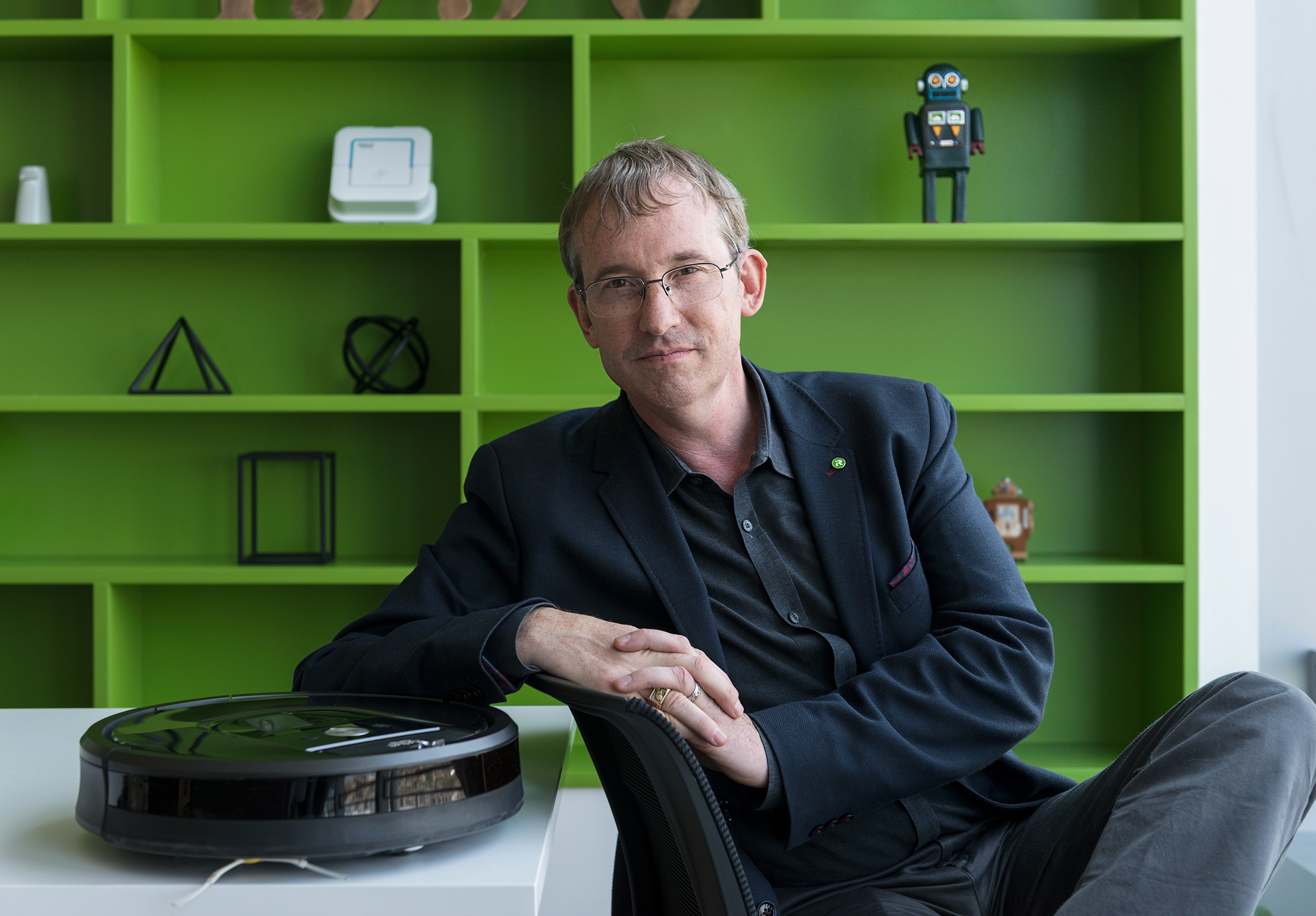
Colin Angle
CEO of iRobot
5
APPEARANCES
5
PODCASTS
Jun 21, 2026


Colin AngleGUEST
And, uh, one day he called me into his office and said, "Hey, Colin, I'm thinking about starting a robot company." And I had...
Colin AngleGUEST
Was just finishing up my master's as part of a PhD program, and I said, "Okay, sounds good.
Colin AngleGUEST
I'll run it." And with about that much, uh, thought because, uh, I had decided that doing thesis-sized robot projects was not particularly interesting because robots are incredibly complicated and take many years and, uh, many, many man years of work to get it, uh, to happen.
Colin AngleGUEST
And so I'd kinda independently thought, "Hey, would be cool to start a robot company to build something actually useful." And so, uh, I was in.
Colin AngleGUEST
And so we started this company, and my first call, uh, was to Helen, who was at the time working out at JPL, and she had come to the conclusion that, uh, maybe it's time to do something else.
37 MINS LATER


Colin AngleGUEST
So what we would do and the way we funded the whole adventure was that, uh, I would research industries where I thought that our robot technology could, uh, create value and then reach out to CTOs of, of large multinationals and say, "Hey, do you want to hear about our technology?" And usually I would get invited in on a Friday afternoon as sort of entertainment.
Colin AngleGUEST
I would, I would s- present a solution to a problem maybe half a step away and say, "Hey, look at this robot.
Colin AngleGUEST
It can do these things." And the CTO or the, you know, sometimes the CEO would show bo- show up just because it was robots and robots are cool, and they'd say, "Oh my God, if you can do this, you could do that." And the that would be something close to what I imagined that company would actually care about.
17 MINS LATER


Colin AngleGUEST
It's like, "Well, what if it was a vacuum?" It's like, "Oh, well, if it was a vacuum, then I'd pay hundreds of dollars for it." And it's like, "Oh, okay, uh, time to make a vacuum." And then we had to go invent the world's most efficient vacuum cleaner because w- we, we couldn't afford a lot of battery power.
Colin AngleGUEST
And so we, um, we k- said, "Well, what if we break this whole vacuuming problem down into two steps, where we have these counter-rotating brushes, just spinning brushes, that pick up all the big debris, and then have..." W- we called it a squeegee vac.
Colin AngleGUEST
It's, i- it, it, uh, between two little rubber blades is a very narrow hole, and because you're pulling the air through that narrow gap, it moved faster.
Colin AngleGUEST
It's kind of like putting your thumb on the end of a, of a hose to make it squirt faster.
8 MINS LATER

Guy RazHOST
But suddenly, and for a reason Colin never could have predicted, things turn around.


Casey NewtonHOST
So make your case that this was a, a bad outcome for America that iRobot was not able to become a part of Amazon.
Colin AngleGUEST
We got to a point where, uh, for very good and, and, uh, understandable reasons, the market pressures and the competition led to an economic model where iRobot was finding itself pressured to innovate.
Colin AngleGUEST
And, you know, iRobot was a proxy for the United States because we were the only public company doing consumer robotics and so that if you were a fan of having consumer robotics being an industry where A- A- America could cons- could claim leadership, you needed iRobot to continue to be able to invest like big dogs and create the innovations that was going to give consumers the choice that they were asking for.
Colin AngleGUEST
And so the challenge was the acquisition seemed to become all about Amazon and not at all about consumer preference, leadership in the consumer robot industry, and doing what the European Commission and the FTC are, are charged with doing is defending the wor- worst abuses of monopoly.
6 MINS LATER
Casey NewtonHOST
What does your experience tell you about their likely path forward, and, you know, what concerns do you have about the future of American manufacturing?
Colin AngleGUEST
You know, uh, the, the tragedy of, of the blocking of the transaction is we did it to ourselves, and the net result, um, which I have argued was done with eyes wide open, was putting the consumer robot industry in a box, gift wrapping it and handing it to someone else.


Colin AngleGUEST
Is there a demand for it, or, or is it what we really want today? No, not at all.
Colin AngleGUEST
In fact, one of my journey, my journey at, in, at iRobot, the question of, after vacuuming, what do people want? And even within the realm of floor care, what did it take to grow to the point we are today where robot vacuuming is generally accepted as a mainstream alternative to upright vacuuming? One of the things that I got most wrong in the early days of Roomba was imagining that the perfect Roomba was a Roomba you never saw, you never touched, you just came home every day to a perfectly clean home.
Colin AngleGUEST
The perfect Roomba was the Roomba that cleaned around your kitchen table, did a great job, eventually earning your trust that it could actually do that job.
12 MINS LATER