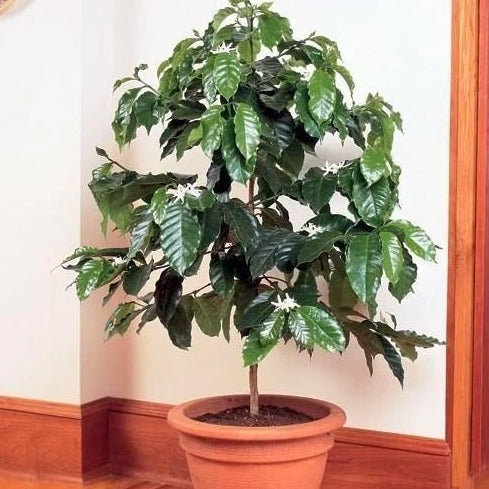
Coffea arabica
PlantWikipedia
61
MENTIONS
12
EPISODES
10
PODCASTS
Search complete. 61 mentions across 12 episodes found for "Coffea arabica".
Sep 11, 2026

Norbert NiederhauserGUEST
We will see what really pans out.
Norbert NiederhauserGUEST
But, well, first of all, the hope is that the great Arabica coffees are still around.
Norbert NiederhauserGUEST
And they can be still produced and commercially viable for hopefully as many people as possible to access.
Norbert NiederhauserGUEST
Why is that hope? Well, my connections to the World Coffee Research, for example, and looking at their work is promising.
6 MINS LATER
Norbert NiederhauserGUEST
It can probably adapt to climate change a little bit better, but it's not a great, it's potentially not a great flavor experience.
Leigh SafarHOST
And also it's a water thief.
Leigh SafarHOST
It requires so much water compared to Arabica.
Leigh SafarHOST
Yeah.

Norbert NiederhauserGUEST
We will see what really pans out.
Norbert NiederhauserGUEST
But, well, first of all, the hope is that the great Arabica coffees are still around.
Norbert NiederhauserGUEST
And they can be still produced and commercially viable for hopefully as many people as possible to access.
Norbert NiederhauserGUEST
Why is that hope? Well, my connections to the World Coffee Research, for example, and looking at their work is promising.
6 MINS LATER
Norbert NiederhauserGUEST
It can probably adapt to climate change a little bit better, but it's not a great, it's potentially not a great flavor experience.
Leigh SafarHOST
And also it's a water thief.
Leigh SafarHOST
It requires so much water compared to Arabica.
Leigh SafarHOST
Yeah.

Jamie TrebyGUEST
There's some fantastic stuff out there.
Jamie TrebyGUEST
For me, where it gets a little bit muddied is like people say, it's almost as good as an Arabica.
Jamie TrebyGUEST
No, it's not Arabica.
Jamie TrebyGUEST
It's a different flavor profile.
Jamie TrebyGUEST
It's a different category.
Jamie TrebyGUEST
And then if you like it, you like it.
Jamie TrebyGUEST
If you don't, you don't.
Jamie TrebyGUEST
And I mean, going back to one of the biggest changes from 20 years ago, what's this Arabica? Well, there's two types of coffee.
Leigh SafarHOST
The environmental elements of sustainability have given us a timer.
Leigh SafarHOST
We've got about 20 years of Arabica left.
Leigh SafarHOST
This is what person after person after person comes on this podcast and tells me.
Leigh SafarHOST
But then there are other layers to this that can accelerate that.

Carlos MeraGUEST
We were in a clear downtrend until the first week of June in terms of pricing.
Carlos MeraGUEST
And ever since, prices were up roughly 20% since then, Arabica prices.
Carlos MeraGUEST
There were two major things taking place since the first week of June.
Carlos MeraGUEST
One is that there has been wet weather in Brazil during the dry season, especially June and early July, and that led to a significant proportion of the cherries dropping to the floor.
Carlos MeraGUEST
Now, El Niño has a number of effects on coffee production.
Carlos MeraGUEST
I would say normally not a lot in Brazil, but it does create a lot of extra rainfall in the southern part of Brazil.
Carlos MeraGUEST
Usually it doesn't affect the coffee belt, but at the moment it is affecting the coffee belt, the Arabica coffee belt.
Carlos MeraGUEST
I talk about the... extra rainfall during the harvest in Brazil, now the harvest is done, but we do see a current rainfall higher than normal.

Paul HorwellHOST
Just give us a background about, you know, what are the best beans that actually go into a good cup of coffee?
Rebecca ZentveldGUEST
let's just get back to that basics of we'll say, we'll say Arabica coffee.
Rebecca ZentveldGUEST
You know, we've got those two family groups of the varieties are either Arabica, which are considered the higher quality, sweeter coffees, and then there's the Robusta.
Rebecca ZentveldGUEST
In Australia, we've only chosen Arabica to this date, although now some farmers are interested in a high quality and Robusta.
Rebecca ZentveldGUEST
That's going to be an extra extension of the research coming up.
Rebecca ZentveldGUEST
But then we talk about where we're growing it, the microclimate, How cool is it? What's the rainfall? What's the soil quality? Is it beautiful red volcanic soil? We'll bring out a richer coffee.

Hamiza HamzaGUEST
Because I'm thinking
Audrey RajHOST
Arabica, Liberica.
Audrey RajHOST
So now I just learned when studying for this interview that Liberica is about 1% of world coffee production, but roughly 87% of what Malaysia grows.
Audrey RajHOST
And for the most of the last century, it's been treated as filler.

AngelaHOST
Mm-hmm.
Geoffrey Ssemakula KinalwaGUEST
But there's also Arabica.
AngelaHOST
Arabica.
Geoffrey Ssemakula KinalwaGUEST
In the, in the, in the, w- you know, Eastern Uganda, Bugisu there.
AngelaHOST
Mm-hmm.
Geoffrey Ssemakula KinalwaGUEST
You know, and some far west there, they have Arabica.
Geoffrey Ssemakula KinalwaGUEST
But here we're talking about Robusta.
Geoffrey Ssemakula KinalwaGUEST
So Robusta is a range between 12,000 to 14, 15,000 per kg.

Kalina StanoHOST
So that's really cool.
Kalina StanoHOST
Going back to 2013, you launched the world's first specialty-grade Robusta coffee in a market that was completely dominated by Arabica.
Kalina StanoHOST
Can you walk us through that decision? What did you see that everyone else was missing? And how did the industry react when you went against the grain?
Eirik HolthGUEST
Yeah, so I guess we were coming into an industry really as outsiders because we had...
Eirik HolthGUEST
But beyond that, in terms of taste profile, the Robusta bean had notes of walnuts and chocolate.
Eirik HolthGUEST
And it had more body, so it would punch through the milk more in what is for the majority of market a product you consume with the milk or these days an alternative milk.
Eirik HolthGUEST
And so we thought, we can't find a good reason why this bean isn't being served and why it's all about 100% Arabica.
Eirik HolthGUEST
And surely if you can have all of these qualities, with the same processing and treatment that you have for a fine Arabica, so you don't have the defect beans, you don't have the moldy beans, you don't use lots of pesticides, then the results might be amazing.

Julie MorganHOST
I'm Julie Morgan.
Julie MorganHOST
Coffee prices are higher again just in time for PSL season, with Arabica futures soaring to their highest level in more than six months.
Julie MorganHOST
The latest move higher reflects growing concerns about near-term supplies of premium coffee beans, particularly from Brazil, even as a larger harvest is expected later in the season.
Julie MorganHOST
Prices have also remained under pressure following the devastating earthquake in Colombia earlier this month.
Julie MorganHOST
The Super El Nino forecast is also something else to look out for.
Julie MorganHOST
It is considered a material upside risk for coffee prices, especially Robusta later this year, and potentially Arabica next year.
Julie MorganHOST
Meanwhile, today is the official kickoff of pumpkin spice latte season at Starbucks, better known as PSL.
Julie MorganHOST
Other companies and chains have already gotten in on the pumpkin action, launching their fall menus at least a week before Starbucks.
2 more episodes mention Coffea arabica.
Create an account to see the whole feed, search across every transcript, and follow the entities you care about.