Code Noir
11
MENTIONS
6
EPISODES
6
PODCASTS
Search complete. 11 mentions across 6 episodes found for "Code Noir".
Nov 4, 2026

Konnen Ki FeHOST
But behind this wealth was severe blood, sweat, and extreme suffering of those that were enslaved.
Konnen Ki FeHOST
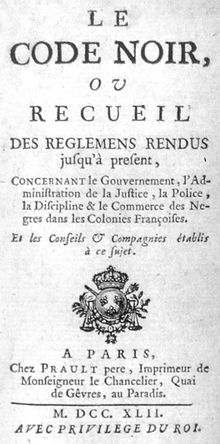
In 1685, the King of France issued what became infamously known as Code Noir or the Black Code.
Konnen Ki FeHOST
And the king essentially established through this document that slavery was was officially legal, giving plantation owners absolute control over the enslaved Africans.
Konnen Ki FeHOST
And the purpose of Code Noir was essentially to further exploit, control, and dehumanize the enslaved Africans while justifying slavery through Catholicism.
Konnen Ki FeHOST
So the goal of Code Noir was really to do a couple of things.
Konnen Ki FeHOST
It was to focus on complete and total erasure of the African identity and culture It was designed to legalize extreme violence against enslaved Africans.
Konnen Ki FeHOST
And it sought to ensure that the enslaved Africans continued to remain powerless, to reinforce this idea of powerlessness in order for them to continue to leverage the wealth of the island through the labor of the enslaved Africans.
Konnen Ki FeHOST
All the laws of enslavement that was put into place that really ratcheted up the already extreme conditions.

Andrew M. HenryHOST
As we'll examine later in this video, some of this blending occurred from Africans who brought Africanized versions of Catholicism from the continent.
Andrew M. HenryHOST
After all, Christianity had already been introduced to West Central Africa centuries before by the Portuguese, but this blending also occurred by force under the colonial rulers, especially in 1685 when King Louis XIV issued the Code Noir, which set rules for the treatment of enslaved people and also decreed that missionaries should try converting them to Christianity.
Andrew M. HenryHOST
Vodou played a major role in throwing off colonial rule during the Haitian Revolution.
Andrew M. HenryHOST
On the night of August 14th, 1791, a group of enslaved Africans met at Bois Caïman, or Alligator Forest, for what has been variously described as both a political rally and a religious ceremony led by a Vodou priest, Dutty Boukman, and priestess Cecile Fatiman.

Wize GrazetteHOST
you know, Mia had an incredible speech.
Wize GrazetteHOST
She talked about a lot of things, but the few things that stood out to me that I had never heard of before, Code Noir, which is like a French code that basically was like a slave code for French colonies, things like Louisiana and all the French colonized islands.
Wize GrazetteHOST
But The one thing, the reason why that stood out to me was because you hear, we've heard a lot of conversation about reparations, and while I know Barrios has an important, while I knew Barrios had an important part in it, I didn't necessarily see the through line, but I saw it Through her speech.
Wize GrazetteHOST
Ghana, where historically the Ivory Coast, a lot of people were taken from them.

Kevin Perez-AllenHOST
They plant sugar cane, and the Portuguese slave ships that have supplied Madeira since the 1450s start calling at Hispaniola.
Kevin Perez-AllenHOST
Louis XIV signs a law for his island colonies of March of 1685 called the Code Noir.
Kevin Perez-AllenHOST
Article 6 bars slaves from working on Sundays.
Kevin Perez-AllenHOST
Article 42 lets a master chain and beat them, but forbids torture.

Claude IkangaSOUNDBITE_SPEAKER
It is not for nothing that later in the 17th century in France, he was called the Sun King.
Claude IkangaSOUNDBITE_SPEAKER
But for us, obviously, he is the King of Darkness, Louis XIV, who deemed in a document he drafted called the Code Noir that we Africans, the Black man, have the same value as the piece of furniture on which my hands are resting.
Claude IkangaSOUNDBITE_SPEAKER
There is no distinction between the human being that we are and the stool in the eyes of Louis XIV.
Claude IkangaSOUNDBITE_SPEAKER
The first part of the communication, therefore, that we must use when people talk to us about Louis XIV as the Sun King, the one who built the Palace of Versailles and who made France great, we must clarify to them that this does not concern us.