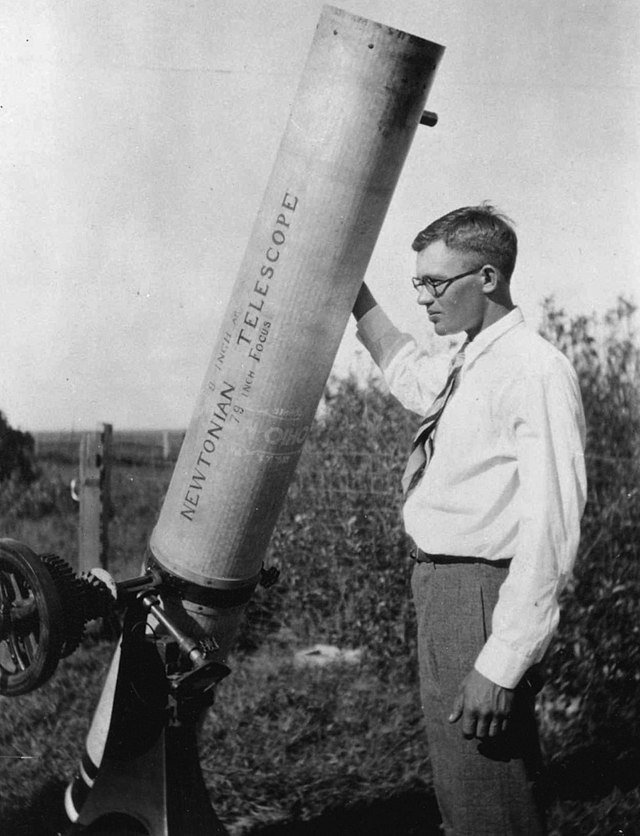
Clyde Tombaugh

Clyde Tombaugh

American astronomerWikipedia

Search complete. 27 mentions across 11 episodes found for "Clyde Tombaugh".

Sep 23, 2026

Jason LisleHOST
19:11
In the early 20th century, Percival Lowell conducted an extended search for a ninth planet, but was unsuccessful.
Jason LisleHOST
19:18
After his death, his successor Clyde Tombaugh continued the search by systematically photographing the heavens night after night at Lowell Observatory.
Jason LisleHOST
19:28
Since planets move relative to the background stars, any undiscovered planet would appear in a different location in two images taken at different dates.
Jason LisleHOST
19:38
Tombaugh used a machine called a blink comparator that would allow him to switch plates back and forth, hoping that the eye would be able to detect any star that appeared to move between the two plates.
Tony CaldwellGUEST
24:12
I don't know.
Tony CaldwellGUEST
24:13
You, you mentioned, uh, y- your, your history in astrophysics, and I'll probably mispronounce his last name, but Clyde Tombaugh or Tombaugh, the guy that discovered Pluto.
Catherine BellHOST
24:23
Oh, okay.
Tony CaldwellGUEST
24:23
Uh, a- anyway, my son was fascinated with him as a child.
Micah HanksHOST
7:55
At the beginning of the 20th century, there were theories about strange things about the orbit of Uranus and Neptune, and it caused astronomers to say, hey, there might be something out there that's exerting enough gravity that it's causing the peculiar wobble and the other little oddities in the orbits of those planets.
Micah HanksHOST
8:12
Well, fast forward to 1930 when astronomer Clyde Tombo spotted something out there, and indeed it was confirmed there was a ninth planet.
Micah HanksHOST
8:20
They named it Pluto.
Micah HanksHOST
8:22
And it remained a planet for some time.

Unknown podcast

The Space Beyond Neptune is Worse Than You Think

Sep 1 · 2 Mentions

speaker_3NARRATOR
5:56
But knowing something should exist and actually finding it are different problems entirely.
speaker_3NARRATOR
6:01
For decades, the only known object beyond Neptune was Pluto, discovered in 1930 by Clyde Tombaugh.
speaker_3NARRATOR
6:08
Pluto was classified as the ninth planet for 76 years, and during that time it seemed like a lonely outpost, a single, small, icy world orbiting at the edge of everything.
speaker_3NARRATOR
6:19
Astronomers searched for companions but found nothing.

23 MINS LATER

speaker_3NARRATOR
29:08
They knew Pluto had a thin atmosphere and a large moon called Chiron, but the details, the geology, the texture, the actual landscape were completely unknown.
speaker_3NARRATOR
29:17
Pluto was a smudge.
speaker_3NARRATOR
29:19
It had been a smudge for 85 years, ever since Clyde Tombaugh first spotted it as a faint dot drifting slowly across photographic plates in 1930.
speaker_3NARRATOR
29:28
The prevailing expectation was modest.

Unknown podcast

Kuiper Belt_ The Invisible Frontier Beyond Neptune

Sep 1 · 1 Mention

speaker_0NARRATOR
104:38
The frontier was always there.
speaker_0NARRATOR
104:40
It was there when Clyde Tombaugh found Pluto in 1930 and did not know what he was looking at.
speaker_0NARRATOR
104:46
It was there when short-period comets blazed across ancient skies, carrying fragments of the outer dark into the inner light.
speaker_0NARRATOR
104:54
It was there when David Jewett and Jane Liu spent five years searching for something the rest of the world assumed did not exist.

Unknown podcast

The Terrifying Reality of the Kuiper Belt

Sep 1 · 1 Mention

speaker_1NARRATOR
64:01
The first high-resolution photographs revealed a world of staggering geological complexity.
speaker_1NARRATOR
64:07
The western hemisphere of Pluto is dominated by a vast, heart-shaped feature now officially named Tombaugh Regio after Pluto's discoverer, Clyde Tombaugh.
speaker_1NARRATOR
64:18
The left lobe of this heart contains a massive plane of nitrogen ice called Sputnik Planitia, a basin roughly 1,000 kilometres across and several kilometres deep.
speaker_1NARRATOR
64:29
Sputnik Planitia is one of the smoothest surfaces ever observed in the solar system.

Unknown podcast

James Webb Just Scanned Pluto for The First Time _ And It_s Horrifying

Aug 31 · 2 Mentions

speaker_4NARRATOR
4:58
This is not the first time humans have seen Pluto.
speaker_4NARRATOR
5:01
Pluto was discovered in 1930 by a young astronomer named Clyde Tombaugh working at Lowell Observatory in Arizona.
speaker_4NARRATOR
5:08
Tombaugh spent months comparing photographic plates of the night sky, looking for a tiny point of light that moved against the background stars.
speaker_4NARRATOR
5:16
When he found it, the discovery made international news.

1 HR 30 MINS LATER

speaker_4NARRATOR
95:22
And the stages did not begin with Webb.
speaker_4NARRATOR
95:24
They began nearly a century ago, and each improvement in observational capability made Pluto less comfortable, not more.
speaker_4NARRATOR
95:32
When Clyde Tombaugh discovered Pluto in 1930, it was a point of light on a photographic plate, nothing more.
speaker_4NARRATOR
95:39
It could have been anything.
Steve KatesGUEST
6:16
So what's about Pluto that's so amazing? In school, my instructor was the discoverer, Dr.
Steve KatesGUEST
6:21
Clyde Tombaugh.
Steve KatesGUEST
6:22
He passed on, and they sent the spacecraft called New Horizons.
Steve KatesGUEST
6:26
But why demote an object like this? It's only 1,473 miles in diameter, smaller than the moon, and if you were able to land there, 5%, like I mentioned, of the astronomers in the world, or 4 or 5%, voted to change it.
Steve KatesGUEST
55:03
So what's about Pluto that's so amazing? In school, my instructor was the discoverer, Dr.
Steve KatesGUEST
55:08
Clyde Tombaugh.
Steve KatesGUEST
55:09
He passed on, and they sent the spacecraft called New Horizons.
Steve KatesGUEST
55:13
But why demote an object like this? It's only 1,473 miles in diameter, smaller than the moon.
Steve KatesGUEST
4:58
So what's about Pluto that's so amazing? In school, my instructor was the discoverer, Dr.
Steve KatesGUEST
5:03
Clyde Tombaugh.
Steve KatesGUEST
5:04
He passed on, and they sent the spacecraft called New Horizons.
Steve KatesGUEST
5:07
But why demote an object like this? It's only 1,473 miles in diameter, smaller than the moon.

1 more episode mentions Clyde Tombaugh.

Create an account to see the whole feed, search across every transcript, and follow the entities you care about.

We value your privacy

We use cookies to understand how you use our platform and to improve your experience. Click “Accept All” to consent, or “Decline non-essential” to opt out of non-essential cookies. Read our Privacy Policy.