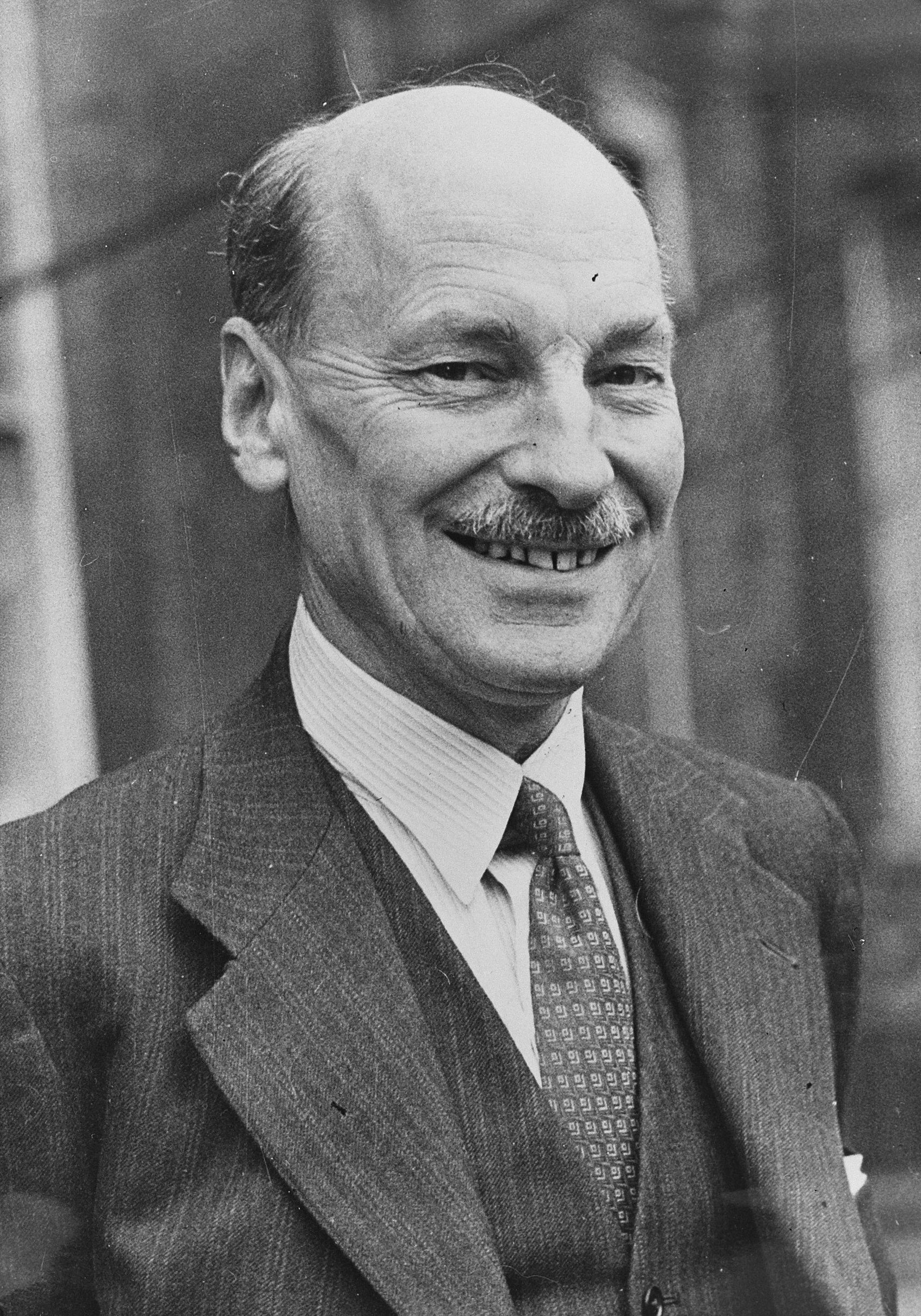
Clement Attlee
Former Prime Minister of the United KingdomWikipedia
144
MENTIONS
81
EPISODES
69
PODCASTS
Search complete. 144 mentions across 81 episodes found for "Clement Attlee".
Sep 13, 2026

David ColettoPANELIST
I think, you know, people have used...
David ColettoPANELIST
I have, the kind of, you know, Clement Attlee, Churchill kind of comparison.
Sean SpeerHOST
Yes.
David ColettoPANELIST
And, and, you know, I think Labour was a brand-new party with a new ideology, and it hadn't been really taken seriously in the UK up until post-war, when the country shifted from "Who can save us?" from "Who can rebuild us?"

Winston ChurchillSOUNDBITE_SPEAKER
Let us then move forward together in this charge of our mission and our duty, cheering God and nothing else.
Lee EvansHOST
Hello and welcome to Since Attlee and Churchill, the podcast about British political history since the Second World War.
Lee EvansHOST
I'm Lee Evans, a historian of the Conservative Party.
Richard JohnsonHOST
And I'm Richard Johnson, a historian of the Labour Party and Lee's husband.
Richard JohnsonHOST
And there are quite a few living ex-prime ministers, in part because of the extraordinary turnaround of prime ministers that we've had at the moment.
Richard JohnsonHOST
So in this episode, we're going to focus on those nine prime ministers who served since the Second World War who are no longer alive.
Richard JohnsonHOST
starting with Clement Attlee and going up to Margaret Thatcher.
Richard JohnsonHOST
So let's begin with Attlee Lee.

Fraser MyersHOST
him.
David StarkeyGUEST
The prime minister traveled around in Baldwin or Attlee or even Harold Wilson.
David StarkeyGUEST
They traveled around in a kind of little Morris Minor.
David StarkeyGUEST
with their wife driving.

Christopher SnowdonPANELIST
I'm sure Andy Byrne would quite like to nationalize the odd industry here and there.
Christopher SnowdonPANELIST
I don't think he wants to go for a full Clement Attlee revolution.
Christopher SnowdonPANELIST
But the fact of the matter is, with things like the water companies, it can't be done.
Christopher SnowdonPANELIST
You can do it with the train companies because eventually the contracts...
Richard JohnsonHOST
But that sounds much more like very strong government intervention in the market and the economy than we would know in Britain.
Lee EvansHOST
Well, that's all for this midweek episode of Since Attlee and Churchill.
Lee EvansHOST
We'll be back on Sunday with our next deep dive into a topic in British political history.
Lee EvansHOST
We'll see you then.

Jared DiamondGUEST
So if Jesus Christ had not had St. Paul, if Joseph Smith, founder of Mormonism, had not had Brigham Young, we would not be talking about Christianity and Mormonism today.
Jared DiamondGUEST
Clement Attlee, the most effective British prime minister in the 20th century, who made massive changes when he basically changed British private social system.
Jared DiamondGUEST
remember Clement Attlee the way we remember Winston Churchill, because Winston Churchill was unique.
Jared DiamondGUEST
But Clement Attlee had four great collaborators with him, and if Clement Attlee had died, those four great collaborators would have taken over and have done it.
Jared DiamondGUEST
Whereas in Winston Churchill's case, In the week of Dunkirk, when five members of the British War Cabinet met to decide what to do, the most powerful person after Winston Churchill was Lord Halifax.
Jared DiamondGUEST
And the Cabinet, including Lord Halifax, said, let's make a deal with Hitler.

Mike MoffattGUEST
You, you don't, you don't wanna compare anybody to Winston Churchill, but it does kind of feel, uh, like this kind of wartime, uh, leader, which actually puts Carney in, in kind of a challenging position because, you know, right now he's seen as the leader who can get us through this war.
Mike MoffattGUEST
But is somebody gonna come around and, you know, become the, the Clement Attlee of the situation, uh, one- once the war is over? So we'll, we'll kind of see where we are 20, 30 years from now, but I think that's how he's seen, as, as the kind of steady hand, uh, who's y- you know, um, keeping us through, through this a- at a time of in- intense turmoil.
Ed ElsonHOST
All right.
Ed ElsonHOST
Mike Moffatt is Canadian economist and founding director at The Missing Middle Initiative.

Norman CorwinNARRATOR
But other things besides food were on the minds of the English people and their government at this particular moment, and I set out to learn what a few of them were.
Norman CorwinNARRATOR
I made an appointment to record the Prime Minister, Clement Attlee, at number 10 Downing Street.
Norman CorwinNARRATOR
He received me in the cabinet room where so many decisions fateful to the world have been made in recent history.
Norman CorwinNARRATOR
He was wearing a cardigan sweater, and he puffed a pipe with an expression of deep absorption.
Norman CorwinNARRATOR
That, like the President of the United States, he always spoke for radio purposes over several networks, never for an individual one.
Norman CorwinNARRATOR
But in deference to the auspices of the One World Award, an exception was being made in this case.
Norman CorwinNARRATOR
You may remember that not too long ago, tension was high in international relations, and against this background, I asked Mr. Attlee whether he felt there were any indications that the concept of One World could make headway.
speaker_10SOUNDBITE_SPEAKER
I don't think we ought to get despondent too early or too easily because of the international difficulties and the suspicions opposing interests.
Norman CorwinHOST
Recommendations came easily, but they were as varied as languages and customs.
Norman CorwinHOST
In England, Clement Attlee recommended patience.
Norman CorwinHOST
In France, Louis Aragon asked for remembrance of the past.
Norman CorwinHOST
Women should organize, said Mrs. Hamar in Stockholm.

Daniel HannanGUEST
The conservatives were an imperialist, mildly protectionist, and quite paternalist party.
Daniel HannanGUEST
Obviously, Attlee's socialist government was nationalizing everything that moved.
Daniel HannanGUEST
So the IEA began engaging with new conservative MPs elected in 1950 and trying to educate them in – understanding the diagnosis of why the country couldn't afford to do what it was doing.
Daniel HannanGUEST
This was people like Geoffrey Howe, Nick Ridley, Enoch Powell.
71 more episodes mention Clement Attlee.
Create an account to see the whole feed, search across every transcript, and follow the entities you care about.