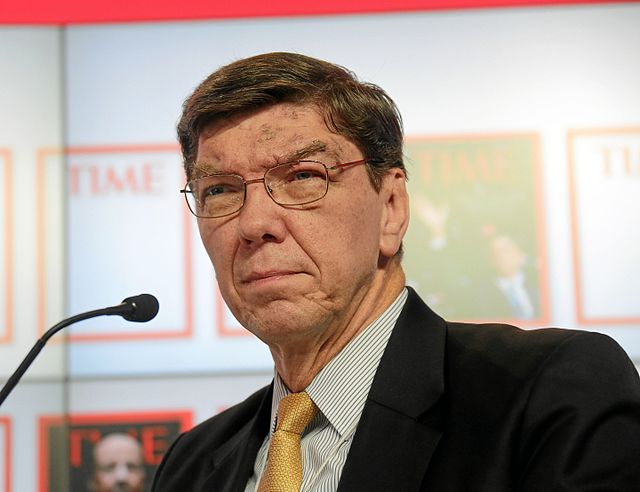
Clayton Christensen
American academic and business professionalWikipedia
102
MENTIONS
77
EPISODES
74
PODCASTS
Search complete. 102 mentions across 77 episodes found for "Clayton Christensen".
Sep 11, 2026

Derek ThompsonHOST
People said that MOOCs were going to change the world.
Derek ThompsonHOST
I think Clayton Christensen, the famous business theorist, said half of all colleges and universities are going to go extinct because of massively open online courses.
Derek ThompsonHOST
Can you remind us what are/were MOOCs, and why isn't artificial intelligence just MOOC 2.0?
David DemingGUEST
Yeah.

Eddie YoonGUEST
But what Apple has done very, very consistently, whether it was Jobs, Cook, or now Ternas has been, taking categories that are new and creating new ones at the highest end of the price points.
Eddie YoonGUEST
Now, this is really important, is that Clay Christensen, the author of The Innovator's Dilemma, has noted that disruption comes from below at lower prices.
Eddie YoonGUEST
And Apple has proven the opposite, that they have not been disrupted because they come in at higher price points.
Eddie YoonGUEST
Remember, the original iPhone was much more expensive than a regular flip phone that you could get.

Scott BakerHOST
Okay, I can s- sorta see what you mean.
Scott BakerHOST
We'll give some details, but I'd like to start with the Clayton Christensen milkshake story.
Scott BakerHOST
I don't know that there's a perfect overlap.
Scott BakerHOST
M- I don't remember if you and I have talked about this.
MikeyHOST
[laughs]
Scott BakerHOST
Um, no, the...
Scott BakerHOST
Clayton Christensen, longtime professor at, uh, at Harvard Business School.
Scott BakerHOST
Um, I had a chance to meet him one time, and he wrote many books.

Dave NortonHOST
And I call them the situations that people find themselves in.
Dave NortonHOST
That switch, that threshold is what Clayton Christensen was talking about in his book, in his article, Marketing Malpractice, where he said, the customer is no longer the unit of analysis.
Dave NortonHOST
He said, the job is the unit of analysis.
Dave NortonHOST
And that... kind of relates to that moment of switching as well.

Peri MuttathGUEST
And then in Harvard, I did it online because of COVID.
Peri MuttathGUEST
I studied the disruptive strategy with Clayton Christensen, the father of the innovator dilemma.
Peri MuttathGUEST
And his view of how disruption works is one of the biggest paths that I took to understand how a company needs to disrupt the ecosystem and the way we see the world.
Peri MuttathGUEST
Because let's say the old companies and the old tier one and tier twos see the world very differently and a new company...
42 MINS LATER
Peri MuttathGUEST
It doesn't have to be an Israeli entity that buys it, but somewhere else even.
Peri MuttathGUEST
And then if you succeed to have your first customer listen to you, he is telling you what he really wants to have.
Peri MuttathGUEST
There's another course that I've done, Jobs to be Done, also by Clayton Christensen.
Peri MuttathGUEST
He says always a customer has the equipment that he's buying from you for a different task that he's trying to do, that you as a company, you think that he wants to do that.

Karl HughesGUEST
There's a book that... was done by the guy who, or written by the guy who wrote The Innovator's Dilemma, which is his more well-known book, but...
Karl HughesGUEST
I know you're talking about Clayton Christensen.
Karl HughesGUEST
Yes, yes, yes.
Karl HughesGUEST
So, you know, live Googling, because my brain is, you know, half working.
Karl HughesGUEST
But Clayton Christensen wrote a book called How Will You Measure Your Life? And it's a collection of his essays about, like, meaning personal meaning and like you know priorities and you know that that to me is super important stuff uh there's another one um called the top five regrets of the dying that i always send people to literally one of the most life-changing books i ever had as far as like remembering that at the end of your life nobody says oh i wish i'd worked harder and i wish i had uh you know like spent more time with my work relationships instead of my family like again silly it sounds silly but man you read those stories i was i was crying multiple points in that book being thinking about And then tactically from an entrepreneurial perspective, there's a book called Buy Then Build that is fantastic if you want to get into acquisitions at any level, whether you're not an entrepreneur and you want to buy your first business or you're an entrepreneur who's looking to acquire to grow.
Karl HughesGUEST
Super helpful as far as working through the mechanics of what finding a deal looks like, how the math works out on buying and funding the business.
Karl HughesGUEST
That's Walker

Julia Freeland FisherGUEST
And I also started to pay attention to education entrepreneurs who were sort of thinking more about the social side of opportunity.
Julia Freeland FisherGUEST
I took a very expensive detour through law school, determined I did not want to be a lawyer, and found by both luck and my network a role at the Clayton Christensen Institute in 2013.
Julia Freeland FisherGUEST
Now, this was a really interesting opportunity to me because, first of all, Clay and his colleague Michael Horn, who created the Institute, were bringing a lot of rigor to the idea of innovation in education.
Julia Freeland FisherGUEST
It wasn't just like try something new, treat kids as guinea pigs, and fingers crossed something good comes out the other side.

Mike VardyHOST
I, I actually think this can wait.
Mike VardyHOST
We're, we're gonna dive into, not randomness per se, but I think, um, like it, it's really cool to kind of think about the, the whole milkshake problem that Clayton Christensen talks about.
Mike VardyHOST
Have you heard about this story, the milkshake thing? Like it's, it's the idea of-
Patrick RhoneGUEST
Uh, I, I like milkshakes.
Patrick RhoneGUEST
Okay
Mike VardyHOST
... it's what the milkshake solves.
Mike VardyHOST
So Clayton Christensen-
Patrick RhoneGUEST
Ah

Nils GilmanHOST
So it takes a while.
Nils GilmanHOST
And I think one of the things that's going to happen is, and this is an example of innovator's dilemma, right, in Clay Christensen's terms.
Nils GilmanHOST
Legacy organizations, I think, are going to struggle to accommodate and adapt and use these things, whereas new organizations are going to have a huge advantage.
Kevin KellyGUEST
Yes.

Kurt FrancomHOST
And by that, I mean the individual passed away.
Kurt FrancomHOST
Even Clayton Christensen, I was talking with his assistant.
Kurt FrancomHOST
We had emails going back and forth.
Kurt FrancomHOST
We were organizing plans for me to interview Clayton Christensen.
Kurt FrancomHOST
And then his health took a turn for the worse, and he passed away.
Kurt FrancomHOST
Another person that I wish I could have interviewed was Coach Lavelle Edwards, the legendary BYU football coach.
67 more episodes mention Clayton Christensen.
Create an account to see the whole feed, search across every transcript, and follow the entities you care about.