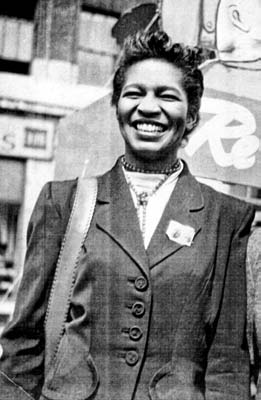
Claudia Jones
Journalist and activistWikipedia
8
MENTIONS
3
EPISODES
3
PODCASTS
Search complete. 8 mentions across 3 episodes found for "Claudia Jones".
Oct 6, 2026

Sudip BhattacharyaGUEST
Yes, that's for sure.
Sudip BhattacharyaGUEST
I mean, Claudia Jones, one of my heroes, and she was a Marxist-Leninist African-American woman who was – she came to the United States, I think, in 1922 from Trinidad.
Sudip BhattacharyaGUEST
She was extremely learned.
Sudip BhattacharyaGUEST
I think she was like the most – audacious member of her family.
Sudip BhattacharyaGUEST
She didn't go to college, but she became a theorist of the Communist Party in the US and is a hero.
Sudip BhattacharyaGUEST
I really, really recommend people looking into her essays, Claudia Jones.
Sudip BhattacharyaGUEST
You'll find some of her work at Verso and at 1804 Books.
Sudip BhattacharyaGUEST
And I quote from her.

Edna BonhommeGUEST
And they were happening in some cases amongst people who were part of the intellectual elite, but not only.
Edna BonhommeGUEST
And so there were Active Black radicals who were part of the Communist Party in some cases and people who were part of the Black International, from Hubert Harrison to Claudia Jones, who you've written about.
Edna BonhommeGUEST
And it goes on and on.
Edna BonhommeGUEST
And, you know, reparations became an interesting one around the 30s and 40s, especially amongst debates where people were really trying to understand, like, do we create a separate democracy? place where we live, either in the South, do we go back to the African continent for those of us who were stolen or our ancestors were stolen, or do we demand something? Do we demand money? Do we demand resources to compensate for the loss that was made and for all of the basically surplus labor that was just taken away? And it was an active debate that was happening amongst, again, in 30s, 40s, 50s, and then Actual movements, reparations committees were formed by people like Audrey Moore or Queen Mother was her nickname in the U.S.
10 MINS LATER
Edna BonhommeGUEST
But in the German context, yeah, it is different also because unlike the British context or even the French context where there have been a larger number of Black people who have consistently been living in in the country for decades who've seen themselves as part of a Black community.
Edna BonhommeGUEST
In a sense, Germany's still figuring that out, mostly because there've been breaks, historical breaks, in which the Black communities have felt united.
Edna BonhommeGUEST
And again, it doesn't mean that the Black radical tradition doesn't exist or that Pan-Africanism It can't have its radical roots, but it's not quite like the Claudia Jones of the 30s and 40s.
Edna BonhommeGUEST
And sadly, we don't have the same type of carnival that was created vis-a-vis Claudia Jones.

Anika Allen-GrayHOST
But Caribbean immigrants were coming together as a community to stand up against racism.
Anika Allen-GrayHOST
Following the Notting Hill riots, in 1959, journalist and activist Claudia Jones founded and published the West Indian Gazette and created the first indoor Caribbean carnival, which later became the Notting Hill Carnival that we know today.
Anika Allen-GrayHOST
In 1963, Paul Stevenson and the West Indian Development Council organised a successful boycott of the city's buses to challenge the Bristol Omnibus Company's Colour Bar against hiring black and Asian drivers.
Anika Allen-GrayHOST
This later became known as the Bristol Bus Boycotts and the Bristol Bus Company was forced to back down.