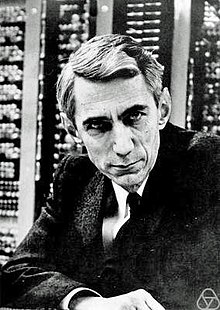
Claude Elwood Shannon
American mathematician and electrical engineerWikipedia
89
MENTIONS
43
EPISODES
37
PODCASTS
Search complete. 89 mentions across 43 episodes found for "Claude Elwood Shannon".
Sep 22, 2026

Matt O'DowdHOST
As long as you can power your computation, information is power.
Matt O'DowdHOST
Claude Shannon, the father of information theory, was deeply inspired by the close connection between entropy and information.
Matt O'DowdHOST
He defined a new type of entropy, Shannon entropy.
Matt O'DowdHOST
It can be interpreted as the amount of previously hidden information that can potentially be revealed by the observation of a random event.
Matt O'DowdHOST
In a sense, it's a measure of the uncertainty of the event.
Matt O'DowdHOST
So for example, the roll of a die has more entropy than the flip of a coin.
Matt O'DowdHOST
There are more potential outcomes in the former, so more uncertainty has been eliminated when the die is cast.
Matt O'DowdHOST
Shannon used the term entropy for this measure because his formula was almost identical to the formula for thermodynamic entropy.

AlexaHOST
In the 1940s, McCullough and Pitts introduced the first mathematical neural network model in 1943.
AlexaHOST
Claude Shannon's 1948 information theory paper gave probabilistic language tools, and early computers like ENIAC provided the hardware that made AI research possible.
AlexaHOST
Those early ideas were just the beginning.
AlexaHOST
Want to hear how they evolved into the AI we know today?

AlexaHOST
In the 1940s, McCullough and Pitts introduced the first mathematical neural network model in 1943.
AlexaHOST
Claude Shannon's 1948 information theory paper gave probabilistic language tools, and early computers like ENIAC provided the hardware that made AI research possible.
AlexaHOST
Those early ideas were just the beginning.
AlexaHOST
Want to hear how they evolved into the AI we know today?

Richard BrennanGUEST
Yeah.
Richard BrennanGUEST
So everyone was aware of, I think it was Ed Thorke and Claude Shannon back in the 1960s.
Richard BrennanGUEST
Ah, yeah.
Richard BrennanGUEST
Developing this computer that allowed them to.

Bob MurphyHOST
The transistor, 1947, invented by Jan Bardeen, William Shockley, and Walter Brayton, launching the solid-state electronics revolution.
Bob MurphyHOST
Information theory, formulated by Claude Shannon, setting the mathematical basis for the digital age.
Bob MurphyHOST
The laser, fundamental principles were first published and patented by Bell Labs researchers.
Bob MurphyHOST
Unix and C, developed by Ken Thompson, Dennis Ritchie, and others.

Matthew ContinettiGUEST
And, uh, the book is great because, um, you know, the art's good, but it's also just a fantastic story, and it's a way to learn about Kasparov because of course we go into his career, his life, his first match with Deep Blue in 1996, uh, and then we learn about the, uh, the creators of Deep Blue, the engineers, uh, where, where it came from.
Matthew ContinettiGUEST
Actually, just passing, in, in passing, I learned why Claude is named Claude.
Matthew ContinettiGUEST
I, I'd forgotten or never read th- that it's named after Claude Shannon, the, uh, one of the progenitors of computer science and intelligent machines.
Matthew ContinettiGUEST
Uh, so you learn about AI, um, but you also get this fantastic story about, uh, one of, uh, a truly remarkable, uh, individual, Garry Kasparov, and his fight, uh, with the super intelligence.
Matthew ContinettiGUEST
Relevant today, of course, but amidst all the doom, uh, saying for, for AI, but with figures like Kasparov, you get the sense that the human spirit as well as the human intellect are, are up to any, uh, challenge.

Chris PonderHOST
So I want to share that story.
Chris PonderHOST
I know I've shared it a couple of times about Claude Shannon and back in the forties when he was still with Bell Labs and the US government approached him and asked him to do a study into instantaneous translation, which is what we call AI today.
Chris PonderHOST
And he shut the study down.
Chris PonderHOST
He said, don't spend another dollar on instantaneous translation until you master the meaning of your words.
23 MINS LATER
Steve KwastHOST
So this is an example where culture is powerful.
Steve KwastHOST
You need to be aware of this and it's rooted in the language and in this powerful conversation that you've talked about.
Steve KwastHOST
And Claude, you know, the AI that is named after the man that was so wise, Claude saying, you can't even start using this tool until you define your words.
Steve KwastHOST
And until you hold your words up together, you're going to just talk past each other and war will break out, conflict will break out.

speaker_4HOST
And not just any binary structures.
speaker_4HOST
There is a real-world concept developed by theoretical physicist James Gates, who found equations in string theory that are indistinguishable from Claude Shannon's block codes.
speaker_3HOST
Okay, what are Claude Shannon's block codes?
speaker_4HOST
They are error-correcting codes.
speaker_4HOST
They are the exact same algorithms that human computer scientists use to prevent data corruption in web browsers and digital communications.

Tom ColluraGUEST
But, uh, to apply these concepts, they come from Buckminster Fuller, Norbert Wiener, um, some other physicists who, uh, were involved in early studies of stability.
Tom ColluraGUEST
Claude Shannon, for example.
Tom ColluraGUEST
Uh, Nyquist himself studied these things.
Tom ColluraGUEST
And, um, these concepts carry directly over into frequencies.
24 MINS LATER
Saul RosenthalHOST
But I think you're also talking about complexity theory.
Tom ColluraGUEST
Absolutely.
Tom ColluraGUEST
Oh, and then Claude Shannon, of course.
Tom ColluraGUEST
Um, the whole concept of information, and this all comes down to information.

Kurt KempleGUEST
Right.
Kurt KempleGUEST
this gets into thermodynamics this gets into entropy and like information and so then i said okay well is it just people is this a socio thing or is this like information theoretical and like all things are bound by um you know information processing And then I discovered that there's actually Shannon, Claude Shannon, who worked at IBM and was a scientist and developed Shannon entropy.
Kurt KempleGUEST
And that's like used in a ton of communications.
Kurt KempleGUEST
And then you have Landauer and Landauer's principle and that to change or erase a bit of data costs like an actual amount of like thermodynamic energy to do.
33 more episodes mention Claude Elwood Shannon.
Create an account to see the whole feed, search across every transcript, and follow the entities you care about.