Civil society
90
MENTIONS
19
EPISODES
18
PODCASTS
Search complete. 90 mentions across 19 episodes found for "Civil society".
Oct 1, 2026

Eddy Micah Jr.HOST
But let me come back to you, uh, Dennis.
Eddy Micah Jr.HOST
Um, there must be, as you talked about, the mixed reactions of civil society groups, you know, opposition figures.
Eddy Micah Jr.HOST
You know, what are they pushing for now? I mean, we do understand that, um, the, the president has, uh, formed a new government on his own after dissolving the one that existed.
Eddy Micah Jr.HOST
So what has been the response from civil society groups? Are there protests? Are they planning protests? Tell us more on that front.
Dennis LugoniGUEST
Uh, well, thank you so much, Eddie.
Dennis LugoniGUEST
Uh, when it comes to the civil society, I think, uh, the civil society as well has been, uh, divided.
Dennis LugoniGUEST
Well, uh, one side says, uh, if the election is to happen, there must be an inclusive, uh, uh, dialogue.
Dennis LugoniGUEST
And as we talk now, there is an ongoing interparty dialogue that was initiated by the president.

Kevin WinterGUEST
But I think if I had to look at a middle ground in the city, and this is really important, and it comes partly from Zoe's comments and involvement in Save the Fishy, but there are many, many civic organizations across the city who are doing amazing work.
Kevin WinterGUEST
And I'd like to see that in particular becoming the hallmark of what we do in the city, that the city of Cape Town is limited in what it can achieve, but what can be achieved through civil society and activists who are doing things in the city, that's got to be spread much further and wider in the city as well.
Kevin WinterGUEST
We need to find incentives to enable people to get involved in dealing with some of these critical issues, because if we expect the city of Cape Town in, say, 50 years' time to be dealing with that, I think we are naive.
Kevin WinterGUEST
It's not going to happen.

Mary Rose GunnHOST
Back in 2009, he co-founded Pro Bono Economics.
Mary Rose GunnHOST
Now known as PBE, this charity and think tank is helping to change how Britain sees the value civil society creates and how seriously that value is taken by government and business.
Mary Rose GunnHOST
Andy, thank you so much for joining me today.
Andy HaldaneGUEST
Mary Rose, it's fantastic to be here to discuss this super important topic.
Mary Rose GunnHOST
And now you have shown them and helped them to really take a step forward and they are doing amazing things and working with the government on changing education policy.
Mary Rose GunnHOST
So yeah, thank you from our perspective as well as the organisation's perspective.
Mary Rose GunnHOST
In 2021, the PPE ran the Commission for Civil Society, which I was delighted to be part of.
Mary Rose GunnHOST
But the main mission of that was to really try and prove the value of civil society, which is, I know you agree, is not reflected in official figures.

speaker_0NARRATOR
Mark Zuckerberg said Meta's focus is on building the best devices for personal superintelligence.
speaker_0NARRATOR
Subheading Civil Society 1.
speaker_0NARRATOR
AI experts including researchers at both Anthropic and OpenAI published a paper arguing policymakers should urgently obtain more visibility into the automation of AI R&D.
speaker_0NARRATOR
2.

Farzam ArbabGUEST
During those conversations, it became very clear that in those couple of years since the opening of Soviet society, something was happening that had already advanced a great deal in other parts of the world, especially in Latin America, India, and then to some extent in Africa and some other parts.
Farzam ArbabGUEST
This is the emergence of what some people have called organizations of civil society.
Farzam ArbabGUEST
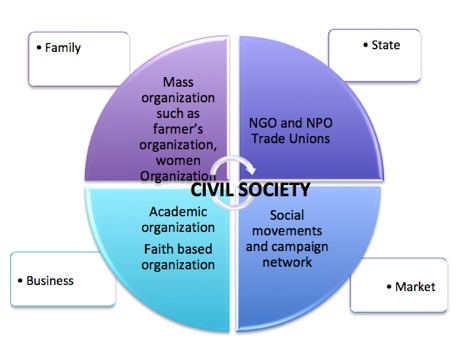
By civil society, they mean that part of society that is not government, that is not the state.
Farzam ArbabGUEST
It includes, of course, private business and all sorts of things.
Farzam ArbabGUEST
But more than that, they were concerned with non-profit organizations, organizations of civil society, which try to somehow take care of the affairs of the society itself, of its social problems.
Farzam ArbabGUEST
Now, in Latin America, for example, this is a phenomenon that is easily 20, 30 years old.
Farzam ArbabGUEST
And has grown to such an extent that really in every country you find thousands and thousands of these organizations, beginning with very small ones, a mother's club in such and such a neighborhood, a youth group, a little
Farzam ArbabGUEST
The government is somehow there or is not.

speaker_0HOST
The agency had given out about $650,000 in grants to 17 organizations so far.
speaker_0HOST
Critics say the agency was only ever a performative gesture meant to soften the impact of Georgia's broader crackdown on civil society funding.
speaker_0HOST
They also point out that despite anti-NGO rhetoric, several senior ruling party officials, including Kobachidze himself, previously worked for and were paid by international organizations like Soros' Open Society Foundation and USAID.
speaker_0HOST
On Sunday the 21st, far-right group Alt-Info held a rally in central Tbilisi.
speaker_0HOST
Protesters say the new price still aren't high enough and they're keeping the road closed.
speaker_0HOST
This year's harvest is expected to be one of the largest in Georgia's independent history, with over 320,000 tons projected.
speaker_0HOST
Posse Media published a feature this week called Three Years After Georgia's NGO Restrictions, What's Left of Civil Society, written by Lana Kukaiya.
speaker_0HOST
follows several Georgian organizations that spent years doing work most people don't even think about, bringing free medical care to remote mountain villages in Ajada, defending disability rights, saving historic wooden mosques, and fighting for children pulled out of a notoriously abusive boarding school.

Lynette CalkinsNARRATOR
THE ANTI-Coup by Gene Sharp and Bruce Jenkins.
Lynette CalkinsNARRATOR
SUPPORT FOR COUPS the basic prerequisite of a coup is that the putschist organizational and repressive forces are believed to be more powerful than the other institutions and forces of the society in short civil society is weaker than the military forces Indeed, in many countries the military forces have been in recent decades expanded to be by far the strongest institution of the whole society.
Lynette CalkinsNARRATOR
These military forces have often been turned against the very society and population on which their existence has depended, and which they were supposed to defend.
Lynette CalkinsNARRATOR
Such a military coup is more likely if the soldiers are more loyal to their officers than they are to the democratic government.
1 HR 41 MINS LATER
speaker_0NARRATOR
Adopting an anti-coup defense.
speaker_0NARRATOR
there are three main ways in which a strong anti-coup defense capacity can be adopted one through widespread dissemination throughout all levels of the society of knowledge and understanding of the grand strategy and broad forms of anti-coup resistance as just discussed 2.
speaker_0NARRATOR
Through the organization of the institutions of civil society so that they are prepared to confront and resist such an attack.
speaker_0NARRATOR
3.

Albert Kwabena DwumfourGUEST
This is what I want to say.
Albert Kwabena DwumfourGUEST
Even if you look at the Yabubo Boudin, Najam Diya Commission, the Ghana Police Service, Relevant Religious Bodies, Civil Society, if you look at them, you will see that there is a lot of work to be done.
Albert Kwabena DwumfourGUEST
You know, leading the charge, yes, in organizing such a national dialogue, you know.
Albert Kwabena DwumfourGUEST
And that's the number one thing.

Astrid Reisinger CoraciniGUEST
And this was actually one of the arguments that has been persistently brought to the authorities by CERI, the Center for the Enforcement of Human Rights International.
Astrid Reisinger CoraciniGUEST
which was the main NGO, civil society organization that was also responsible for bringing the case to the attention of the authorities.
Astrid Reisinger CoraciniGUEST
How does that
Stephanie van den BergHOST
work? Because we've seen in other universal jurisdiction cases in France that these NGOs can become even parties to the case, which is rare.
Stephanie van den BergHOST
But in the Netherlands with universal jurisdiction cases, we see often that it is NGOs that kind of push the prosecutors and provide some assistance with finding victims and people willing to testify? Is that how it goes in Austria or do they have a particular role they can play in court?
Astrid Reisinger CoraciniGUEST
Well, information on crimes can be submitted to the authorities by anyone, by individuals, by organizations.
Astrid Reisinger CoraciniGUEST
And in this case, it was particularly civil society organizations.
Astrid Reisinger CoraciniGUEST
I've mentioned CERI already.

Stephanie SladeGUEST
But the sphere outside of government, everything we do that doesn't involve the coercive power of the state markets, religion, you know, faith, family, all of that.
Stephanie SladeGUEST
It happens in the non-governmental sphere and through civil society institutions and all the various associations that we form.
Stephanie SladeGUEST
You know, that's where we try to build a virtuous life in a virtuous society.
Stephanie SladeGUEST
And so what that suggests to me, at least, and this is part of the reason that I ended up as a libertarian, is that our politics really should be fairly libertarian.
Stephanie SladeGUEST
So I don't know where it breaks.
Stephanie SladeGUEST
But I mean, I think that there are tools within the fusionist toolbox that allow us to try to rebuild that consensus short of, you know, using the coercive power of the state to impose one way of life on everybody else.
Stephanie SladeGUEST
And that is through rebuilding the sort of institutions of civil society that can sort of educate and shape people and help them to find their way back to what we think is moral truth.
Megan McArdleHOST
We've got to hold that thought because we're going to take a quick break, but we're going to be right back.
9 more episodes mention Civil society.
Create an account to see the whole feed, search across every transcript, and follow the entities you care about.