Civil Rights Act of 1964
559
MENTIONS
382
EPISODES
317
PODCASTS
Search complete. 559 mentions across 382 episodes found for "Civil Rights Act of 1964".
Sep 22, 2026

speaker_4NARRATOR
The stirring speech was an instant success, captivating the millions of people who heard it.
speaker_4NARRATOR
In fact, so captivating was King's I have a dream speech, within two years, the Civil Rights Act and the Voting Rights Act were passed, both of which were pivotal in the fight for racial equality in the US.
speaker_4NARRATOR
Who knows what would have happened if Mahalia Jackson didn't tell King to talk about the dream? After serving as the 26th President of the United States from 1901 to 1909, Theodore Roosevelt fancied another stab at the whole presidency gig, putting himself in the running for the 1912 election.
speaker_4NARRATOR
In an attempt to sway votes, Roosevelt gave a speech at the Milwaukee auditorium.

Charlie KirkSOUNDBITE_SPEAKER
It's true.
Charlie KirkSOUNDBITE_SPEAKER
And Kirk's self-described very, very radical view that the country made a mistake when it passed the Civil Rights Act.
Charlie KirkSOUNDBITE_SPEAKER
Also true.
Tim WhitakerHOST
I'm asking you

Nicole HemmerHOST
So it is very mixed.
Nicole HemmerHOST
And this is why you need a Southern strategy, because as we're about to talk about the Civil Rights Act, but there is this moment when white Southerners say, and to a certain extent, white Northerners will get there, but say this party.
Nicole HemmerHOST
Is no longer going to represent my racial and therefore my economic and political interests.
Nicole HemmerHOST
And I need a new home.
Jody AvirganHOST
Let's talk about 1964.
Jody AvirganHOST
Yeah, exactly.
Jody AvirganHOST
Let's talk about 1964 and the Civil Rights Act.
Jody AvirganHOST
You know, we've done episodes about this.

Jody AvirganHOST
Uh, tell us about that moment.
Kelly Carter JacksonHOST
So the Civil Rights Act of 1964 is monumental in that it is the first real federal dismantling of Jim Crow segregation.
Kelly Carter JacksonHOST
And so all of the physical infrastructure of Jim Crow, your white only, your Black only, your ability to be able to bar someone from a restaurant or prevent someone from going to a school or prevent someone from sort of, you know, participating in these public spaces, all of that is shattered, and it's fair to say white Southerners lose their mind.
Kelly Carter JacksonHOST
Didn't [laughs] like the idea that...
Kelly Carter JacksonHOST
Hmm
Jody AvirganHOST
...
Jody AvirganHOST
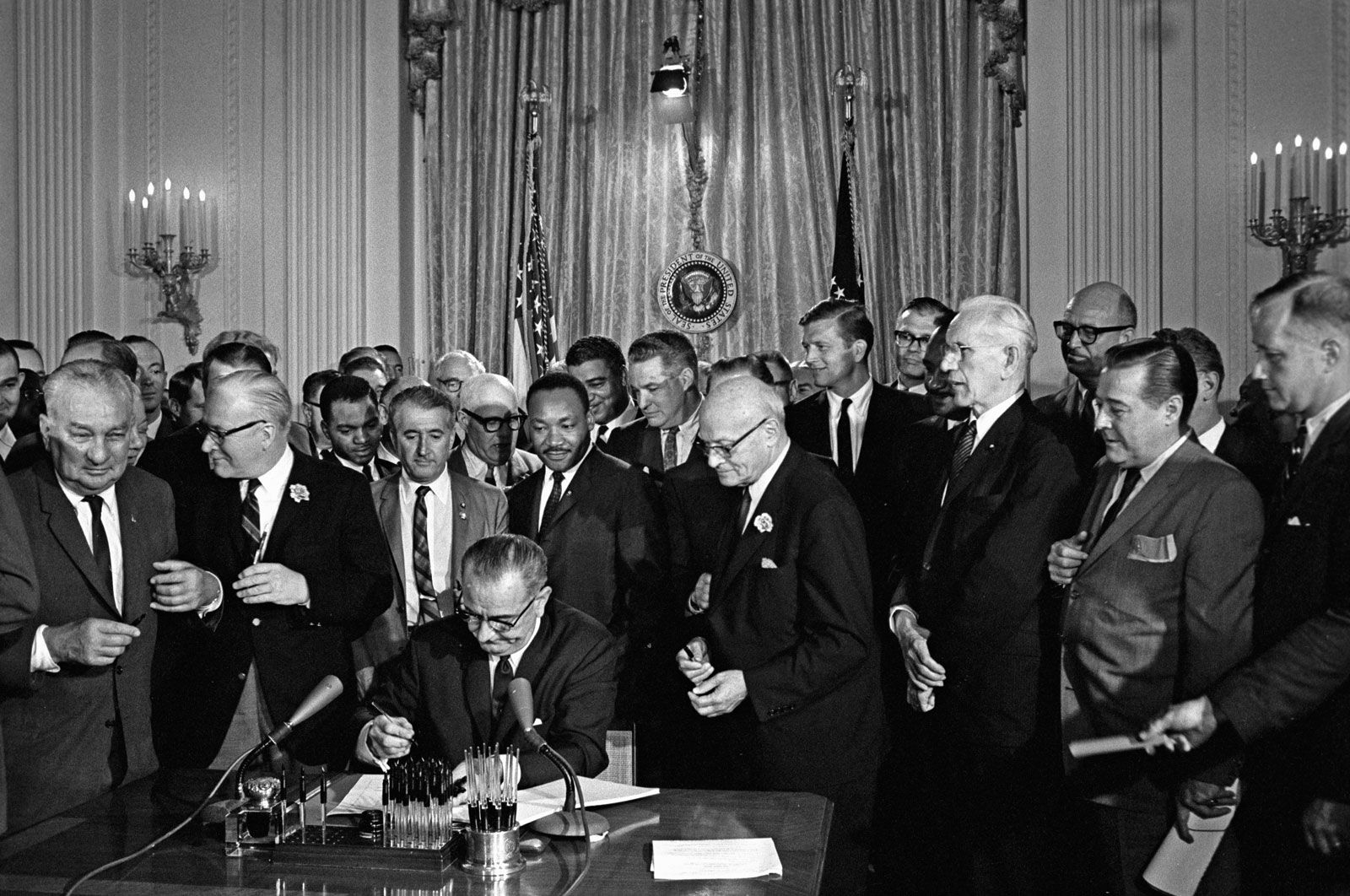
I'm about to ask, but, you know, LBJ signs the Civil Rights Act of 1964, and I take your point, Kelly, that it's a long time to implement-
Kelly Carter JacksonHOST
Mm-hmm

Clint SmithHOST
Disc jockeys, more commonly known as DJs or MCs, would compete with each other by layering and remixing beats at their turntables and rhyming over the beats while friends battled it out in informal breakdancing competitions.
Clint SmithHOST
After the civil rights victories of the 1960s, like the Civil Rights Act of 1964 and the Voting Rights Act of 1965, Black communities experienced a decreased interest in their political and economic well-being from the government and policymakers.
Clint SmithHOST
The result was a lack of investment in Black communities and their social infrastructure, resulting in staggering poverty rates, increased police surveillance, and ambiguous messaging from former allies of the Black liberation struggle.
Clint SmithHOST
At the same time, the country was seeing the burgeoning Black arts movement of the 1960s and 1970s, which emphasized radical visions of reimagining Blackness through music, visual art, poetry, theater, and literature.

TashaHOST
Yeah.
TashaHOST
Though they were working, though, they wouldn't earn rights against employment discrimination and they wouldn't earn protection for equal pay until the Civil Rights Act of 1964.
TashaHOST
So, yes, there are more women working, but these women are facing so much crap in the workplace and they're not getting paid the same.
TashaHOST
Received

Sean ThompsonHOST
When did it become a rubber stamp for people of color to always be Democrat?
Jessica JacksonGUEST
Well, I don't know when it became a rubber stamp for people of color, but I know it became, and I don't know if I would call it a rubber stamp for black people behind the Civil Rights Act in 1964.
Jessica JacksonGUEST
See, when we say terms like rubber stamp, you have to look at a people who, let's say like my family, for example, my mother and father that came out of Jim Crow South.
Jessica JacksonGUEST
So when I became a certain age and I asked my mother, how do I vote? My mother told me Democrat, because she lived through a period of time where the Democrats did legislation that bought her out of Jim Crow.

Christina GreerGUEST
It's about these people who aid and abet this really illegal, dangerous, anti-constitutional behavior.
Christina GreerGUEST
And far too many Americans are complicit in helping him sort of erode the Civil Rights Act, the Voting Rights Act, the Immigration Act, and so many principles and norms that we have in this nation.
Antonia HyltonHOST
Christina Greer, thank you so, so much for your expertise.
Antonia HyltonHOST
Anytime.

Jim PfaffGUEST
You need to wear them down so badly that they're willing to go to that.
Jim PfaffGUEST
That's exactly what happened with the 1964 Civil Rights Act.
Jim PfaffGUEST
You eventually got to a cloture vote because Mike Mansfield wouldn't let anything else happen on the floor until that happened, and he kept a group of Republican and Democrat senators willing to keep the quorum going.
Jim PfaffGUEST
to make people have to suffer if they wanted to filibuster on it.

Danah BoydGUEST
One of the things that happens in the mid 1960s is we pass a series of civil rights laws.
Danah BoydGUEST
There's the 64 and 65 Civil Rights Act, there's the Voting Rights Act, and then later we have the Equal Employment Opportunity Act.
Danah BoydGUEST
The Voting Rights Act actually says, oh, well, actually, if you're going to allocate those representatives and then the states are going to go further and distribute political power through redistricting, which is where the drawing of the maps happens.
Danah BoydGUEST
And to be clear, that's often often called in the public language of gerrymandering, which has its own fun history.
16 MINS LATER
Danah BoydGUEST
And I think this is where we, I keep thinking about Pam Heard and Don Moynihan's book, Administrative Policymaking by Other Means.
Danah BoydGUEST
which is when you can't get what you want through Congress, you find other ways of making it happen through, you know, this micromanagement of policy.
Danah BoydGUEST
And I think that that's part of what we're seeing, you know, which is that you don't like the Civil Rights Acts.
Danah BoydGUEST
You can make them impossible to enforce by erasing the data that they depend on.
372 more episodes mention Civil Rights Act of 1964.
Create an account to see the whole feed, search across every transcript, and follow the entities you care about.