Civil Liberties Act of 1988
6
MENTIONS
4
EPISODES
4
PODCASTS
Search complete. 6 mentions across 4 episodes found for "Civil Liberties Act of 1988".
Oct 9, 2026

Craig BairdHOST
Japanese Canadians lost an estimated four hundred and thirty-three million dollars during that time, and it took until 1988 for the government to officially apologize.
Craig BairdHOST
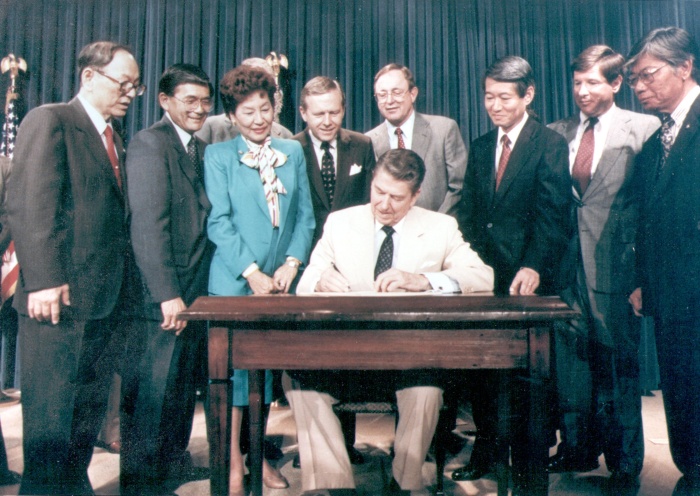
That's also the same year that President Ronald Reagan signed the Civil Liberties Act, admitting the US government acted on race prejudice, war hysteria, and a failure of political leadership when it forcefully removed and incarcerated about a hundred and twenty thousand Japanese Americans, two-thirds of whom were US citizens.
Craig BairdHOST
The second thing the attack on Pearl Harbor did was it showed the immediate need for a quick route to Alaska.
Craig BairdHOST
At first, supplies and troops could be sent by air rather than by boat or road, but that idea came to a halt in January 1942.

Amy ElizabethHOST
Her work shed light on the situation and galvanized a group seeking to demand restitution and reparations for the survivors.
Amy ElizabethHOST
Reagan signed the Civil Liberties Act of 1988, and Mamoru Ito received the very first reparations check on October 1990.
Amy ElizabethHOST
Unfortunately, Dorothea never got to see the fruit of her time spent giving Japanese Americans the dignity and voice they deserved.
Amy ElizabethHOST
Her health failed in the last decade of life as she dealt with post-polio syndrome and esophageal cancer.

Dorothy BrownGUEST
There were others in the Japanese American community who thought litigation was the way to go.
Dorothy BrownGUEST
And you had this lawsuit that was actually hanging over Congress's head when they enacted the Civil Liberties Act.
Dorothy BrownGUEST
And part of the Civil Liberties Act was if you took payment under the Civil Liberties Act, you could no longer be part of or benefit from any lawsuit.
Dorothy BrownGUEST
So honestly, I don't think there was any widespread support for Japanese Americans to get reparations, yet they got it.
Dorothy BrownGUEST
I don't think anybody cared or knew about Italy getting reparations.
Dorothy BrownGUEST
40 in Congress that was first introduced in 1989.
Dorothy BrownGUEST
It's never gone far.
Dorothy BrownGUEST
Why 1989? It was a year after the Civil Liberties Act of 1988.

Andrew NapolitanoGUEST
I mean, there must be a breach of a duty to the plaintiff that is to the person actually being compensated.
Andrew NapolitanoGUEST
Under Ronald Reagan, the government enacted something called the Civil Liberties Act of 1988, shortly before he left office, which renounced the Japanese incarceration and which compensated everybody then living who had endured it.
Andrew NapolitanoGUEST
It did not compensate the descendants of those who had endured it.
Andrew NapolitanoGUEST
Now, I think we're safe to say that nobody is living today who was enslaved in the pre 13th Amendment era.