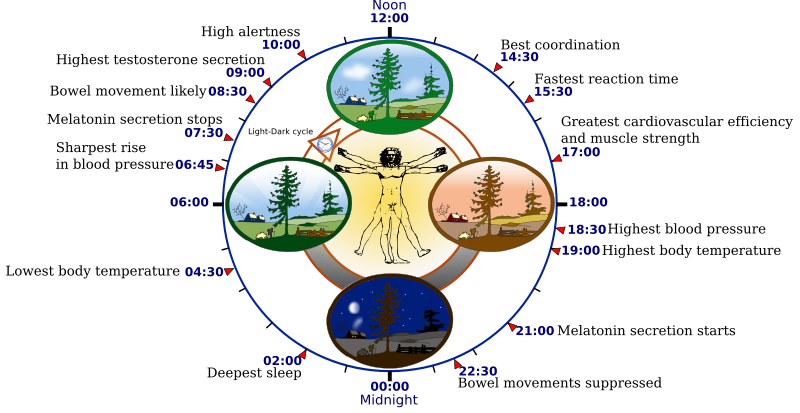
Circadian rhythm
353
MENTIONS
100
EPISODES
90
PODCASTS
Search complete. 353 mentions across 100 episodes found for "Circadian rhythm".
Sep 22, 2026

Robert SantanaHOST
Like I said, I'm trying to be one of these 6 o'clock in the morning people, which means I'm waking up at 5, and my days have been a lot more productive with that.
Robert SantanaHOST
I need to get a sleep guy in here to talk about circadian rhythm someday, but it's not something I've done a deep dive on, but I understand the basics of it.
Robert SantanaHOST
And what I know is your nervous system isn't working properly because you're poorly rested.
Robert SantanaHOST
Your hormones get disrupted.
Robert SantanaHOST
I'm crankier.
Robert SantanaHOST
And it's much harder to focus because I've lost those key hours of the morning.
Robert SantanaHOST
So I think there is such a thing as a natural circadian rhythm.
Robert SantanaHOST
I think it's similar for most of us, but I think there's some of us that all fall outside the norm.

Grant SchofieldGUEST
And so you're in a perpetual twilight with the wrong light signals and you can't get the rhythm.
Hannah McQueenHOST
Your circadian rhythm.
Grant SchofieldGUEST
Yeah, because it relies on light to tell it what to do.
Grant SchofieldGUEST
Every cell in the body has these clocks.

Tracy HarrisonHOST
And we are designed actually to awaken with a good, healthy cortisol surge, what's often called a cortisol awakening response, so that even on a typical normal day, we are jump-starting our physiology into functioning optimally.
Tracy HarrisonHOST
We have baseline levels of cortisol that follow a diurnal rhythm.
Tracy HarrisonHOST
And then the cortisol levels that we experience over time might be adaptively increasing in anticipation of greater levels of stress.
Tracy HarrisonHOST
We might experience this if we go through a challenge or a project.
8 MINS LATER
Tracy HarrisonHOST
But often behind the scenes, there are physiological stressors involved that we may need a good partnership with a practitioner in order to understand so that we can assess and resolve what is at play in our unique lives.
Tracy HarrisonHOST
But as I said earlier, cortisol is designed to protect us and to help to prime the body's entire endocrine system.
Tracy HarrisonHOST
We're not only experiencing episodic higher levels of cortisol, we have a healthy diurnal rhythm, including that large first morning cortisol awakening response that helps to prime all of our nuclear receptors for hormones so that we can experience vitality.
Tracy HarrisonHOST
Ultimately, we want to have surges of cortisol, higher levels when necessary in order to protect us.

Shivani GuptaGUEST
So don't in the summer go to the beach all day and get cooked.
Shivani GuptaGUEST
Instead of go to the mountains, go to the lakes, like be in the water, eat summer foods, eat seasonally according to the circadian rhythm of Mother Earth.
Chris MotleyHOST
Yes.
Shivani GuptaGUEST
And that is what will keep you balanced.
8 MINS LATER
Chris MotleyHOST
Wow.
Shivani GuptaGUEST
So once you understand the Constitution, that's the first step.
Shivani GuptaGUEST
And then what I did was I talked about circadian rhythm, circadian clock.
Shivani GuptaGUEST
Ayurveda came up with the circadian clock and said we must live according to these different times of day.

Steve HarveyHOST
I have to now, yeah.
Steve HarveyHOST
If you go outside in direct sunlight early in the morning, it sets your circadian rhythms.
Steve HarveyHOST
Rhythm.
Steve HarveyHOST
I was going to say it

speaker_12PANELIST
I have to now, yeah, I have to.
speaker_12PANELIST
If you go outside in direct sunlight early in the morning, it sets your circadian rhythms.
speaker_11HOST
Rhythm.
speaker_12PANELIST
I was going to say it starts with an R, but the only thing that starts with an R is rhythms.

Sabrina AtterbomHOST
No, you go.
Sabrina AtterbomHOST
Another thing with getting back into your, you know, getting your circadian rhythm back to how you want it for your normal routine is getting sunlight exposure first thing in the morning.
Sabrina AtterbomHOST
So that just goes hand in hand with trying to get back to what your normal time zone is.
Sabrina AtterbomHOST
And if you can get outside first thing in the morning, get some sunshine, that's going to help.

Pete EvansGUEST
But, um, you know, anybody that's got compromised health, um, I wish them very well on, on, on their journey.
Pete EvansGUEST
But perhaps re-listen to what we've spoken about today and contemplate that and invite that and explore these things and do further reading and research into this.
Pete EvansGUEST
There's a great doctor called Dr. Jack Kruse out there that talks all about, um, circadian rhythms-
Karl StefanovicHOST
Mm
Pete EvansGUEST
... and EMF pollution and these types of things and, and why our, um, why spending more time out in the sun is-- can be very b- beneficial for people that do these shift work, um, [laughs] vocations and also, uh, surround themselves with artificial light, especially in the daytime or early in the morning.

Roger SeheultGUEST
And it's just phenomenal to me, like how... how inspired she was.
Roger SeheultGUEST
Because one of the things that you'll hear from circadian rhythm experts today, sleep specialists, of which I'm one, is they cannot, they'll say this themselves, they cannot emphasize enough how important it is to do things with regularity.
Roger SeheultGUEST
Going to bed at different times, there's just a study that came out showing this, going to bed at different times is more injurious than going to bed at a regular time, even on the weekends.
Roger SeheultGUEST
Even on the weekends.
Roger SeheultGUEST
So they're already delayed.
Roger SeheultGUEST
Yeah.
Roger SeheultGUEST
Their circadian rhythm is already delayed because they're getting up late and they miss out on the very one thing.
Roger SeheultGUEST
that can advance them back into normalcy, which is morning sunlight.

John NeustadtHOST
She's a PhD in nutrition, but she wants to talk about light.
John NeustadtHOST
And how light affects our circadian rhythms and the effects of light.
John NeustadtHOST
And I'm not surprised by that.
John NeustadtHOST
I wasn't surprised when I heard it because when I read her book, which everybody should get, The Rainbow Diet, it looks at the different colors.
14 MINS LATER
John NeustadtHOST
So there's diurnal, there's monthly, there's annual.
John NeustadtHOST
Talk a little bit about that because it's sort of the image I get is a symphony of interacting sort of parts and biological systems that are all hopefully working together to optimize health and longevity.
John NeustadtHOST
And the chronobiology and the circadian rhythms, daily, monthly, yearly, and I'm sure others, I think is a wonderful way to conceptualize health.
Deanna MinichGUEST
Yes.
90 more episodes mention Circadian rhythm.
Create an account to see the whole feed, search across every transcript, and follow the entities you care about.