Cinerama
Film formatWikipedia
56
MENTIONS
17
EPISODES
16
PODCASTS
Search complete. 56 mentions across 17 episodes found for "Cinerama".
Oct 26, 2026

Jonathan LackHOST
And it doesn't require theaters to install any new equipment.
Jonathan LackHOST
You don't need any new lenses or anything, which is what CinemaScope, Cinerama would do.
Jonathan LackHOST
And you could kind of vary the aspect ratio so it wouldn't mean you had to put in a whole new screen.
Jonathan LackHOST
In its initial use case though, VistaVision was pretty short-lived.

EricHOST
That's significant.
EricHOST
And co-created the widescreen Cinerama process.
EricHOST
Okay.
EricHOST
So he got a lot of accomplishments.

Josh CalderHOST
Rob has been the projectionist at the Sun Theatre in Yarraville, Melbourne for over 20 years, which was just named one of the Time Out's top 100 cinemas in the world.
Josh CalderHOST
He made a documentary called Splice Here about the history of Cinerama and projection, ending up in the Academy's Margaret Herrick Library.
Josh CalderHOST
And the film led to Quentin Tarantino visiting the Sun Theatre for The Hateful Eight.
Josh CalderHOST
But the big news right now is that the Sun Theatre is installing a VistaVision projector.
Josh CalderHOST
I was kicking myself.
Josh CalderHOST
Do you have any favorites from it?
Rob MurphyGUEST
I've been to the Cinerama Dome, of course.
Rob MurphyGUEST
I haven't seen anything projected there, but look, that was amazing just to see the

Michael ChaikenGUEST
It was shot on a format that That is, you know, virtually impossible really to project.
Michael ChaikenGUEST
Essentially, it was projected on a dome, on a Cinerama dome.
Michael ChaikenGUEST
So it was a 360 degree environment.
Michael ChaikenGUEST
So they had to build kind of a theater, kind of like a planetarium to show the film.

ZachGUEST
... right? So that version.
ZachGUEST
There was a thing called Cinerama which was even wider than CinemaScope.
ZachGUEST
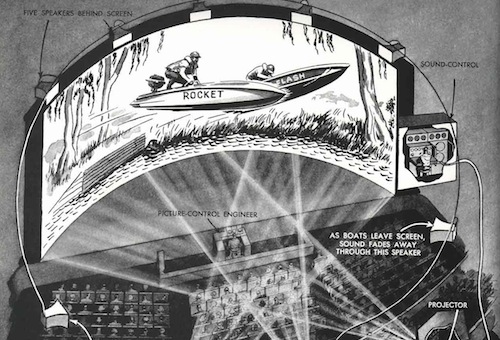
It was like three different projectors basically like you were in the sphere, but in a movie.
AdamHOST
Oh.
ZachGUEST
So that's...
ZachGUEST
It was, like, this stitch work.
ZachGUEST
So, like, Cinerama was three cameras essentially-
SarahHOST
Oh

James CurtisGUEST
And, um, if you've seen the news items recently, uh, after six years they're going to reopen it again and, uh, start showing films again.
James CurtisGUEST
It's the Cinerama Dome on Sunset Boulevard.
James CurtisGUEST
And, uh, Mad World opened it in November of 1963, and I hope that when they reopen it in two, 2028, that it'll, uh, be the first film they show again.
Arthur E. FriedmanHOST
I, I was really fascinated [laughs] to know, uh, Jim, in reading the book, that, uh, even at the Cinerama Dome they weren't really finished building it [laughs] at the premiere.
James CurtisGUEST
Well, well they, they, they were on three shifts a day to, to get it done in time because they had announced the film's opening and also the, um, the international press preview before they ever had even a, a, a plot of land to put it on.
James CurtisGUEST
And, uh, so, uh, as you know from the book, uh, they were still installing fixtures, light fixtures, in the, uh, uh, lounges, uh, on the afternoon of the opening.
22 MINS LATER
Julian SchlossbergHOST
... marketing made it successful.
Julian SchlossbergHOST
Mike Todd was a, was a genius.

Ron FalzoneGUEST
I mean, what you do is less looking at films and looking at technological advances.
Ron FalzoneGUEST
So this is Cinerama, started to pull people into the theaters, but it was impossible to actually tell narratives because you would-- needed three projectors and three cameras, and the screen was so big you couldn't do close-ups.
Ron FalzoneGUEST
But that led, in nineteen fifty-three, to CinemaScope.
Ron FalzoneGUEST
And CinemaScope almost immediately, because Twentieth Century Fox was charging so much to use it, led to all the other studios creating their own.
Ron FalzoneGUEST
Literally, the width of it was three times greater than the height of it.
Michael PhillipsHOST
Hmm.
Ron FalzoneGUEST
So it, it was almost Cinerama.
Ron FalzoneGUEST
It took up most of the vision.

Charisse NixonSOUNDBITE_SPEAKER
Keep your hands up
Barry FernsHOST
On the right side of the room, they have anagrams of B-A-T, bat, lemon, and Cinerama, which is simple.
Barry FernsHOST
Tab, melon, American.
Barry FernsHOST
But on the other side of the room, it has whirl, slapstick, and Cinerama.
Barry FernsHOST
And you probably don't know this, but whirl and slapstick have no anagram at all.
Barry FernsHOST
They're impossible

Josh SandersGUEST
Um, which began around the same time.
Josh SandersGUEST
And I think, um, Cinerama was the kind of first-
Brandon DavisHOST
Oh
Josh SandersGUEST
... process that came along, I think in 1952, I think.
Josh SandersGUEST
Um, and Cinerama [laughs] is this incredible process that I find it hard to believe that even happened where, you know, you had three cameras recording simultaneously, and it was 180 degree, or I think it was actually 170 degree view.
Josh SandersGUEST
And then you had three projectors running simultaneously projecting on a giant curved stre- screen.
Josh SandersGUEST
Um- But as you can imagine, a system like that is hugely problematic [laughs] because you've got to sync the three cameras.
Josh SandersGUEST
You've got these, uh, s- you know, where the three, um, projections come together, you get these lines, um, where you can see the, the, um, the, uh, I guess, edges of each frame coming together.

Josh SandersGUEST
Um, which began around the same time.
Josh SandersGUEST
And I think, um, Cinerama was the kind of first-
Brandon DavisHOST
Oh
Josh SandersGUEST
... process that came along, I think in 1952, I think.
Josh SandersGUEST
Um, and Cinerama [laughs] is this incredible process that I find it hard to believe that even happened where, you know, you had three cameras recording simultaneously, and it was 180 degree, or I think it was actually 170 degree view.
Josh SandersGUEST
And then you had three projectors running simultaneously projecting on a giant curved stre- screen.
Josh SandersGUEST
Um- But as you can imagine, a system like that is hugely problematic [laughs] because you've got to sync for three cameras.
Josh SandersGUEST
You've got these, uh, s- you know, where the three, um, projections come together, you get these lines, um, where you can see the, the, um, the, uh, I guess, edges of each frame coming together.
7 more episodes mention Cinerama.
Create an account to see the whole feed, search across every transcript, and follow the entities you care about.