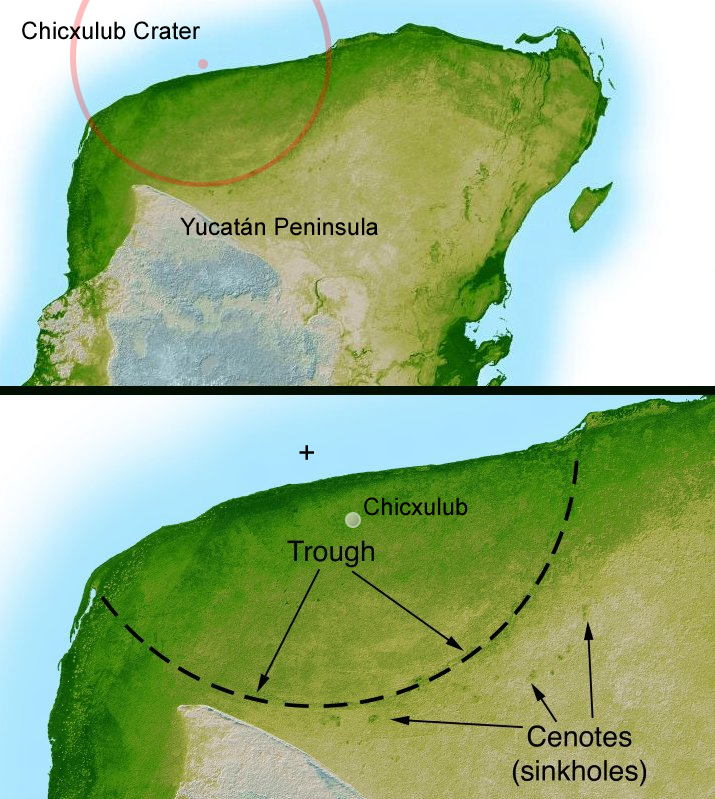
Chicxulub crater
Impact craterWikipedia
52
MENTIONS
30
EPISODES
28
PODCASTS
Search complete. 52 mentions across 30 episodes found for "Chicxulub crater".
Sep 21, 2026

ChaseVOICE_ACTOR
Pero no, no ese Big Bang.
ChaseVOICE_ACTOR
Un asteroide que medía diez kilómetros de diámetro y que ahora llamamos Chicxulub atravesó el espacio y luego nuestra atmósfera hasta su destino final, donde hoy queda la península de Yucatán, en México.
ChaseVOICE_ACTOR
El impacto de este descomunal pedazo de roca espacial liberó una energía comparable a la de cien billones de toneladas de TNT.
ChaseVOICE_ACTOR
Fue como si miles de millones de bombas atómicas, como las lanzadas por Estados Unidos al final de la Segunda Guerra Mundial, explotaran a la vez.
6 MINS LATER
ChaseVOICE_ACTOR
La civilización humana, en lugar de desarrollarse en comunidades gigantescas, estaría dispersa en pequeños grupos nómadas alrededor del planeta, viviendo de la recolección y la caza.
ChaseVOICE_ACTOR
La evolución es un rompecabezas complejo cuya solución solo la conoce el tiempo.
ChaseVOICE_ACTOR
Si reservamos el curso de tan solo un evento como la colisión del Chicxulub, básicamente nos enfrentamos a un número infinito de posibles versiones de nuestro presente.
RicoVOICE_ACTOR
[música tranquila] ¿Cómo sería ver a un Tyrannosaurio rex en la vida real? Si solo este asteroide mortal no hubiera impactado la Tierra, ¿todavía estarían vivos los dinosaurios? ¿Habrían evolucionado? ¿Habrían sobrevivido tanto tiempo los humanos? ¿Podríamos haber aprendido a coexistir? Esto es Qué pasaría si y esto es lo que sucedería si los dinosaurios no se hubieran extinguido.

Ron HackneyGUEST
So we're already getting the clues of what's going on.
Ron HackneyGUEST
It's reasonably close to the big Chicxulub crater on the Yucatan Peninsula of Mexico into the Gulf of Mexico, where that big crater is the day the dinosaurs died.
Ron HackneyGUEST
And this reflects that process.
Ron HackneyGUEST
So you can see the- So what are we

GilbertSOUNDBITE_SPEAKER
Wrote extinction dates in the margins.
GilbertSOUNDBITE_SPEAKER
Next to the passages about the stars falling and the mountains moving, I'd write the date of the Chicxulub impact.
GilbertSOUNDBITE_SPEAKER
66 million years ago.
GilbertSOUNDBITE_SPEAKER
The one that got the dinosaurs.

James StewartHOST
And then in 1991, geologists searching for oil accidentally stumbled across it.
James StewartHOST
Named the Chicxulub crater and nicknamed Crater of Doom, it is one of the most important geological discoveries ever made.
James StewartHOST
Not because of its size, but because of what it contains.
James StewartHOST
Every stage of this catastrophic asteroid impact left a physical signature in the rock layers.
7 MINS LATER
James StewartHOST
Had it hit at a shallower angle, much of its energy would have been spread out across the surface.
James StewartHOST
Had it struck head-on, well, two to three times less material may have been blasted upwards.
James StewartHOST
Instead, the Chicxulub asteroid hit the planet with a deadly precision which maximized the amount of climate-altering debris that scattered around the globe.
James StewartHOST
In that instant, a deadly chain of events was set in motion, and Earth entered one of the most extraordinary and, until recently, unknown chapters in its history.

Fred JourdanSOUNDBITE_SPEAKER
So the crater is 2,500 kilometer.
Fred JourdanSOUNDBITE_SPEAKER
You compare that with Chicxulub that extinguished the dinosaur at, uh, 100, uh-
Stuart GaryHOST
80, yeah
Fred JourdanSOUNDBITE_SPEAKER
... yeah, 180 kilometer.

Fred JourdanGUEST
So the crater is two thousand five hundred kilometer.
Fred JourdanGUEST
You compare that with Chicxulub that extinguished the dinosaurs at one hundred, uh-
Stuart GaryHOST
Eighty, yeah
Fred JourdanGUEST
... yeah, one hundred eighty kilometer.

TomHOST
I just feel like there's so many things here where it could all come together and it doesn't.
TomHOST
It's like you have something as cool as the gunpowder jar, but then no one tells people, oh, if you drop it, you basically do the Chicxulub crater on yourself.
TomHOST
Then you have these guys building the world's biggest, most comically oversized siege engines, but they're like, you should probably let the Navy know so that they don't get A, shot to pieces, or B, washed up on the rocks.
TomHOST
And it's like in the end, they have this basically able to do a sort of late 16th century Normandy landing.

Alya Al NuaimiHOST
Now, you probably know the famous story, a huge asteroid about 10 kilometres wide, that's like a mountain flying through space, of course, and it came down and struck planet Earth in the area we know called Mexico, and we call it now Mexico, of course.
Alya Al NuaimiHOST
It hit so hard, it dug out a massive crater, called, um, Chicxulub.
Alya Al NuaimiHOST
I hope I did not butcher the pronunciation.
Alya Al NuaimiHOST
So it's Chicxulub.
Alya Al NuaimiHOST
Yeah.
Alya Al NuaimiHOST
So, and for all those years, of course, scientists believed this story went like this.

speaker_6NARRATOR
The Age of the Dinosaurs came to an end 65 million years ago.
speaker_6NARRATOR
It is thought that a giant asteroid six miles across smashed into the Earth where the town of Chicxulub in Mexico now sits, triggering tsunamis and dust clouds that blotted out the sun.
speaker_6NARRATOR
Plants could not grow.
speaker_6NARRATOR
Animals were cold and hungry and began to die.

PeterNARRATOR
Se venissimo colpiti da particelle che viaggiano al 99% della velocità della luce, la Terra verrebbe sterilizzata.
PeterNARRATOR
Oppure cosa succederebbe se non avvistassimo un asteroide in arrivo? Un vagabondo interstellare come 3I/ATLAS che schizza nel nostro sistema ad altissima velocità? Quel coso viaggiava a quasi 7 km/s e se avesse colpito la Terra avrebbe fatto molti più danni dell'asteroide di Chicxulub.
PeterNARRATOR
E Chicxulub, che ha centrato la Terra 65 milioni di anni fa, ha spazzato via i dinosauri, ha incenerito foreste, sparato trilioni di tonnellate di gas e lava nell'atmosfera e creato un inverno nucleare.
PeterNARRATOR
Quel tipo di impatto cancellerebbe gran parte delle conquiste umane in brevissimo tempo.
PeterNARRATOR
Quindi è possibile che un asteroide ci faccia sparire insieme a gran parte delle nostre infrastrutture.
20 more episodes mention Chicxulub crater.
Create an account to see the whole feed, search across every transcript, and follow the entities you care about.