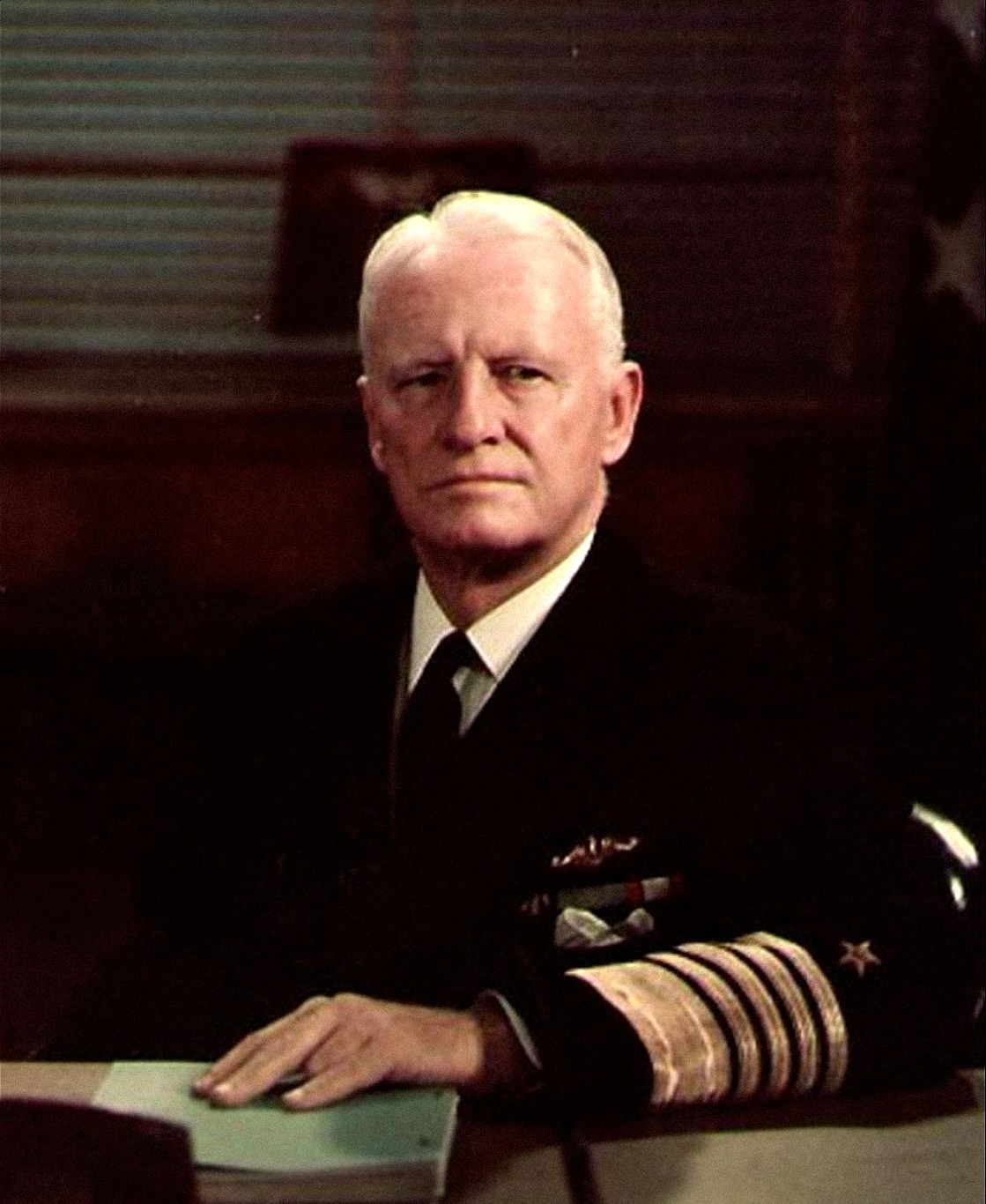
Chester W. Nimitz
AdmiralWikipedia
178
MENTIONS
41
EPISODES
29
PODCASTS
Search complete. 178 mentions across 41 episodes found for "Chester W. Nimitz".
Sep 24, 2026

Tony RobinsonNARRATOR
Facing him across the Coral Sea is one of America's finest admirals.
Tony RobinsonNARRATOR
Chester Nimitz is commander-in-chief of the US Navy in the region.
Tony RobinsonNARRATOR
Nimitz fought in World War I and is recognized as a brilliant tactician.
Tony RobinsonNARRATOR
He also leads a large fleet.
Tony RobinsonNARRATOR
It includes two aircraft carriers and an assortment of cruisers and destroyers.
Tony RobinsonNARRATOR
For two days, the US and Japanese fleets send up aircraft to scout the Coral Sea.
Tony RobinsonNARRATOR
Neither knows what's out there or where the enemy is.
Tony RobinsonNARRATOR
Finally, US warplanes locate the Japanese carrier Shoho Nimitz sends up dive bombers.

Pete HegsethSOUNDBITE_SPEAKER
In World War II, General Marshall used the Louisiana Maneuvers, matched by the Navy's fleet problems, to test commanders under realistic friction.
Pete HegsethSOUNDBITE_SPEAKER
Peacetime reputation dissolved as leaders like Eisenhower, Nimitz, and Bradley emerged.
Pete HegsethSOUNDBITE_SPEAKER
The Joint War Fighter Evaluation brings that standard to the modern multi-domain fight.
Pete HegsethSOUNDBITE_SPEAKER
This evaluation is an objective equalizer.
Mark HertlingGUEST
I'll stop
Ben ParkerHOST
...
Ben ParkerHOST
I went, "What?" Nimitz? Now, he does mention the fleet problems, and the fleet problems for the Navy-
Mark HertlingGUEST
Yeah, but, but he doesn't define that.

speaker_5UNKNOWN
And the pressure got so intense that the military finally had to yield.
speaker_5UNKNOWN
On May 27, 1942, aboard the flight deck of the USS Enterprise, Fleet Admiral Chester W. Nimitz, the commander of the whole Pacific Fleet, personally pinned the Navy Cross on Doris Miller's chest.
speaker_4UNKNOWN
Which was a massive milestone.
speaker_4UNKNOWN
Miller became the very first African-American to receive the Navy Cross, which is their second highest award for valor.
speaker_0NARRATOR
And the pressure got so intense that the military finally had to yield.
speaker_0NARRATOR
On May 27th, 1942, aboard the flight deck of the USS Enterprise, Fleet Admiral Chester W. Nimitz, the commander of the whole Pacific Fleet, personally pinned the Navy Cross on Doris Miller's chest.
speaker_3NARRATOR
Which was a massive milestone.
speaker_3NARRATOR
Miller became the very first African American to receive the Navy Cross, which is their second highest award for valor.

DaleHOST
Not literally, but close enough that it mattered just as much.
DaleHOST
Navy codebreakers working out of a windowless basement at Pearl Harbor, the outfit known as Station Hypo, had been chewing through the Japanese Navy's operational code for months, and by April 1942, they'd cracked enough of the traffic surrounding Operation Moe to hand Admiral Chester Nimitz the Something close to Japan's actual playbook.
DaleHOST
Not everything.
DaleHOST
Not perfectly.
DaleHOST
But enough to know that something big was coming at Port Moresby.
DaleHOST
And enough to know roughly when.
DaleHOST
Nimitz did something that, on its face, sounds almost reckless.
DaleHOST
He committed two of his four available Pacific carriers to intercept it.

Tail DraggerHOST
He would be traveling in a Mitsubishi G4M bomber with an escort of six Zero fighters.
Tail DraggerHOST
When that decoded message reached Admiral Chester Nimitz, the debate was immediate and serious.
Tail DraggerHOST
If American fighters intercepted a mission that only the codebreakers knew about, Japan would understand their codes had been broken.
Tail DraggerHOST
The intelligence value of those broken codes was essentially incalculable.

Aaron BennettNARRATOR
It would also protect the flank of the pending invasion of Okinawa.
Aaron BennettNARRATOR
In October 1944, the Joint Chiefs directed Fleet Admiral Chester W. Nimitz, Sink Pack, to seize and develop Iwo Jima within the ensuing three months.
Aaron BennettNARRATOR
This launched Operation Detachment.
Aaron BennettNARRATOR
The first enemy in the campaign would prove to be the island itself, an ugly, barren, foul-smelling chunk of volcanic sand and rock barely 10 square miles in size.
1 HR 21 MINS LATER
Aaron BennettNARRATOR
That was what made it important, not who took it.
Aaron BennettNARRATOR
Rosenthal took 18 photographs that day, went down to the beach to write captions for his undeveloped film packs, and, as the other photographers on the island, sent his films out to the command vessel offshore.
Aaron BennettNARRATOR
From there they were flown to Guam, where the headquarters of Admiral Chester W. Nimitz, Commander-in-Chief, Pacific Fleet, Commander-in-Chief, Pacific Ocean Areas, was situated and where the photos were processed and censored.
Aaron BennettNARRATOR
rosenthal's pictures arrived at guam before lowry's were processed sent to the states for distribution and his flag-raising picture became one of the most famous photographs ever taken in the war or in any war Bennis M. Frank.

Aaron BennettNARRATOR
Planning the Attack In May 1943, the Combined Chiefs of Staff decided to seize them.
Aaron BennettNARRATOR
This difficult assignment fell to Admiral Chester W. Nimitz who bore the impressive titles of Commander-in-Chief Pacific and Commander-in-Chief Pacific Ocean Areas based at Pearl Harbor in Hawaii.
Aaron BennettNARRATOR
He turned to four very capable men who would carry out the actual operation.
Aaron BennettNARRATOR
three admirals who were experts in amphibious landings fast carrier strikes and shore bombardment and major-general holland m smith who was the commanding general of the marines five amphibious corps and now also would be commanding general expeditionary troops it was he who would command the troops once they got ashore original cautious plans for stepping-stone attacks starting in the eastern marshals were modified and the daring decision was made to knife through the edges and strike directly at kwajalein atoll in the heart of the marshals cluster of thirty-two atolls more than one thousand islands and eight hundred sixty seven reefs kwajalein is the largest atoll in the world sixty miles long and twenty miles wide a semi enclosed series of eighty reefs and islets around a huge lagoon of some eight hundred square miles located six hundred twenty miles northwest of tarwa and two thousand four hundred fifteen miles southwest of pearl harbor its capture would have far-reaching strategic significance in that it would break the outer ring of japanese pacific defense lines within the atoll itself there were two objectives roye and namur a pair of connected islands shaped like weights on a four-mile barbell in the north end and crescent-shaped quadrillean island at the south end the fourth marine division under major-general harry schmidt was to assault roi namur and the army seventh infantry division under major-general charles h corlett would attack kwajalein after these islands were taken there was one more objective in the marshals eniwatak atoll this was targeted for attack some three months later by a task force comprised of the twenty second marine regiment called in the corps the twenty second marines and most of the army's one hundred sixth infantry regiment brig general thomas e watson u s m c would be in command as a preliminary to these priority operations the occupation of another atoll in the eastern marshals was planned this objective was majiro which would serve as an advanced air and naval base and safeguard supply lines to quadrillion two hundred twenty miles to the northwest because it was believed to be very lightly defended only the marine five amphibious corps reconnaissance company and the second battalion one hundred sixth infantry seventh infantry division were assigned to capture to support all of these thrusts there would be a massive assemblage of u s navy ships carriers battleships cruisers destroyers and an astonishingly varied array of transports and landing craft these warships provided a maximum potential for intensive pre-invasion aerial bombing and ship-to-shore bombardment the increased tonnage in high explosives the lengthened duration of the softening up process and the pinpointing of priority enemy targets were all lessons sorely learned from the inadequate preparatory shelling which had contributed to the steep casualties of tarawa for the marshals there were altogether three hundred eighty ships carrying eighty five thousand men with the plans in place and a very tight schedule to meet the d-day deadline the complex task of assembling and transporting the assault troops to the target area was put in motion readying the army seventh division was the easiest part of the logistical plan it was already in hawaii after earlier operations at attu and kiska in the aleutian islands off alaska the twenty second marines however had to come from samoa where it had been on garrison duty for some eighteen months and the fourth marine division was still at camp pendleton in california where it had recently been formed on thirteen january nineteen forty four the division sailed from san diego to commence the longest shore-to-shore amphibious operation in the history of warfare forty three hundred miles life at sea soon settled down into a regular routine all hands soon became acquainted with the rituals of alerts for general quarters in the blackness of pre-dawn mess lines stretching along the passageways inspections and calisthenics on the cluttered decks the loud speaker with its shrill whistle of a boatswain's pipe and its now hear this fresh-water hours and classes and weapons cleaning every day off duty the men took advantage of the opportunity to sleep play cards stand in line for ice cream write letters and of course engage in endless speculation about the division's objective which was originally known only by the intriguing title of burlesque and camouflage on twenty one january the transports carrying the marines anchored in lahaina roads off maui hawaii and visions of shore leave raced through the minds of all the men pula girls surf swimming cooling droughts and a local bar just what was needed after the long nights in the crowded humid troop compartments during the voyage over the ship's loudspeakers sad to say came a not unexpected announcement there will be no liberty after one day filled with conferences and briefings for the senior officers the task force sailed again next stop the marshall islands en route crossing the one hundred eightieth meridian there were the traditional colorful ceremonies in which the old salts initiated the men who had never before crossed the international date line into the domain of the golden dragon on thirty january the ships threaded their way through the eastern atolls of the marshals and the following morning dawn thirty one january they halted before their objectives with the northern component off roi namur and the southern component facing kwajalein island on every transport the men crowded the ships rails to stare at the low-lying islets which they must soon attack the twenty third twenty fourth and twenty fifth marines were assigned to the roi namur operation and the thirty second seventeenth and one hundred eighty fourth infantry regiments of the army's seventh division were to take the quadrillean island objectives meanwhile the small group assigned to majoro second battalion hundred sixth infantry plus the five amphibious corps

Bruce McCandless IIIGUEST
And, Finally, the U.S. Gregory gets its orders and heads out to Hawaii to report for further orders at Pearl Harbor.
Bruce McCandless IIIGUEST
He stops in pursuant to a standing directive from Chester Nimitz.
Bruce McCandless IIIGUEST
He stops in and sees Chester Nimitz and uh, it's interesting because the, um, the battle of Lady Golf is taking place at the time.
Bruce McCandless IIIGUEST
And, and, uh, you know, Nimitz is, waves him in and, you know, Nimitz was a, a famously, uh, by the standards of Navy admirals, a famously hospitable and even tempered sort of guy.
Bruce McCandless IIIGUEST
And, and, uh, they sit and talk for a while.
31 more episodes mention Chester W. Nimitz.
Create an account to see the whole feed, search across every transcript, and follow the entities you care about.