Chauvet Cave
Cave in FranceWikipedia
53
MENTIONS
9
EPISODES
7
PODCASTS
Search complete. 53 mentions across 9 episodes found for "Chauvet Cave".
Sep 18, 2026

Dan KieranHOST
What would that have been? And in the run-up to going, Isabel, my wife and I watched this documentary on the
Chris PerezGUEST
cave at Chauvet, which is where the sorcerer is.
Chris PerezGUEST
That's different to Lascaux.
Dan KieranHOST
And in that documentary, they talk about, and there is evidence of this at Lascaux, where they're using perspective,
Chris PerezGUEST
which is
Dan KieranHOST
something that Prior to the discovery of this cave art, we thought humans had kind of invented, inverted commas, during the Renaissance.
Dan KieranHOST
But in Chauvet, there's an animal and they couldn't work out why there was just a head, one bit of the rock, and then further down there's a floating back of an animal.
Dan KieranHOST
But when you line up, you start to see the head and the body of an animal in perspective.
speaker_1NARRATOR
And then the passage opened and they were standing in a chamber that would turn out to contain the oldest known representational art in the world.
speaker_1NARRATOR
The age of Chauvet Cave, established through radiocarbon dating of the charcoal used in the paintings, is approximately thirty-six thousand years before present for the earliest phase of painting.
speaker_1NARRATOR
A second phase of artistic activity, identified through stylistic analysis and confirmed by independent dating, occurred at roughly thirty thousand years before present.
speaker_1NARRATOR
These dates have been confirmed by multiple laboratories using different samples and by thermoluminescence dating of fire-scorched areas on the cave floor.

speaker_0NARRATOR
The cave paintings, In 1994, three French explorers discovered something that changed our understanding of ancient humans forever.
speaker_0NARRATOR
The Chauvet Cave in southern France.
speaker_0NARRATOR
When they squeezed through a narrow passage and shined their lights into a hidden chamber, they found themselves staring at the most sophisticated prehistoric art ever discovered.
speaker_0NARRATOR
lions horses rhinoceroses dozens of animals rendered with such skill such understanding of anatomy and perspective that they could have been painted yesterday except they weren't Radiocarbon dating put the paintings at 36,000 years old.
speaker_0NARRATOR
Let that sink in.
speaker_0NARRATOR
36,000 years ago, humans were creating masterpiece-level art in pitch-black caves using charcoal and ochre and manganese oxide, mixing pigments with animal fat to create paints that would last for millennia.
speaker_0NARRATOR
they were applying shading techniques to suggest three-dimensional form they were using the natural contours of the cave walls to add depth and movement to their subjects they were painting animals in ways that captured not just their appearance but their essence their motion their spirit And Chauvet isn't unique.
speaker_0NARRATOR
Lascaux Cave, Altamira Cave, dozens of sites across Europe, all showing the same incredible sophistication, the same artistic vision.

speaker_2NARRATOR
It was December 18th, 1994.
speaker_2NARRATOR
Jean-Marie Chauvet, Eliette Brunel and Christian Hilaire were exploring cliff faces along the Ardèche Gorge in southeastern France, a limestone canyon that cuts through the Rhône valley south of Lyon.
speaker_2NARRATOR
The gorge is dramatic, sheer walls of pale stone rising above the river, riddled with overhangs and alcoves, and the dark mouths of known caves.
speaker_2NARRATOR
The three cavers were systematic.
speaker_2NARRATOR
Temperature differences between the cave interior and the surface cause air to move through passages and exit through any available opening.
speaker_2NARRATOR
A crack that breathes is a crack that connects to a space large enough to hold a significant volume of air, large enough to generate thermal currents, large enough to be a cave.
speaker_2NARRATOR
Chauvet, Brunel and Hilaire knew what the draft meant.
speaker_2NARRATOR
They cleared rubble.
speaker_8NARRATOR
The big names were European.
speaker_8NARRATOR
Lascaux, Chauvet, Altamira.
speaker_8NARRATOR
If textbooks mentioned Asia at all, it was usually as an afterthought.
speaker_8NARRATOR
Then, over the past couple of decades, teams of researchers started hiking into the limestone hills of Sulawesi and the narrative quietly began to crack.
9 MINS LATER
speaker_8NARRATOR
Altamira in northern Spain was the first to be discovered in modern times in the late 19th century.
speaker_8NARRATOR
But in terms of age, it sits roughly around 20,000 years ago for many of its most famous images, with some layers older and some younger.
speaker_8NARRATOR
Chauvet in southern France, which no one knew about until 1994, goes much further back.
speaker_8NARRATOR
Some of its paintings appear to date to around 36,000 years ago, maybe a bit more or less depending on how you interpret the samples and the methods used.

Claire Downes WhitehurstGUEST
It crystallizes them in time.
Claire Downes WhitehurstGUEST
And, you know, in Lascaux, and I think in Chauvet, those two, the large caves that, you know, that calcite film started to fall off because I know in Lascaux, people were throwing parties down there, which sounds fabulous and like so fun, but...
Dan GratzHOST
Not so good for the paintings.
Claire Downes WhitehurstGUEST
Well, they've been sealed.
Dan GratzHOST
Yeah,
Claire Downes WhitehurstGUEST
it corrupts it.
Dan GratzHOST
Those two caves, Chauvet and Lescaut, were mentioned in the movie Cave of Forgotten Dreams, right? Yeah.
Dan GratzHOST
If people haven't seen that movie, it's one of the best documentaries of all time, in my

Lachlan GoudieGUEST
Yeah, yeah.
Lachlan GoudieGUEST
So the first chapter in my book is written about the prehistoric cave paintings at Chauvet in the Ardèche region of France, where there is a network of caves which are decorated.
Lachlan GoudieGUEST
It was probably completed about 36,000 years ago.
Lachlan GoudieGUEST
And many of the images inside this cave are created using ochre, dried earth, crushed, potentially in the palm of the artist's hand, mixed with a little water, perhaps a little spit.
Lachlan GoudieGUEST
Historically, we have analysed the paints used in cave paintings.
Lachlan GoudieGUEST
We know that they used often things like bone marrow, even blood.
Lachlan GoudieGUEST
But when I went to visit Chauvet Cave, you can't actually get inside.
Lachlan GoudieGUEST
But I made a pilgrimage to find the entrance to the cave.

Asia SulerHOST
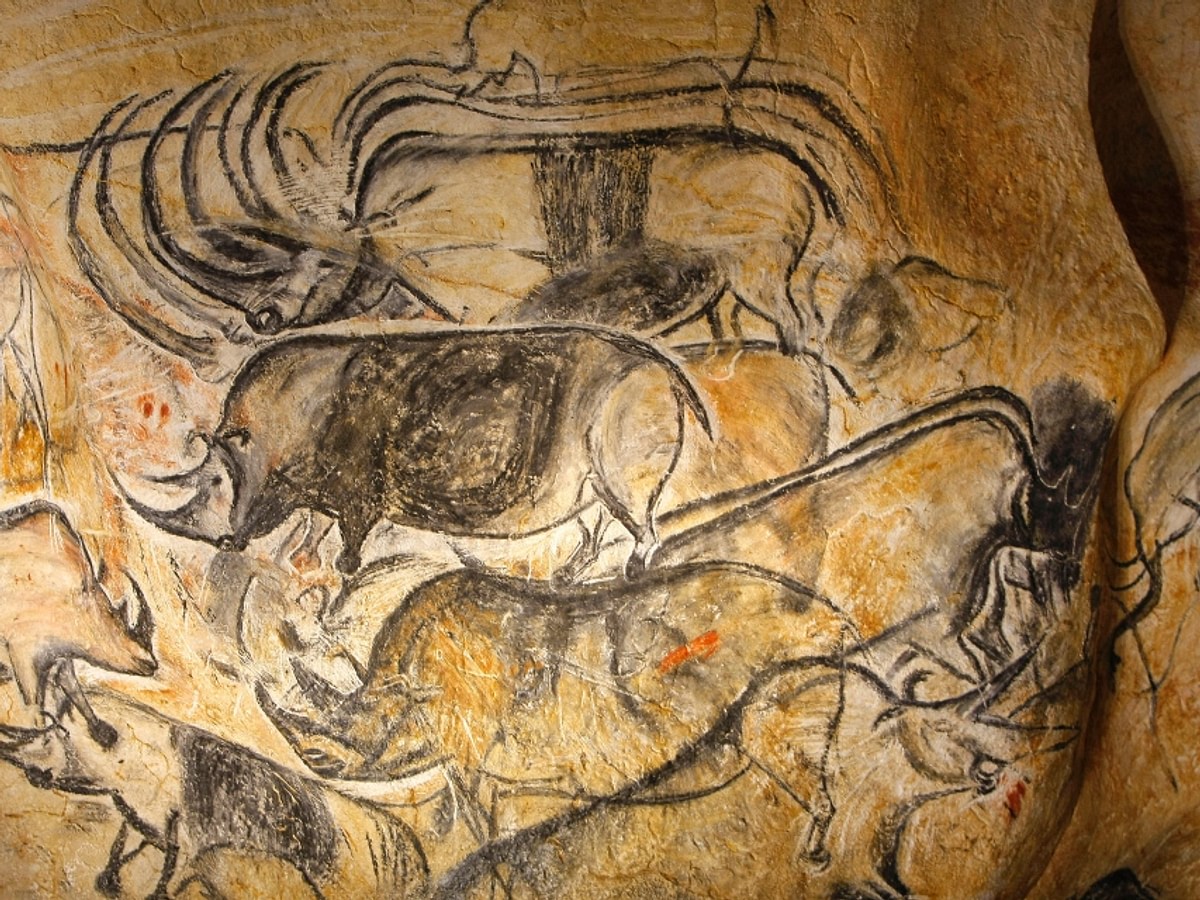
But before I talk about that, I want to talk about the image on the card and where it actually comes from.
Asia SulerHOST
So this image of the woolly rhinoceros comes from Chauvet Cave.
Asia SulerHOST
So Chauvet Cave was discovered in 1994.
Asia SulerHOST
So it was relatively recent in terms of a discovery.
Asia SulerHOST
And it's home to some of the oldest known cave art in the world.
Asia SulerHOST
But here we found this cave art that was 36,000 years old, and we see that this tradition continued forever.
Asia SulerHOST
for tens of thousands of years and that our ancestors were making art much further back than we had anticipated.
Asia SulerHOST
And so this was a landmark find, Chauvet Cave.

Maarten PeelsGUEST
It's 18 minutes long.
Maarten PeelsGUEST
And it was inspired by the cave art of Chauvet Cave in southern France, as well as the flutes found in Swabia in southern Germany, such as in Holefels and Geissenklösterle.
Maarten PeelsGUEST
And the film follows a shaman and his friend, on a dream quest to make a new cave painting.
Maarten PeelsGUEST
That's basically what happens in the film.
23 MINS LATER
Maarten PeelsGUEST
There are several paintings or drawings that have different outlines, like the legs.
Maarten PeelsGUEST
You showed the bison that I copied for the beginning of the film.
Maarten PeelsGUEST
There's another one in Chauvet, which is the one that got me going on this project, but has like eight legs.
Maarten PeelsGUEST
Also seemed to show movement.