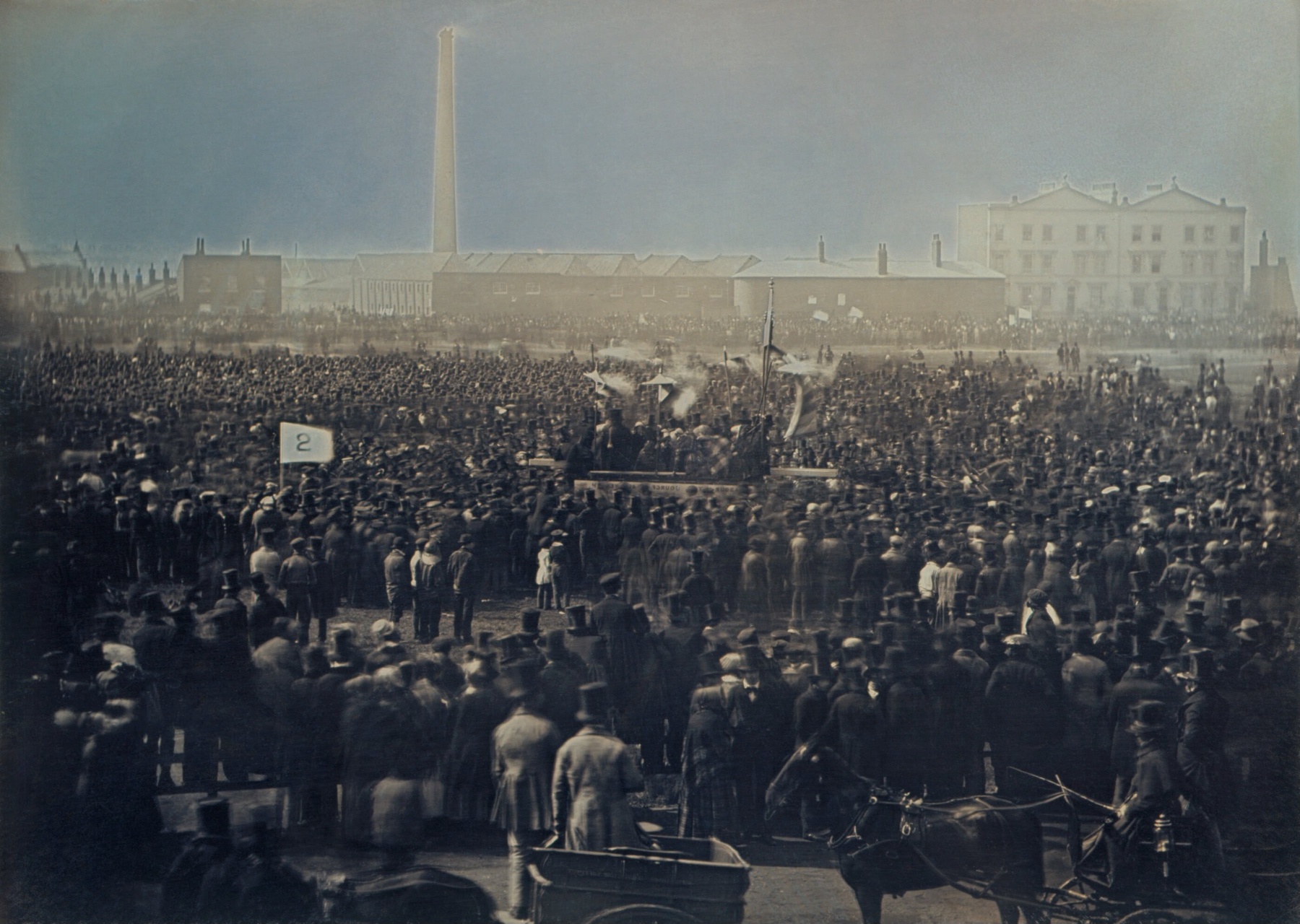
Chartism
48
MENTIONS
29
EPISODES
26
PODCASTS
Search complete. 48 mentions across 29 episodes found for "Chartism".
Nov 22, 2026

Michelle EatonNARRATOR
It was a battle of the rich against the poor, of the masters against the men, of right against might.
Michelle EatonNARRATOR
England was a sick nation, at war with itself, and Chartism and the Chartists were some of the signs of the disease.
Michelle EatonNARRATOR
The early Victorian age is the age of Thomas Carlyle, the stern, grim prophet who, undaunted by poverty and ill health, painted England in dark colours as a country hastening to its ruin.
Michelle EatonNARRATOR
His message was old and yet new.
25 MINS LATER
Michelle EatonNARRATOR
The meeting in London to present a petition to Parliament proves a failure.
Michelle EatonNARRATOR
1853-56.
Michelle EatonNARRATOR
Years of prosperity owing to free trade and growth of intelligence among the working classes prove the chief causes of the death of Chartism.
Michelle EatonNARRATOR
The workers now begin to aim at reforms through their trade unions.

Aya Fubara EneliHOST
He was a tailor whose father had been born a slave in St. Kitts.
Aya Fubara EneliHOST
And by 1848, he was the leader of the Chartists, the working people who wanted to vote for every man we have always been fighting back.
Aya Fubara EneliHOST
And the Times, well, they sneered at the black man and his party.
Aya Fubara EneliHOST
In that summer, he was convicted on the word of police spies and transported for life.

Jamie HeywoodGUEST
There was no voice that the individuals had.
Jamie HeywoodGUEST
The second half of the Industrial Revolution After they had the Chartist movement, effectively the franchise was increased, you had the Labour Party, you had the birth of unions.
Jamie HeywoodGUEST
Those created a sort of political counterweight that proved incredibly healthy.
Jamie HeywoodGUEST
And interestingly, the rate of productivity growth, the rate of innovation was equal throughout.

Deborah BrabinNARRATOR
It sprang up with particular vigour in the years immediately following the Great Reform Bill, and it has been remarked that disappointment of the hopes which that measure had cherished had something to do with its bitterness.
Deborah BrabinNARRATOR
as it went on obvious causes for failure were developed in it self-seeking leadership futile discussion of the means of making the change before organisation of the party was perfected blind fear of ultimate consequences on the part of some blind disregard to immediate consequences on the part of others these were the surface reasons for its failure but it would have triumphed over all these and accomplished revolution in england if it had not been for causes deeper and more vital than these Chartism differed from mere radicalism in being a class movement, but its aim was after all political rather than social.
Deborah BrabinNARRATOR
The socialism of Robert Owen fell short of its object because it did not understand that as long as there is a privileged class in possession of the executive power, they will take good care that their economical position, which enables them to live on the unpaid labour of the people, is not tampered with.
Deborah BrabinNARRATOR
The hopes of the Chartists were disappointed because they did not understand that true political freedom is impossible to people who are economically enslaved.
Deborah BrabinNARRATOR
These two aims united mean the furthering of the class struggle till all classes are abolished.
Deborah BrabinNARRATOR
The divorce of one from the other is fatal to any hope of social advancement.
Deborah BrabinNARRATOR
Chartism, therefore, though a genuine popular movement, was incomplete in its aims and knowledge.
Deborah BrabinNARRATOR
The time was not yet come, and it could not triumph openly.

Michelle EatonNARRATOR
1853-56.
Michelle EatonNARRATOR
Years of prosperity owing to free trade and growth of intelligence among the working classes proved the chief causes of the death of Chartism.
Michelle EatonNARRATOR
The workers now begin to aim at reforms through their trade unions.
Michelle EatonNARRATOR
The cooperative movement set on foot in Rochdale in 1844 leads to the formation of many other branches.
Michelle EatonNARRATOR
Thomas Carlyle, 1795-1881.
Michelle EatonNARRATOR
His writings, more than those of any other man, give us a key to the meaning of the early Victorian age.
Michelle EatonNARRATOR
1839 Chartism 1841 Heroes and Hero Worship 1843 past and present 1850 latter-day pamphlets charles dickens 1812 to 1870 1836 pickwick papers 1838 oliver twist the evils of the workhouse 1850 david copperfield contains sketches of dickens early life 1853 hard times 1857, Little Dorrit, the Marshallsea Prison for debtors.
Michelle EatonNARRATOR
Disraeli, Lord Beaconsfield, 1804-1881.

Alistair BeggSOUNDBITE_SPEAKER
I don't want to take time with him except to recount this.
Alistair BeggSOUNDBITE_SPEAKER
that I remember he would be working with us through something like the Chartists movement in the 19th century that went on for a while.
Alistair BeggSOUNDBITE_SPEAKER
And he used to sit up on the window ledge and try not to fall asleep as he was putting us to sleep.
Alistair BeggSOUNDBITE_SPEAKER
And eventually, he said to us, "'Now, listen here, lads.

Owen JonesGUEST
Yeah, and, you know, these people have contempt for their own country, actually.
Owen JonesGUEST
Because why are we celebrating... all the terrible evil injustices that the people at the top did? Why aren't we celebrating what ordinary people did throughout our history to fight for our rights and our freedoms? Why aren't we celebrating the levelers and the diggers in the English Revolution who stood up for democracy and socialism in a primitive way way back in the 17th century? Why aren't we celebrating the Chartists, the world's first great working class political movement, the suffragettes? who fought for the rights of women, who were vilified as terrorists, much like Palestine Action are today, I have to say, you know, thrown into dirty cells and force-fed and brutally attacked by the police and deemed as hateful terrorists and all the rest.
Owen JonesGUEST
Why aren't we celebrating the trade unionists who fight for the rights of workers? Why aren't we celebrating the LGBTQ activists who fought for their rights or the people who fought racism? You know, that's the history we should be proud of.
Owen JonesGUEST
People who stood against what seemed like insurmountable odds, who had everything thrown at them, but who had courage, determination and who were visionaries.

speaker_2NARRATOR
The first fruits of these studies was a series of articles in the New York Tribune, in which I proved Palmerston's relations with the Russian government.
speaker_2NARRATOR
Shortly after, these studies were reprinted in the Chartist organ edited by Ernest Jones, the People's Paper.
speaker_2NARRATOR
Meantime, the Glasgow Sentinel had reproduced one of these articles, and part of it was issued in pamphlet form by Mr. Tucker, London, end quote.
speaker_2NARRATOR
and the sheffield foreign affairs committee thanked marx for the great public service rendered by the admirable expose in his cars papers published both in the new york tribune and the people's paper a large number of articles on the subject were also printed in the free press by marx's old friend c d collet i hope to republish these and other articles As to the New York Tribune, it was at this time an admirably edited paper, with an immense staff of distinguished contributors, both American and European.
speaker_12NARRATOR
advocated moral suasion,
speaker_4NARRATOR
The Chartists favored force, physical or political.
speaker_4NARRATOR
The Marxists talked revolution and remembered the Paris Commune.
speaker_4NARRATOR
George wrote in a land where the people ruled themselves,
2 HRS 13 MINS LATER
speaker_5NARRATOR
The socialism of the Social Democratic Federation and the Socialist League, the two societies which had hitherto represented socialism
speaker_4NARRATOR
to the general public, was altogether revolutionary.
speaker_4NARRATOR
Socialism was to be the result of an outbreak of violence engineered by a great popular organization like that of the Chartists or the Anti-Corn Law League, and the Commune of Paris in 1871 was regarded as a premature attempt which pointed the way to future success.
speaker_4NARRATOR
The socialist government thus established was

Sebastian MilbankGUEST
No, it's not.
Sebastian MilbankGUEST
But I think it ought to be more so, because one thing that we learn from history, you know, if you go back and look in Chartism, you look at the men who served in the wars, you look at the struggle for democracy in this country, it's that Young men and women could go out, they could claim agency over their lives and over their society, and they could change things for the better.
Sebastian MilbankGUEST
People didn't become more prosperous.
Sebastian MilbankGUEST
They didn't start earning their home younger in the 60s and 70s out of nowhere.
19 more episodes mention Chartism.
Create an account to see the whole feed, search across every transcript, and follow the entities you care about.