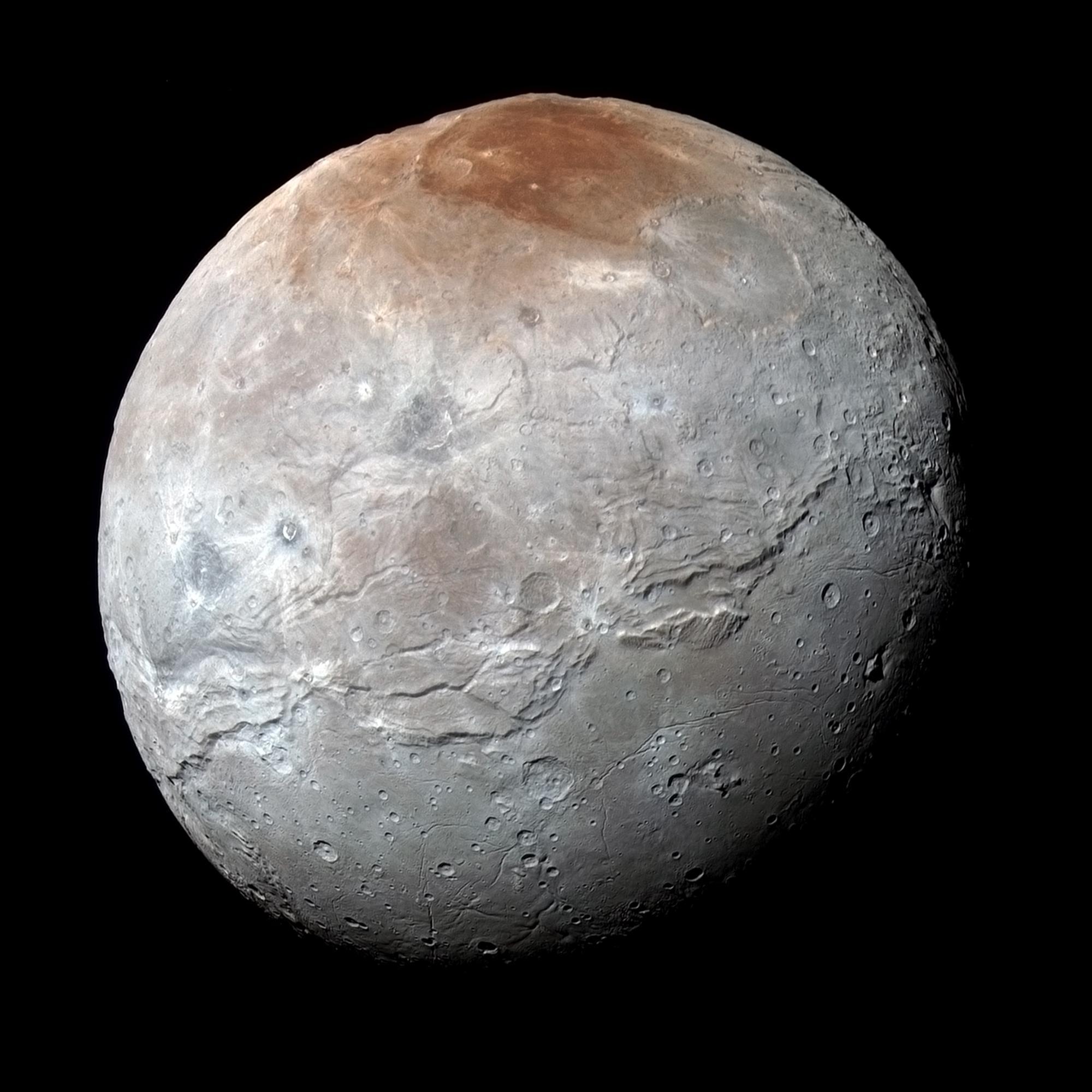
Charon

Charon

Natural satelliteWikipedia

Search complete. 70 mentions across 9 episodes found for "Charon".

Sep 2, 2026

Unknown podcast

How Long Would It Take to Reach the Kuiper Belt

Sep 2 · 8 Mentions

speaker_3NARRATOR
64:02
The mission concept used a conventional chemical rocket to launch the spacecraft and a Jupiter gravity assist to send it toward the outer solar system, then switch to electric propulsion for the long, slow deceleration as it approached the Pluto system.
speaker_3NARRATOR
64:17
The study found that the spacecraft could enter orbit around Pluto and conduct a comprehensive survey of the entire system, including close-up studies of Charon and the four smaller moons, Nix, Hydra, Kerberos and Styx.
speaker_3NARRATOR
64:32
An orbiter could observe Pluto through all seasons and lighting conditions, map the entire surface at high resolution rather than the single hemisphere New Horizons captured, monitor weather patterns and atmospheric changes over years, and study how nitrogen ice migrates across the surface in response to the faint but measurable cycle of Pluto's seasons.
speaker_3NARRATOR
64:52
The scientific return from an orbiter would be comparable to what Cassini achieved at Saturn, or what the Mars Reconnaissance Orbiter continues to achieve at Mars.
speaker_3NARRATOR
65:15
The travel time to Pluto alone, using the slow, fuel-efficient electric propulsion trajectory, would be measured in decades rather than the nine and a half years New Horizons achieved.
speaker_3NARRATOR
65:26
The spacecraft would spend years decelerating as it approached, trading speed for the ability to stop, and even after entering orbit, the low-thrust propulsion system would need years more to maneuver through the Pluto system.
speaker_3NARRATOR
65:39
Using a combination of electric propulsion burns and gravity assists from Charon to change its orbital parameters, the Charon assist concept is one of the study's most innovative ideas.
speaker_3NARRATOR
65:50
Charon, Pluto's largest moon, orbits at a distance of roughly 12,000 miles from Pluto, with an orbital period of about six and a half days.

Unknown podcast

The Terrifying Reality of the Kuiper Belt

Sep 1 · 15 Mentions

speaker_1NARRATOR
31:07
Its surface is a patchwork of nitrogen ice, methane frost and carbon monoxide ice, sculpted by processes that scientists are still working to understand.
speaker_1NARRATOR
31:17
It has five known moons, the largest of which, Charon, is so big relative to Pluto that the two orbit a common centre of gravity located in empty space between them.
speaker_1NARRATOR
31:29
The Pluto-Charon system is sometimes described as a binary world rather than a planet and moon, a gravitational partnership unique among known solar system bodies.
speaker_1NARRATOR
31:39
But Pluto is not the only dwarf planet in the Kuiper belt.
speaker_1NARRATOR
31:43
Eris, discovered in 2005, has a diameter of approximately 2,326 kilometres, making it almost the same size as Pluto, though slightly more massive.

39 MINS LATER

speaker_1NARRATOR
71:02
The atmosphere inflates and deflates over centuries, rising and falling like a slow cosmic breath.
speaker_1NARRATOR
71:09
At its most distant orbital point, the atmosphere may collapse almost entirely, freezing out onto the surface as a thin frost.
speaker_1NARRATOR
71:18
Charon, Pluto's largest moon, presented its own set of revelations that proved almost as scientifically disorienting as the discoveries on Pluto itself.

Unknown podcast

Kuiper Belt_ The Invisible Frontier Beyond Neptune

Sep 1 · 8 Mentions

speaker_0NARRATOR
22:50
It was tilted 17 degrees off the ecliptic, rising far above and below the plane where the other planets travel.
speaker_0NARRATOR
22:57
Its largest moon, Charon, was so big relative to Pluto itself that the two objects orbited a shared centre of gravity located in the space between them, a true binary system rather than a planet with a subordinate satellite.
speaker_0NARRATOR
23:11
Everything about Pluto was strange when measured against the eight planets, but that strangeness vanished the moment astronomers recognised the Kuiper belt.
speaker_0NARRATOR
23:20
Pluto was not a misfit planet.

7 MINS LATER

speaker_0NARRATOR
29:57
Nitrogen ice sublimates from sunlit regions, travels through the atmosphere and refreezes on colder surfaces in a cycle that slowly reshapes the terrain over millions of years.
speaker_0NARRATOR
30:07
On a world smaller than Earth's moon, orbiting in the deep freeze of the outer solar system, active atmospheric and glacial processes are reshaping the landscape in real time.
speaker_0NARRATOR
30:17
New Horizons also transformed our understanding of Charon, Pluto's largest moon.
speaker_0NARRATOR
30:23
Charon is 750 miles across more than half Pluto's diameter, making the Pluto-Charon system the most extreme binary in the solar system relative to the sizes of its two members.

Unknown podcast

The Space Beyond Neptune is Worse Than You Think

Sep 1 · 4 Mentions

speaker_3NARRATOR
39:32
A world with a collapsing atmosphere that will rebuild itself centuries later is not a dead world.
speaker_3NARRATOR
39:38
Charon, Pluto's largest moon, added its own set of surprises that deepened the story.
speaker_3NARRATOR
39:43
At roughly 1200 kilometers in diameter, about half the size of Pluto-Chiron is large enough that the Pluto-Chiron system is sometimes called a double dwarf planet.
speaker_3NARRATOR
39:54
The two bodies orbit a common center of gravity located in the space between them, locked in a mutual tidal embrace where the same face of Chiron always points toward Pluto.
speaker_3NARRATOR
40:38
Argo Chasma, in the southern hemisphere, appears to reach depths of nine kilometers based on shadow measurements, making it one of the deepest known canyons in the solar system relative to the size of the body it crosses.
speaker_3NARRATOR
40:50
These are not impact features.
speaker_3NARRATOR
40:52
They are tectonic fractures, cracks formed when Charon's crust was pulled apart by forces originating from within.
speaker_3NARRATOR
40:58
The most likely explanation is ice expansion.

Unknown podcast

James Webb Just Scanned Pluto for The First Time _ And It_s Horrifying

Aug 31 · 24 Mentions

speaker_4NARRATOR
6:24
Then, in 1978, astronomers discovered that Pluto had a companion, a large moon, roughly half Pluto's own diameter, orbiting so close that the two bodies are effectively a double system.
speaker_4NARRATOR
6:38
The moon was named Charon after the ferryman of the dead in Greek mythology, and its discovery immediately complicated the simple picture of Pluto as a lonesome drifter.
speaker_4NARRATOR
6:48
This was not just a rock with a rock orbiting it, this was a gravitationally locked pair, tidally bound so that the same faces always point toward each other, spinning together through the darkness like two dancers frozen in position.
speaker_4NARRATOR
7:02
In the decades that followed, astronomers discovered four more tiny moons, detected hints of an atmosphere through stellar occultation measurements and began to suspect that the surface contained exotic ices frozen solid at temperatures that defy human experience.
speaker_4NARRATOR
11:44
What it could not do is watch Pluto change.
speaker_4NARRATOR
11:47
It could not measure the thermal glow of the surface and atmosphere in the mid-infrared wavelengths where heat radiation reveals temperature variations across the globe.
speaker_4NARRATOR
11:56
It could not separate Pluto's faint thermal signal from Charon's at those wavelengths because the two bodies are so close together and so far from Earth that their infrared emissions blend into a single unresolved source for any instrument operating from near-Earth space.
speaker_4NARRATOR
12:12
It could not observe the haze over time to determine whether those organic particles were actively heating and cooling the atmosphere or merely floating passively in the sky.
Paul ByrneGUEST
7:28
It's got at least five.
Paul ByrneGUEST
7:29
But its biggest moon, called Charon, or Charon, or Charon, or C- there's about 15 ways to say it.
Emile DonovanHOST
7:34
Uh-huh.
Paul ByrneGUEST
7:35
But Pluto's biggest moon doesn't technically, and we're getting into real technicality here, but this is why, this is what underpinned this vote.
Paul ByrneGUEST
7:59
So for all intents and purposes, practically speaking, the Moon goes around Earth.
Paul ByrneGUEST
8:04
But strictly speaking, it doesn't.
Paul ByrneGUEST
8:06
This shared point in space between Pluto and its largest moon, Charon, is actually physically outside Pluto, and that, the reason for that is because where two objects orbit each other is a, is a kind of a trade-off of how big they are and how far apart they are, and Charon's pretty big as moons go.
Paul ByrneGUEST
8:21
It's actually s- it's actually the largest moon to a larger primary, uh, i- in the solar system.

Unknown podcast

The True Scale of the Universe_ How Small Is Earth Really_

Aug 24 · 3 Mentions

KeithNARRATOR
31:32
Pluto is small, only about one thousand four hundred seventy-three miles across, but it's fascinating.
KeithNARRATOR
31:40
It has five known moons, the largest being Charon, which is about half Pluto's size.
KeithNARRATOR
31:47
Pluto and Charon are so close in size that they're sometimes called a binary system.
KeithNARRATOR
31:53
They orbit a point in space between them rather than Charon simply orbiting Pluto.
KeithNARRATOR
31:59
NASA's New Horizons spacecraft flew past Pluto in July twenty fifteen, giving us our first close-up views.
KeithNARRATOR
32:09
The images revealed a complex world with mountains made of water, ice, vast plains of frozen nitrogen, and a thin atmosphere that extends much farther than expected.

Unknown podcast

Percival Lowell: Martian Canals, Pluto, and Grand Errors

Aug 18 · 2 Mentions

Chuck BryantHOST
16:41
As time went on, our ability to measure the cosmos advanced.
Chuck BryantHOST
16:44
In 1978, Pluto's moon, Charon, was discovered.
Chuck BryantHOST
16:48
By observing how Charon and Pluto orbited their common center of gravity, scientists could finally determine Pluto's exact mass.
Josh ClarkHOST
16:55
Wait, if Pluto's mass is tiny, its gravitational pull is negligible.
Chuck BryantHOST
16:58
Exactly.
Fred WatsonGUEST
7:33
Uh, it's about half the size of Pluto, actually.
Fred WatsonGUEST
7:35
It's called Charon, uh, or Charon, not Sharon.
Fred WatsonGUEST
7:39
Some people call it Sharon.
Andrew DunkleyHOST
7:40
They do.
Andrew DunkleyHOST
7:41
[laughs]
Fred WatsonGUEST
7:41
[laughs] Charon.
Fred WatsonGUEST
7:43
Uh-
Andrew DunkleyHOST
7:43
Char's for short.

We value your privacy

We use cookies to understand how you use our platform and to improve your experience. Click “Accept All” to consent, or “Decline non-essential” to opt out of non-essential cookies. Read our Privacy Policy.