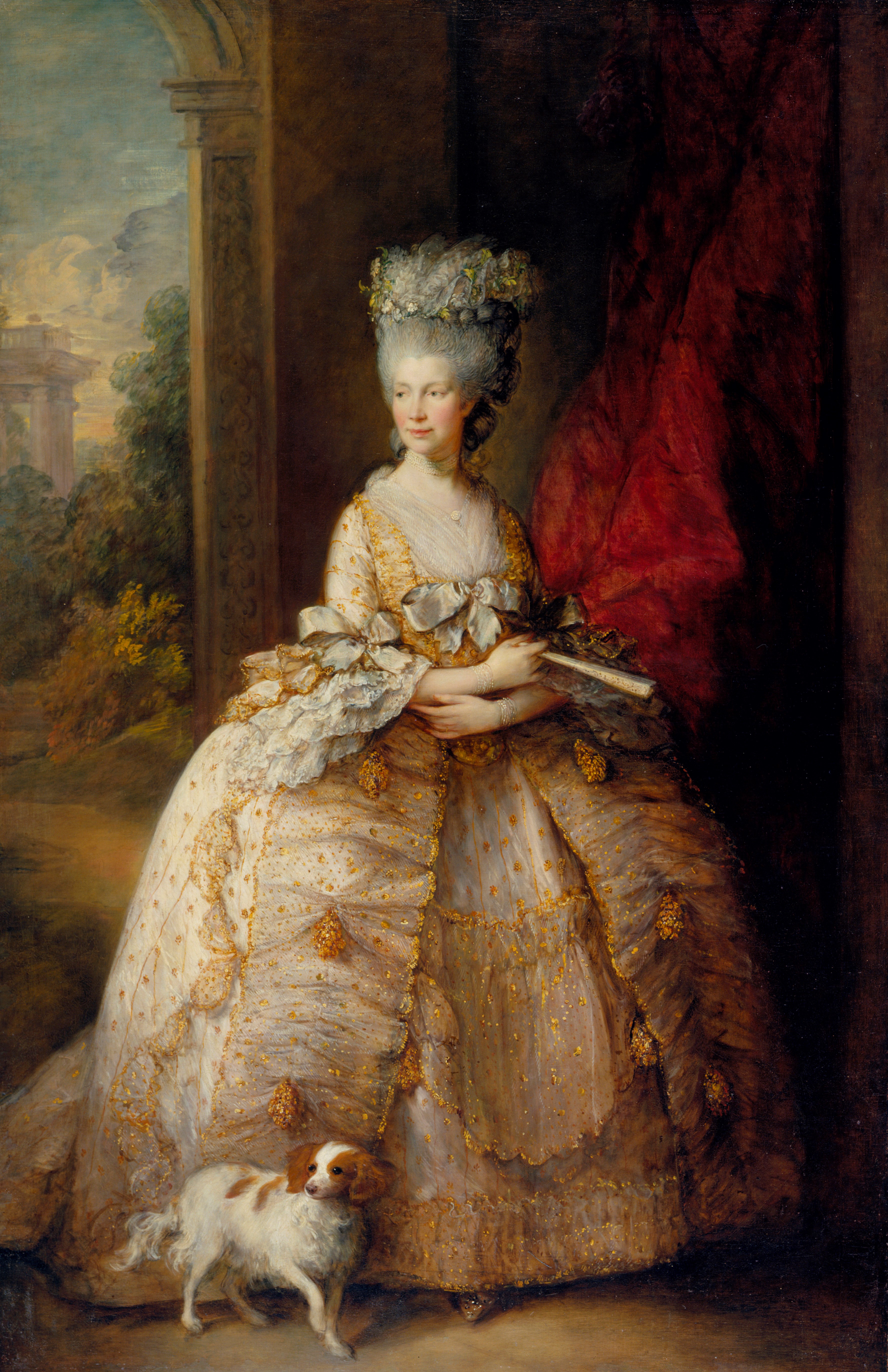
Charlotte of Mecklenburg-Strelitz
Former Queen consort of the United KingdomWikipedia
81
MENTIONS
30
EPISODES
25
PODCASTS
Search complete. 81 mentions across 30 episodes found for "Charlotte of Mecklenburg-Strelitz".
Sep 18, 2026

Benjamin BosterHOST
Early puzzles, known as dissections, were produced by mounting maps on sheets of hardwood and cutting along national boundaries, creating a puzzle useful for teaching geography.
Benjamin BosterHOST
Royal governess Lady Charlotte Finch used such dissected maps to teach the children of King George III and Queen Charlotte.
Benjamin BosterHOST
Cardboard jigsaw puzzles appeared in the late eighteen hundreds, but were slow to replace wooden ones because manufacturers felt the cardboard puzzles would be perceived as low quality, and because profit margins on wooden jigsaws were larger.
Benjamin BosterHOST
The name jigsaw came to be associated with the puzzle around eighteen eighty, when fretsaws became the tool of choice for cutting the shapes.

Jann ArdenHOST
You know, I don't know if there was any Bridgerton fans out there, but Shonda very much also wants to bring this re-envisioning of history and of classic stories.
Jann ArdenHOST
So Queen Charlotte, and you know what a history buff I am.
Jann ArdenHOST
I do.
Jann ArdenHOST
I'm very much into Tudor history, but Queen Charlotte, who was married to King George, and everybody knows him because they called him Mad King George.
Jann ArdenHOST
He had I mean, when they look at his health now, he had all kinds of bipolar or manic depressive or all these things.
Jann ArdenHOST
But obviously, Queen Charlotte was not a person of color.
Jann ArdenHOST
But Shonda Rhimes reimagined this whole story, and it is fantastical.
Jann ArdenHOST
So I love that story.

Chuck DransfieldHOST
What was that about?
Whimsy AndersonHOST
What's that about? Oh, Bridgerton is a mockumentary on Queen Charlotte, but the Queen Charlotte is pretty accurate.
Whimsy AndersonHOST
The film, the miniseries, is that? Whatever they call it.
Whimsy AndersonHOST
Yeah, you guys can, we'll see it.

speaker_5NARRATOR
He hardly ever alluded to them.
speaker_5NARRATOR
I remember, indeed, that he once mentioned to me Queen Charlotte, calling her that bad woman.
speaker_5NARRATOR
He was very shy and disliked being stared at.
speaker_5NARRATOR
Windham and I accompanied him one night to Vauxhall, where he was much annoyed at being followed about as a spectacle from place to place.

MelanieHOST
So we're not jumping around.
MelanieHOST
So we're going to start with technically we're starting with Queen Charlotte and we're just going to go briefly over her.
MelanieHOST
She was Queen Victoria's grandmother and she married, who was it? King Charles II? King George III.
MelanieHOST
King George III.
MelanieHOST
I want to know the real things.
MelanieHOST
Yes.
MelanieHOST
queen charlotte was is the person that people attribute with bringing pomeranians to britain or do we say the uk is it just the uk that she because i know that things got weird with territories and commonwealths and things like that so i'm just going to say the uk okay for this yeah yeah just to make it easy and So she brought Pomeranians there and she also started the tradition of gifting Pomeranians to her peers.
MelanieHOST
So like ladies in waiting or certain other women who had the same status so that she was able to spread the Pomeranians out throughout the UK and they became very, very popular for that.

Ann FosterGUEST
But she ended up in a horrible marriage.
Ann FosterGUEST
And she, because of her outsider status, like coming from Germany even, like she was, which is funny because the Queen was also from Germany, Queen Charlotte.
Ann FosterGUEST
But Caroline was, she was ostracized from the royal family, mostly because Prinny did not like her.
Ann FosterGUEST
Queen Charlotte did not like her.
Ann FosterGUEST
And Part of that was because Caroline was what we would say today.
Ann FosterGUEST
I don't know.
Ann FosterGUEST
And that just kind of was inconvenient for a lot of people.
Carol Ann LloydHOST
Right.

Andrew M. HenryHOST
By the 1800s, the Christmas tree grew increasingly popular outside of Germany.
Andrew M. HenryHOST
The practice got a big boost in England from Queen Charlotte, the German wife of King George III, who decorated Windsor Castle with a Christmas tree in the year 1800.
Andrew M. HenryHOST
And an image published by the Illustrated London News went viral in 1848, which showed Queen Victoria with her German husband Prince Albert with a Christmas tree.
Andrew M. HenryHOST
And with the help of German immigration and mass media, the Christmas tree took off in the United States.
speaker_7NARRATOR
She has given up, he said, five years of her pen.
speaker_6NARRATOR
that during those five years she might without painful exertion without any exertion that would not have been a pleasure have earned enough to buy an annuity for life much larger than the precarious salary which she received at court is quite certain the same income too which in st martin's street would have afforded her every comfort must have been found scanty at st james's We cannot venture to speak confidently of the price of millinery and jewellery, but we are greatly deceived if a lady who had to attend Queen Charlotte on many public occasions could possibly save a farthing out of a salary of 200 a year.
speaker_6NARRATOR
The principle of the arrangement was in short simply this, that Francis Burney should become a slave and should be rewarded by being made a beggar.
speaker_6NARRATOR
with what object their majesties brought her to their palace we must own ourselves unable to conceive their object could not be to encourage her literary exertions for they took her from a situation in which it was almost certain that she would write and put her into a situation in which it was impossible for her to write Their object could not be to promote her pecuniary interest, for they took her from a situation where she was likely to become rich, and put her into a situation in which she could not but continue poor.
speaker_6NARRATOR
And the Frances
speaker_7NARRATOR
Burney ought to be full of gratitude for being permitted to purchase, by the surrender of health, wealth, freedom, domestic affection and literary fame, the privilege of standing behind a royal chair and holding a pair of royal gloves.
speaker_7NARRATOR
And who can blame them? Who can wonder that princes should be under such a delusion when they are encouraged in it by the very persons who suffer from it most cruelly? Was it to be expected that George III and Queen Charlotte should understand the interest of Fanny Burney better, or promote it with more zeal than herself and her father?
speaker_6NARRATOR
No deception was practised.

Betty B.NARRATOR
I read Young People every week.
Betty B.NARRATOR
The answer to the personation in number 24 is Queen Charlotte of England, wife of George III.
Betty B.NARRATOR
She was married in 1761 and died in 1818.
Betty B.NARRATOR
The town in which I live is named for her.
11 MINS LATER
Betty B.NARRATOR
Number six, Montcalm.
Betty B.NARRATOR
Decapitated charade on page 328, prelate.
Betty B.NARRATOR
A personation on page 328, Queen Charlotte Sophia, wife of George III of England.
Betty B.NARRATOR
Favors are acknowledged from Gracie Allen, John W. Gebhardt, Grace Whitney, Walter Vassar, Earn Werner, Edna Hamilton, Correct answers to puzzles are received from Louise Goff, Mae Burt, Vanderbilt Olmsted, Fanny and Florence M, G.W. Raymond, Lulu Pierce, Susie Benedict, Camilla W.M., Bertie Randolph, Eva Castle, Elcina Murphy, Cora M. McKay, Barrett Eastman, North Star, and Little Lizzie, Carrie March, Jay McClintock, Bertha Colombe, G.C. McIntosh, Alice Hammond, A.A.
20 more episodes mention Charlotte of Mecklenburg-Strelitz.
Create an account to see the whole feed, search across every transcript, and follow the entities you care about.