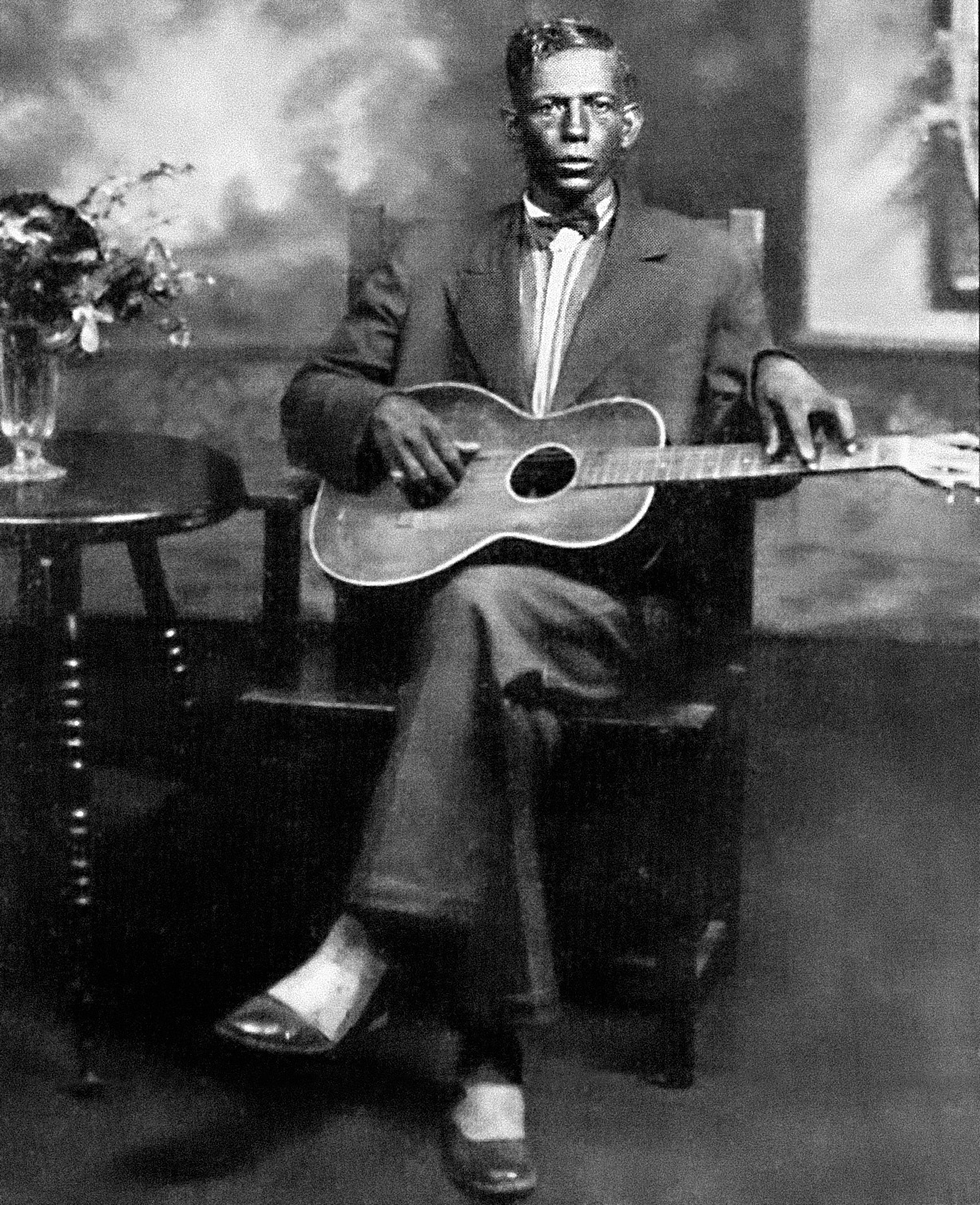
Charley Patton
American musician and songwriterWikipedia
40
MENTIONS
13
EPISODES
11
PODCASTS
Search complete. 40 mentions across 13 episodes found for "Charley Patton".
Nov 21, 2026

Ben MartinHOST
Eric Clapton's Unplugged stuff is also really fantastic.
Ben MartinHOST
I mean, there's an endless list really of Skip James, endless list of these guys, Charlie Patton, you know, you can just go on and on and on.
Ben MartinHOST
But it's really important to study their music.
Ben MartinHOST
And it doesn't mean you have to learn like every Charlie Patton song, although that would be a cool thing to do.
Ben MartinHOST
But just listen to it.
Ben MartinHOST
And when you're listening to it, listen to the guitar playing.

Norbert KrapfGUEST
I had not ever seen cotton growing and pulled off the road and walked and reached down to break off stalks to bring them back to Indianapolis with me so I could remember how hard it had to be to pick whole fields of it by hand all day long.
Norbert KrapfGUEST
When I wake and see these soft white bowls of cotton that is in my bedroom, I see, I hear sun housed and Charlie Patton and Robert Johnson and Muddy Waters and B.B. King calling up deep from their souls the blues that rose up in them from fields in which I visited by myself feeling transported back in time to slaves reciting call and response songs in code telling tales of misery but also gritty determination to survive together and one day leave these fields of white bowls behind as they would bring north the sounds of the 12-bar blues as they began a new life, yet haunted by the memory of bowls of white they once had picked all day in fields.
Norbert KrapfGUEST
So there.
speaker_2NARRATOR
And
Norbert KrapfGUEST
ahead.
Norbert KrapfGUEST
Okay, well, let's see.
Norbert KrapfGUEST
This is Sun House and Charlie Patton in Lula.
Norbert KrapfGUEST
And that's an old town.

Woody SistrunkGUEST
don't think it was.
Woody SistrunkGUEST
I, and I, and I can't Charlie Patton.
Woody SistrunkGUEST
Probably, probably
Steve AzarHOST
handy, but it's like, yeah, but it was that, or those two obviously were probably Charlie was first, I would imagine.

AndreVOICE_ACTOR
It is time for your favorite part of the show, Andre Karaoke.
AndreVOICE_ACTOR
This song is called High Water for Charlie Patton.
AndreVOICE_ACTOR
Here you go.
AndreVOICE_ACTOR
I hope you like the banjo.

Georgette FryGUEST
Because before that, I basically hadn't listened to anything before Robert Johnson.
Georgette FryGUEST
So here I learned all about, you know, Blind Lemon Jefferson and Willie McTell and all these, and Charlie Patton, who started it all.
Georgette FryGUEST
So that really broadened my horizons.
Georgette FryGUEST
And then when I lived in London, so yeah, I had three bands on the go.

Jimbo "Big Train" MadsenHOST
Delta Blues legend Bucca White was a powerful singer and guitarist, known for his driving rhythms and fierce slide playing.
Jimbo "Big Train" MadsenHOST
Born November 12, 1906, in Houston, Mississippi, he learned guitar as a young boy and later crossed paths with Charlie Patton in Clarksdale.
Jimbo "Big Train" MadsenHOST
A cousin of B.B. King's mother, White also pursued baseball and boxing before establishing his enduring place in blues history.
Jimbo "Big Train" MadsenHOST
New Orleans singer Lulu Barker brought a playful, sophisticated style to blues and jazz, often performing alongside her husband, guitarist Danny Barker.

Grant StovelHOST
My name's Grant Stovel.
Grant StovelHOST
They're a band that can cite influences ranging from punk and metal icon Glenn Danzig to 1920s and 30s Mississippi blues legend Charlie Patton in literally the same breath.
Grant StovelHOST
They get into their youth in this conversation and how the scene and punk rock helped make them who they are today.
Grant StovelHOST
And who they are is a pair of fascinating folks.
6 MINS LATER
Jasmine ColletteGUEST
I mean, that's, that's in our core, you know, punk, the punk spirit and the energy of that music.
Jasmine ColletteGUEST
And even if you go back, I was talking earlier about pulling back the layers of music and the history and who's listening to what, and you can go to like one of our favorite places.
Jasmine ColletteGUEST
Bands with the Misfits, and you look at someone like Glenn Danzig, who talks about, you know, Howlin' Wolf, and Howlin' Wolf talks about Charlie Patton, who's known as the godfather of Delta Blues, but to me, he's like the first punk rocker.
speaker_3UNKNOWN
Mm-hmm.

Grant StovelHOST
My name's Grant Stovel.
Grant StovelHOST
They're a band that can cite influences ranging from punk and metal icon Glenn Danzig to 1920s and 30s Mississippi blues legend Charlie Patton in literally the same breath.
Grant StovelHOST
They get into their youth in this conversation and how the scene and punk rock helped make them who they are today.
Grant StovelHOST
And who they are is a pair of fascinating folks.
6 MINS LATER
Jasmine ColletteGUEST
I mean, that's, that's in our core, you know, punk, the punk spirit and the energy of that music.
Jasmine ColletteGUEST
And even if you go back, I was talking earlier about pulling back the layers of music and the history and who's listening to what, and you can go to like one of our favorite places.
Jasmine ColletteGUEST
Bands with the Misfits, and you look at someone like Glenn Danzig, who talks about, you know, Howlin' Wolf, and Howlin' Wolf talks about Charlie Patton, who's known as the godfather of Delta Blues, but to me, he's like the first punk rocker.
speaker_3UNKNOWN
Mm-hmm.

Nate WilcoxHOST
But I think the key thing is that this was a new form, and this was very modern music.
Nate WilcoxHOST
And even though Johnson was kind of a latecomer, and you know was a decade recording almost a full decade after people like charlie patton he was still wrestling with the la the newest and the latest if that if that makes sense yeah i mean
Yuri CampbellGUEST
i i you know you made several points there and i think that johnson himself i think his his sort of blues approach was almost anachronistic or it was kind of out of season right i mean like part of the part of his lack of commercial success or widespread notoriety during his time was that blues wasn't really ascendant at that point.
Yuri CampbellGUEST
And for whatever reason, he primarily recorded blues songs.
11 MINS LATER
Nate WilcoxHOST
So let's jump in there and talk about how does commercial success work? Because, you know, Elijah Wald tells a story in the book and kind of his epiphany came when he was teaching a music class about Robert Johnson and about the Delta Blues.
Nate WilcoxHOST
And most of the students had heard of Robert Johnson, but he didn't start with Robert Johnson because he was teaching in historical order.
Nate WilcoxHOST
So he starts with people like Skip James and Charlie Patton, who are Johnson's immediate precursors and Delta Blues.
Nate WilcoxHOST
the students are very eager to hear Robert Johnson.

Karl SorochinskiHOST
Pair number two, Howlin' Wolf's Spoonful and Creams.
Karl SorochinskiHOST
wolf cut it in june of 1960 with hubert sumlin on guitar otis span on piano fred below on drums and dixon on bass and here's the strange wonderful thing about it it never changes chords it sits on one chord the entire time a modal blues with wolf's enormous rasp bellowing on top dixon drew loosely on a 1929 charlie patton record called a spoonful blues and he turned the Spoonful into a metaphor for whatever it is people crave and will fight over.
Karl SorochinskiHOST
Now, jump to London.
Karl SorochinskiHOST
Cream.
Karl SorochinskiHOST
Dixon's original title was simply The Red Rooster, and Wolf recorded it in June of 1961, playing the slide guitar himself, slow and sly, with Dixon on bass.
Karl SorochinskiHOST
It draws on older Delta Rooster songs.
Karl SorochinskiHOST
from Charlie Patton and Memphis Mini.
Karl SorochinskiHOST
Sam Cooke had a pop hit with a brisk version in 1963, and then, in November of 1964, the Rolling Stones released it as a single in Britain, slow, with Brian Jones playing the slide part.
3 more episodes mention Charley Patton.
Create an account to see the whole feed, search across every transcript, and follow the entities you care about.