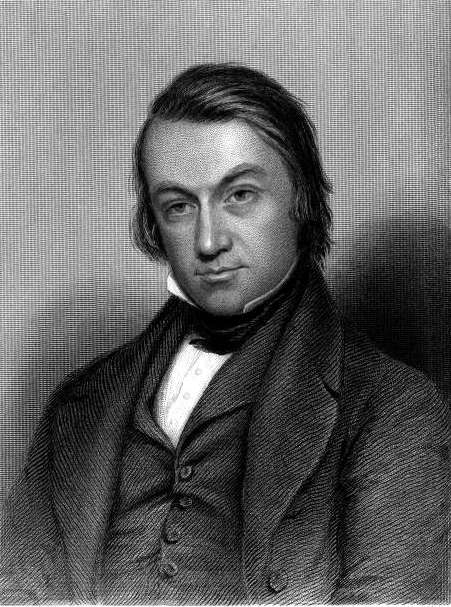
Charles Mackay
Scottish poet and journalistWikipedia
8
MENTIONS
6
EPISODES
6
PODCASTS
Search complete. 8 mentions across 6 episodes found for "Charles Mackay".
Nov 17, 2026

speaker_5NARRATOR
Keep thou back from the hot unwholesome wind, that it infect not thee.
speaker_5NARRATOR
Say, is there any who mourneth for the multitude dead here? August, 1848 The Mowers by Charles Mackay An Anticipation of the Cholera, 1848 Dense on the stream the vapors lay Thick as wool on the cold highway Spongy and dim each lonely lamp Shone o'er the streets so dull and damp The moonbeam could not pierce the cloud That swathed the city like a shroud There stood three shapes on the bridge alone three figures by the coping stone, gaunt and tall and undefined, spectres built of mist and wind, changing ever in form and height, but black and palpable to sight.
speaker_5NARRATOR
This is a city fair to see, whispered one of the fearful three, a mighty tribute it pays to me, into its river, winding slow, thick and foul from shore to shore, the vessels come, The vessels go, and teeming lands their riches pour.
speaker_5NARRATOR
It spreads beneath the murky sky a wilderness of masonry, huge, unshapely, overgrown, dingy brick and blackened stone.
13 MINS LATER
speaker_5NARRATOR
Of Dowager Mrs. Flaccus and Professor and Mrs. Cheetah, I remember a slice of lemon and a bitten macaroon.
speaker_5NARRATOR
Health, Disease, and Everything in Between by T.S. Eliot and Kingsmill Finch at Alia.
speaker_5NARRATOR
Health, or Yarkus and His Rings by Charles Mackay.
speaker_5NARRATOR
The clamorous people throng about my porch to purchase rings, which they believe I weld in holy fire and steep in essences and permeate with virtuous healing powers known but to gods in heaven and me on earth.

Patrick BoyleHOST
Tulip Mania is a great story.
Patrick BoyleHOST
According to the Scottish journalist Charles Mackay, who told this story in his popular book Extraordinary Popular Delusions and the Madness of Crowds, the tulip craze took hold of all levels of Dutch society.
Patrick BoyleHOST
The rage amongst the Dutch to own tulips was so great at the time that the ordinary industry of the country was neglected and the population, even to its lowest dregs, embarked in the tulip trade.
Patrick BoyleHOST
According to popular legend, everyone from the wealthiest merchants to the poorest chimney sweeps jumped into the tulip fray, buying bulbs at high prices and selling them for even more.
6 MINS LATER
Patrick BoyleHOST
Historians William Quinn and John Turner, who wrote Boom and Bust, A Global History of Financial Bubbles, say that tulip mania had negligible economic impact and it was too unremarkable to merit inclusion in their book.
Patrick BoyleHOST
Tim Harford in an FT column points out that McKay wrote the book with hindsight some 200 years after the event, and says that McKay seemed much more interested in cartoonish exaggeration than in accurate history.
Patrick BoyleHOST
Interestingly, there might be greater lessons that we can take from the story of Charles MacKay himself than the lessons offered up in his book, as not only did MacKay misreport the story of Tulip Mania, but he lived through a number of huge and significant investment manias in his own lifetime that not only didn't make it into his book, but that he actively participated in and cheer-led in the newspaper columns that he wrote at the time.
Patrick BoyleHOST
So, what really happened in 17th century Holland then? At the time of Tulip Mania, Holland was still breaking away from Spain at the later stages of the Eighty Years' War.

Edward ChancellorGUEST
So it clearly is a social movement, speculative mania.
Edward ChancellorGUEST
And actually, think of it, the first book on collecting together accounts of speculative mania's childhood Charles Mackay's Extraordinary Popular Delusions, The Madness of Crowds.
Edward ChancellorGUEST
That's published in the early 1840s.
Edward ChancellorGUEST
He provides descriptions of tulip mania, Mississippi bubble, and South Sea bubble, but he puts them in the context of other social manias, you know, the witch mania, the dancing mania, which are tarantellism in Italy, and other type of manias.

speaker_3ADVERTISER
Book now a vacation rental loved by guests.
speaker_4NARRATOR
front matter of stories of the coal mine this is a librivox recording all librivox recordings are in the public domain for more information or to volunteer please visit librivox dot org stories of the coal mine by frank mundell front matter preface i beg to acknowledge my indebtedness to major lindsay of sunderland who placed at my disposal a sketch of his son's career and gave me permission to reproduce the photograph of the hero of usworth to mr william dodd of orderly fame for a similar kindness and to the proprietors of punch for the use of the poem in chapter eight signed frank mundell london december eighteen ninety five old king cole was a merry old soul i'll move the world quoth he my england's high and rich and great but greater she shall be and he called for the pick and he called for the spade and he called for his miner's bold and it's dig he said in the deep deep earth you'll find my treasures better worth than mines of indian gold old king cole was a merry old soul a merry old soul is he may he never fail in the land we love who has made us great and free while his miners mine and his engines work through all our happy land we shall flourish fair in the morning light and our name and our fame and our might and our right in the front of the world shall stand by charles mackay end of front matter chapter i king coal the traveller from london to the north by the midland railway must needs pass through one or more of the great coal-fields on all sides as far as the eye can reach mounds of black and burning rubbish are seen which tell of years of labour expended in getting coal it is well named the black country for it is really the land of coal the two largest english coal fields lie on the borders of the sea and the coal-laden trucks run right down to the vessels which carry the black diamonds far across the ocean one of these great deposits is situated in the west and forms the famous welsh basin which is said to be the largest and deepest in europe the other extends towards the east with newcastle as its centre it is said that as much as one-half of this coal-field lies under the north sea there an army of upwards of forty thousand miners produce as much coal as the whole of france it would be impossible to exaggerate the importance of coal to the british people to the possession of this valuable mineral we owe our position as the chief manufacturing nation on the globe but for the mines of coal our country would have made little progress during the last century and much of its area now rich in commercial and agricultural prosperity would be little more than a wilderness those who live in our large towns have an especial right to know all about coal the very fact that they are living in a city of thousands of inhabitants instead of in a little village is simply owing to the circumstance of coal being found in the neighbourhood let us consider for a moment a few of the chief uses of coal it feeds the fires that warm our dwellings and cook our food from it is obtained the gas which lights our houses and streets the steam which drives the engine along the iron road and the ship across the sea it works the printing press wields the hammer lifts great weights draws heavy loads grinds corn spins cotton and wool weaves cloth and yields rich and brilliant dyes of every shade and colour we are able to manufacture for the world and our manufacturing power is only limited by our coal supply why has cotton emigrated from india egypt america and other far-off lands and made its home in lancashire where to-day cotton is king and where populous towns huge factories and hundreds of thousands of workers have been prepared and brought together for its reception wire's wool carried thousands of miles from the great sheep runs of australia south africa and south america to be manufactured into cloth in the yorkshire mills how does it happen that for miles around such cities as birmingham manchester leeds sheffield and glasgow the country is lighted up with furnaces by day and night and is for ever resounding with the clang and clash and roar of steam hammers engines and other machinery the answer to all that is simply coal manufacturers use immense quantities of coal therefore they must set up their factories where a supply can be easily obtained and thus save the cost of carriage any other plan would enormously increase the expense of production and everything would be proportionately dearer when coal and iron are found in separate districts it is cheaper to carry the iron to the coal than it would be to take the coal to the iron devonshire produces china clay but there is none in staffordshire devonshire however has no coal fields and staffordshire has the china clay is therefore carried to staffordshire to be made into pottery from this example it will be seen that but for the presence of coal in large quantities in our country our metals and other productions would have to be sent to coal-producing countries to be manufactured and our industries would never have assumed their present enormous proportions The United Kingdom yields nearly one-half of the coal production of the globe.
speaker_4NARRATOR
From about 4,000 collieries, nearly 165 million tonnes are obtained every year.
speaker_4NARRATOR
Coal mining and the coal trade together give employment to more than half a million persons.

Peter WaitzmanHOST
These satirical works were later picked up by the writers in the late 17th century and then by a German historian whose work had huge success and was translated into English.
Peter WaitzmanHOST
This material was then plundered by Charles Mackay for his influential 1841 book.
Peter WaitzmanHOST
The tulip story became a moral lesson about greed and a practical warning about chasing overpriced investments.
Peter WaitzmanHOST
As Goldgar notes, religious concepts like pride goes before the fall have persisted in our cultural understanding of economic events.

Scott RankSOUNDBITE_SPEAKER
One book that has cast a long shadow on how we understood the Salem Witch Trial and other events of mass hysteria is the 1841 book Extraordinary Popular Delusions and the Madness of Crowds.
Scott RankSOUNDBITE_SPEAKER
This book was published by Scottish journalist Charles Mackay in 1841, and he had three sections to the book, National Delusions, Peculiar Follies, and Philosophical Delusions.
Scott RankSOUNDBITE_SPEAKER
And the subjects of Mackay's debunking include alchemy, duels, crusades, fortune-telling, holy relics.
Scott RankSOUNDBITE_SPEAKER
But then he includes other things like economic bubbles.