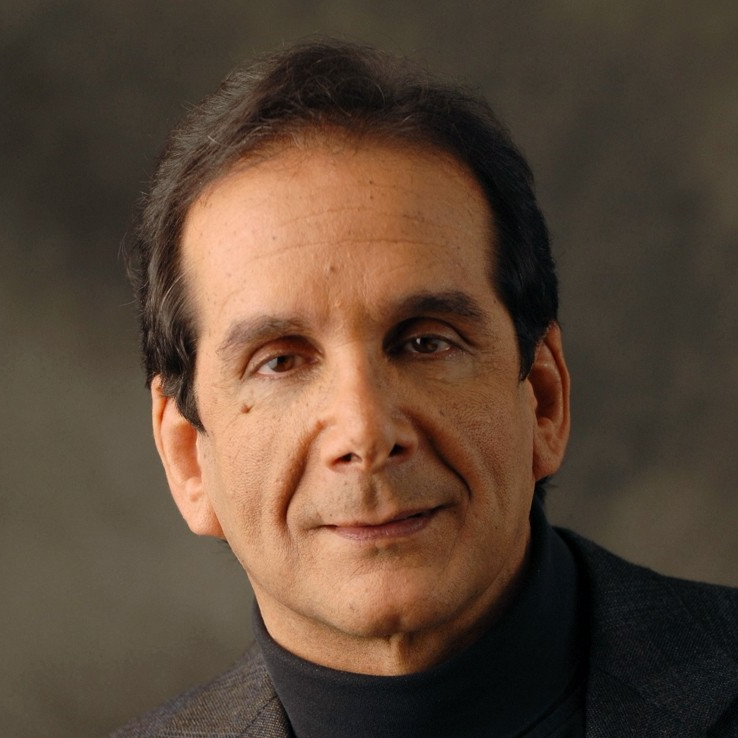
Charles Krauthammer
American columnist and psychiatristWikipedia
31
MENTIONS
30
EPISODES
26
PODCASTS
Search complete. 31 mentions across 30 episodes found for "Charles Krauthammer".
Sep 24, 2026

Jack ArmstrongHOST
So that's interesting.
Jack ArmstrongHOST
Uh, that's Charles Krauthammer, the late Charles Krauthammer, who we were big fans of back in the day, 2016, when I suppose...
Jack ArmstrongHOST
Huh, who was...
Jack ArmstrongHOST
Uh, Trump got elected in '16, so it was at the end of Obama's...

Jack ArmstrongHOST
So that's interesting.
Jack ArmstrongHOST
That's Charles Krauthammer, the late Charles Krauthammer, who we were big fans of back in the day, 2016.
Jack ArmstrongHOST
When I suppose who was Trump got elected in 16.
Jack ArmstrongHOST
So was that the end of Obama? Anyway, Chinese care about these little tiny snubs and that sort of stuff.

Jack ArmstrongHOST
So that's interesting.
Jack ArmstrongHOST
Uh, that's Charles Krauthammer, the late Charles Krauthammer, who we were big fans of back in the day, 2- 2016, when I suppose...
Jack ArmstrongHOST
Oh, who was...
Jack ArmstrongHOST
Uh, Trump got elected in '16, so was that the end of Obama's...

Jeff PoorHOST
You just, it just reeks of it.
Jeff PoorHOST
I say this all the time, the late Charles Krauthammer, y'all remember him? And he was a psychologist or a psychiatrist or whatever.
Jeff PoorHOST
He studied the art of psychiatry.
Jeff PoorHOST
And the way he explained it was if we could do it all over again and we had to have one legal intoxicant, cannabis would have been the preferred option by far because it just does.

LucretiaHOST
You can't have people standing in the way.
Steve HaywardHOST
The popular form of that was Charles Krauthammer years ago saying, to understand American politics, you have to know that liberals think conservatives are evil and conservatives think liberals are dumb.
Steve HaywardHOST
But the more serious version of it is the one that's presented here in our topic today, which is if you think history is a rational process going to a certain destination and you're on the side of that history, then certainly any opposition is akin to you know bacteria that are bad for your health and things like that in medicine um and and i think that becomes the unconscious premise of an awful lot of progressives who don't they haven't read hegel they don't thought this stuff through but they come to believe it because it's easy to believe in comforting but what i want to do now though is draw this to a close and have a quick break and then come back and let's get out with just quickly a couple of news items from this week that i think are I shouldn't laugh, but they're a little bit funny and ironic, but also illustrative of some aspects of what we're talking about.
Steve HaywardHOST
So don't go away, folks.

LucretiaHOST
We can't have people standing in the way.
Steve HaywardHOST
The popular form of that was Charles Krauthammer years ago saying, to understand American politics, you have to know that liberals think conservatives are evil and conservatives think liberals are dumb.
Steve HaywardHOST
But the more serious version of it is the one that's presented here in our topic today, which is if you think history is a rational process going to a certain destination and you're on the side of that history, then certainly any opposition is akin to you know bacteria that are bad for your health and things like that in medicine um and and i think that becomes the unconscious premise of an awful lot of progressives who don't they haven't read hegel they don't thought this stuff through but they come to believe it because it's easy to believe in comforting but what i want to do now though is draw this to a close and have a quick break and then come back and let's get out with just quickly a couple of news items from this week that i think are I shouldn't laugh, but they're a little bit funny and ironic, but also illustrative of some aspects of what we're talking about.
Steve HaywardHOST
So don't go away, folks.

Andrew CollingwoodHOST
And perhaps gathering force, you know, at first during the Reagan administration, but then in academia and through informal networks.
Andrew CollingwoodHOST
These, this group of people who became, came to be known as the neoconservatives, people like Paul Wolfowitz and Donald Rumsfeld, William Crystal, Charles Krauthammer, all of these characters.
Andrew CollingwoodHOST
What they decided was that, first of all, they recognized what this moment meant for American power.
Andrew CollingwoodHOST
They recognized that the US had this unique opportunity to remold the world.

Michael AntonGUEST
It doesn't need to keep doing all of this.
Michael AntonGUEST
And obviously they lost the argument in the there and now, in the there and then, to people like Charles Krauthammer, Francis Fukuyama on the intellectual side, and to people like Paul Wolfowitz in the policy side.
Michael AntonGUEST
And ultimately Bill Clinton is the ratifier of, this debate was raging throughout the H.W. Bush administration, unresolved in 1992.
Michael AntonGUEST
Remember the president walks out of the Gulf War in 1991 with an 85% approval rating, everybody assumes he's a shoo-in.

Eliot KaufmanGUEST
Uh, a lot of people.
Eliot KaufmanGUEST
Um, uh, and actually, uh, Charles Krauthammer's column-
Karol MarkowiczHOST
Mm-hmm
Eliot KaufmanGUEST
... was always syndicated there.

Elliot KaufmanGUEST
A lot of people.
Elliot KaufmanGUEST
And actually, Charles Krauthammer's column was always syndicated there.
Elliot KaufmanGUEST
George Will, George Jonas.
Elliot KaufmanGUEST
Yeah, it's the good paper
20 more episodes mention Charles Krauthammer.
Create an account to see the whole feed, search across every transcript, and follow the entities you care about.