Changchun
City in ChinaWikipedia
65
MENTIONS
26
EPISODES
15
PODCASTS
Search complete. 65 mentions across 26 episodes found for "Changchun".
Sep 28, 2026

Robert L. MorrellNARRATOR
It was generally observed by the forces of the Republic.
Robert L. MorrellNARRATOR
On the 15th of April, however, there was a resounding breach when the Yenan Reds laid siege to the important city of Changchun in Manchuria, which lies on the railway from Mukden to Harbin.
Robert L. MorrellNARRATOR
Three days later, the Reds had Changchun.
Robert L. MorrellNARRATOR
That day, General Marshall returned to Nanking.
Robert L. MorrellNARRATOR
Chang, finding the truce broken to his disadvantage, ordered his forces to recapture Changchun.
Robert L. MorrellNARRATOR
A month later, the Nationalist forces defeated the Reds in a battle south of Changchun and, with the Reds in flight to the northward, the Nationalists easily retook Changchun on the twenty-third of May.
Robert L. MorrellNARRATOR
At this time, the advantage lay with the forces of the Republic.
Robert L. MorrellNARRATOR
This was before, mind you, the Yenan Reds had been able to train their conscripts with the new weapons handed them by the Russians.

JoeHOST
And in order to get a handle on things...
JoeHOST
Yamada orders all of his subordinate commanders to come to his headquarters in Changchun, which is where they all were when the Soviets invaded on the 9th.
JoeHOST
So there is no subordinate commanders for the entire Japanese army in the field when the Soviets invade.
JoeHOST
For almost the first entire day of the invasion, the Japanese commanders are completely and totally unable to get back to their units or even communicate with them as the Soviets steamroll over the border.

Aaron BennettNARRATOR
By 1948 there was no longer much doubt about the outcome in China.
Aaron BennettNARRATOR
In the battles of Tsinnen, Changchun, and Mukden, the nationals lost 33 divisions totaling more than 320,000 men in killed, wounded, and missing.
Aaron BennettNARRATOR
Losses of equipment included 250,000 rifles and vast quantities of other arms and equipment.
Aaron BennettNARRATOR
During the four and a half months following the fall of Tsinnen in September 1948, the nationalists' losses were estimated at a million men and 400,000 rifles.

Wei ChenHOST
It is heavier, wetter, clinging to the skin like a damp cloth that refuses to dry even when the sun breaks through the cloud cover.
Wei ChenHOST
I arrived here yesterday evening, moving south along the Harbinjilin Corridor from Changchun, a journey that felt less like a crossing of provinces and more like a descent into a different atmosphere entirely.
Wei ChenHOST
The road was long, roughly 230 kilometers, taking nearly three hours as we navigated the familiar gray stretches of infrastructure that stitched the Northeast together.
Wei ChenHOST
By the time I pulled into Wuchang, the sky was already bruising with the promise of rain, and the temperature had settled at a steady 17 degrees Celsius.
Wei ChenHOST
It is late September, and the air outside carries that specific crispness you only find when summer finally releases its grip on the northeast.
Wei ChenHOST
I am sitting in my small flat in Chaoyang District, watching the water trace paths down the glass, knowing that today is my last full day in Changchun before the high-speed rail takes me north toward Harbin.
Wei ChenHOST
There is a quiet melancholy to leaving a place that has offered such cool relief from the heat of the capital, especially as the first autumn colors begin to stain the wide boulevards with gold and rust.
Wei ChenHOST
Before I step out into the drizzle, I want to take a moment to thank those who have been following this journey.
Wei ChenHOST
I am sitting in my modest one-bedroom flat in Chaoyang District, watching the drops trace slow paths down the glass, thinking about how quickly time moves when you are living somewhere rather than just passing through.
Wei ChenHOST
This is my last full day in Changchun before the high-speed rail takes me north towards Harbin, and there is a quiet melancholy in packing boxes that feels less like leaving and more like pausing.
Wei ChenHOST
I have spent the morning sorting through the small accumulation of objects that make a space a home, folding shirts, stacking books, and deciding what is essential enough to carry across the province.
Wei ChenHOST
The rent for this place was about one thousand three hundred yen a month, which is roughly one hundred and eighty dollars, a figure that still surprises me with its accessibility, especially when compared to the cost back home or even in the southern cities.
Wei ChenHOST
Yet here I am, relying on the local shop near the station for my top-ups, a habit born of necessity rather than preference.
Wei ChenHOST
Stepping out into the street, the temperature is a brisk eleven degrees Celsius, cool enough to require a light jacket but warm enough to walk without rushing.
Wei ChenHOST
The boulevards of Changchun are unusually wide, a legacy of the Soviet-era planning and the Japanese colonial grid that laid out these avenues with an arrogance of space that few other Chinese cities possess.
Wei ChenHOST
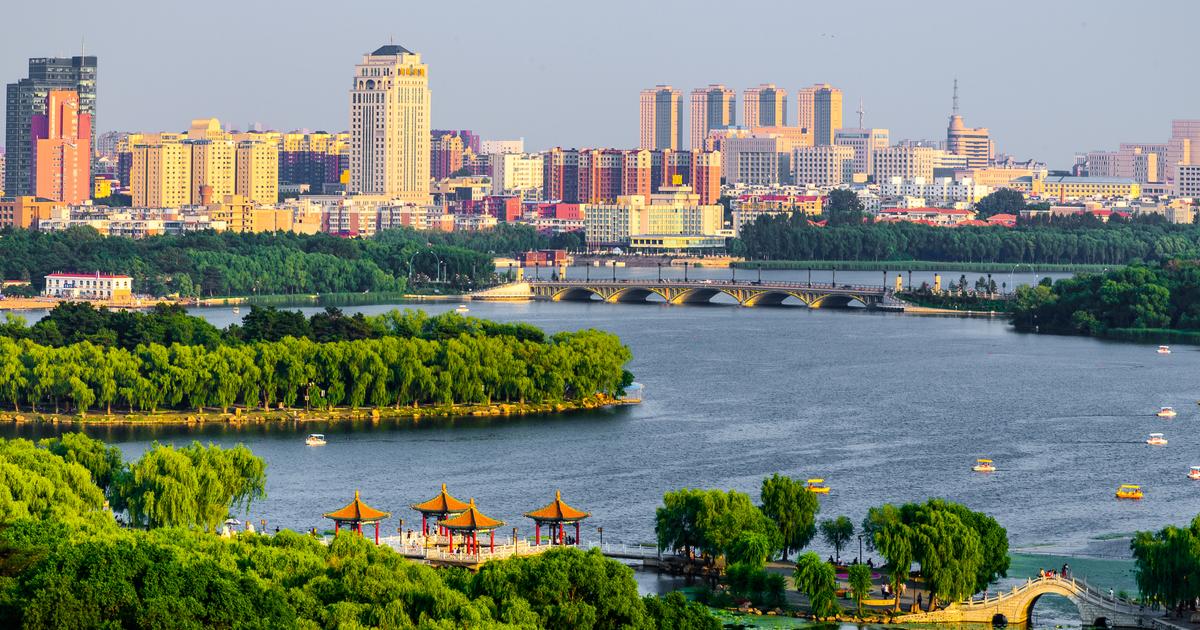
I walk towards Jinjiuetan National Forest Park, the vast expanse of artificial pine forest that serves as the city's green lung, its ninety-six percent forest cover standing in stark contrast to the concrete sprawl surrounding it.
Wei ChenHOST
The light in Changchun has a particular weight to it now.
Wei ChenHOST
It is late September, and the air has shifted from the humid warmth of summer into something crisp and clear, carrying the faint, dry scent of pine and fallen leaves.
Wei ChenHOST
I am on day 10 of 12 here, settled into this northern city with its unusually wide boulevards and forest parks, watching the first hints of autumn color begin to touch the edges of the trees.
Wei ChenHOST
As I rode, I noticed the first turning leaves, patches of yellow and orange breaking through the green, signaling the approach of winter.
Wei ChenHOST
The silence here is profound, broken only by the sound of tires on pavement and the occasional call of a bird hidden in the branches.
Wei ChenHOST
Changchun is a city built on contradictions, a place where Soviet-era planning meets Japanese colonial architecture, and where heavy industry sits beside serene nature.
Wei ChenHOST
It is known as both Auto City and Film City, home to the first automobile works, which produced China's first domestically built car, the Hongqi, and the Changchun Film Studio, the birthplace of New China Cinema.
Wei ChenHOST
I had visited the studio earlier in the week, seeing the preserved workshops and props from classic films, but today I felt drawn to the natural spaces instead.

Jeremy ThomasGUEST
When we think that we filmed with Peter O'Toole on the harbor side in, uh, in Dalian.
Jeremy ThomasGUEST
We were shot in Puyi's old palace, which we rebuilt in Changchun.
Daniella Taplin LundbergHOST
Yeah.
Jeremy ThomasGUEST
Where there were no hotels there.
Wei ChenHOST
We pass the former ministerial buildings, their facades preserved but repurposed, housing government offices and banks now.
Wei ChenHOST
I get out near the Changchun History and Culture Museum, which is free to enter, and walk along the sidewalk.
Wei ChenHOST
The city planning here is remarkable.
Wei ChenHOST
The streets are impossibly wide, designed for military parades and imperial processions, and they still dominate the skyline.
7 MINS LATER
Wei ChenHOST
Tomorrow, I will visit the Chongchun Film Studio, the birthplace of New China Cinema.
Wei ChenHOST
But for tonight, I am content with the silence, the warmth, and the memory of the golden leaves falling on the lake.
Wei ChenHOST
If you are thinking of visiting Changchun or even living here, know that it is an affordable city.
Wei ChenHOST
Rent for a one bedroom flat is around 1300 yuan a month.

ZacHOST
The three-stall in Huifang, China.
ZacHOST
The three-stall in Changchun, China.
ZacHOST
The three-stall in Shenyang, China.
ZacHOST
The three-stall in Xian, China.
16 more episodes mention Changchun.
Create an account to see the whole feed, search across every transcript, and follow the entities you care about.