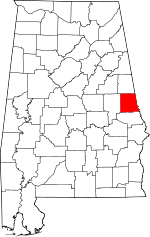
Chambers County
County in AlabamaWikipedia
4
MENTIONS
4
EPISODES
3
PODCASTS
Search complete. 4 mentions across 4 episodes found for "Chambers County".
Oct 1, 2026

Dusty SlayGUEST
So I go, "I don't know.
Dusty SlayGUEST
I don't know why you let me keep doing those jokes." But, um, but, uh, so I lived in, uh, Chambers County, Alabama, a town called LaFayette, Alabama, when I-- until I was two or three.
Dusty SlayGUEST
And then my parents divorced, and I moved to Opelika.
Dusty SlayGUEST
And, uh, and then I went back and forth, you know, my whole life.

Fenn ChurchGUEST
It was one case in 1984.
Fenn ChurchGUEST
It's called the Taunton case, and it was in Chambers County, Alabama, which, um, I will be in Chambers County this weekend.
Fenn ChurchGUEST
I got my nephew's k- getting married [laughs] there this weekend.
Sean SullivanHOST
Okay.
Fenn ChurchGUEST
It was one case in 1984.
Fenn ChurchGUEST
It's called the Taunton case, and it was in Chambers County, Alabama, which, um, I will be in Chambers County this weekend.
Fenn ChurchGUEST
I got my nephew's kid getting married [laughs] there this weekend.
Sean SullivanHOST
Okay.

John HagedornHOST
Among very many good ones, we shall perhaps best get at the type of all by giving the story of one, and we shall also learn something of the dangerous business of manhunting in a region filled with men who must be hunted down." Patrick Floyd Garrett, better known as Pat Garrett, was a Southerner by birth.
John HagedornHOST
He was born in Chambers County, Alabama, June 5, 1850.
John HagedornHOST
In 1856, his parents moved to Claiborne Parish, Louisiana, where his father was a large landowner, and of course at that time and place, a slave owner, and among the bitter opponents of the new regime which followed the Civil War.
John HagedornHOST
When young Garrett's father died, the large estates dwindled under bad management, and when within a short time the mother followed her husband to the grave, the family resources, affected by the war, became involved, although the two Garrett plantations embraced nearly 3,000 acres of rich Louisiana soil.