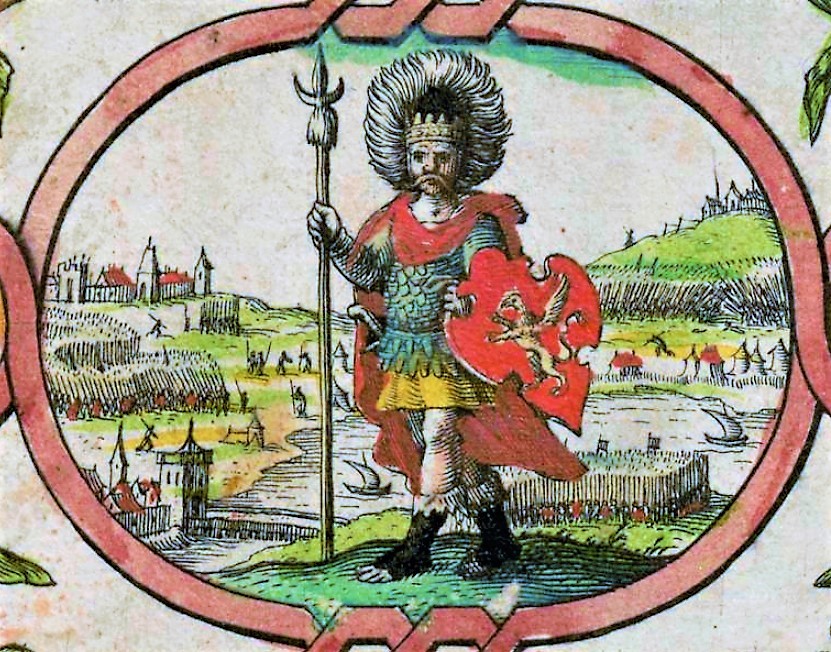
Cerdic of Wessex
Former King of WessexWikipedia
9
MENTIONS
5
EPISODES
5
PODCASTS
Search complete. 9 mentions across 5 episodes found for "Cerdic of Wessex".
Oct 17, 2026

Paul HarperGUEST
And yeah, so that was really what kind of got me into it.
Paul HarperGUEST
I kind of moved into, I wrote my first book about the first king of Wessex, Cerdic.
Paul HarperGUEST
And I kind of did a big investigation into his potential burial site.
Paul HarperGUEST
And then for this book, it was just, I was a huge fan of the Vikings and it was just a kind of a natural challenge to take on to try and work out what I could and try and find out the real story behind it in some cases I you know I just had to accept that you know there's an element there's a lot in a lot of cases there's an element of just not knowing unfortunately which is a bit frustrating for me and that's the kind of conclusion you have to reach but yeah no it's fascinating and Yeah, that was, I think I remember the first thing that, I remember the point when this book started.

Charlie HigsonHOST
It was bonanza time for the Scandis.
Charlie HigsonHOST
So where do the kings from our Anglo-Saxon rhyme fit into all this? Um, if you remember, it starts, "Egbert's name our list will head, then Ethel's, Wulf, Bald, Bert, and Red." Well, the House of Wessex traditionally starts with a guy called Cerdic, who ruled sort of some time in the 6th century.
Charlie HigsonHOST
But it was some 300 years earlier than Egbert, and Cerdic is regarded as the founder, and therefore the first king of Wessex itself, which was one of the first proper established Saxon settlements in England.
Charlie HigsonHOST
But very little is known about him, where he came from, who he was exactly, or even if he really actually existed.
Charlie HigsonHOST
This is the whole problem with the years after the Romans left, uh, and before Alfred started keeping proper records.
Charlie HigsonHOST
There's so little contemporary evidence.
Charlie HigsonHOST
But Cerdic was the sort of mythical ruler that gave you legitimacy if you claimed to be descended from him, like Romulus and Remus, the founders of Rome.
Charlie HigsonHOST
And the original line of the House of Wessex descends from Cerdic through various kings for 300 years, until we get to the time of King Offa of Mercia.

ChipNARRATOR
All the chiefs who founded Teutonic dynasties in the continental provinces of the Roman Empire, Alaric, Theodoric, Clovis, Alboin, were zealous Christians.
ChipNARRATOR
The followers of Ida and Cerdic, on the other hand, brought to their settlements in Britain all the superstitions of the Elbe.
ChipNARRATOR
While the German princes who reigned at Paris, Toledo, Arles, and Ravenna listened with reverence to the instructions of bishops, adored the relics of martyrs, and took part eagerly in disputes touching the Nicene theology, the rulers of Wessex and Mercia were still performing savage rites in the temples of Thor and Woden.
ChipNARRATOR
The continental kingdoms which had risen on the ruins of the Western Empire kept up some intercourse with those eastern provinces where ancient civilization, though slowly fading away under the influence of misgovernment, might still astonish and instruct barbarians; where the court still exhibited the splendor of Diocletian and Constantine; where the public buildings were still adorned with the sculptures of Polycletus and the paintings of Apelles; and where laborious pedants, themselves destitute of taste, sense, and spirit, could still read and interpret the masterpieces of Sophocles, of Demosthenes, and of Plato.