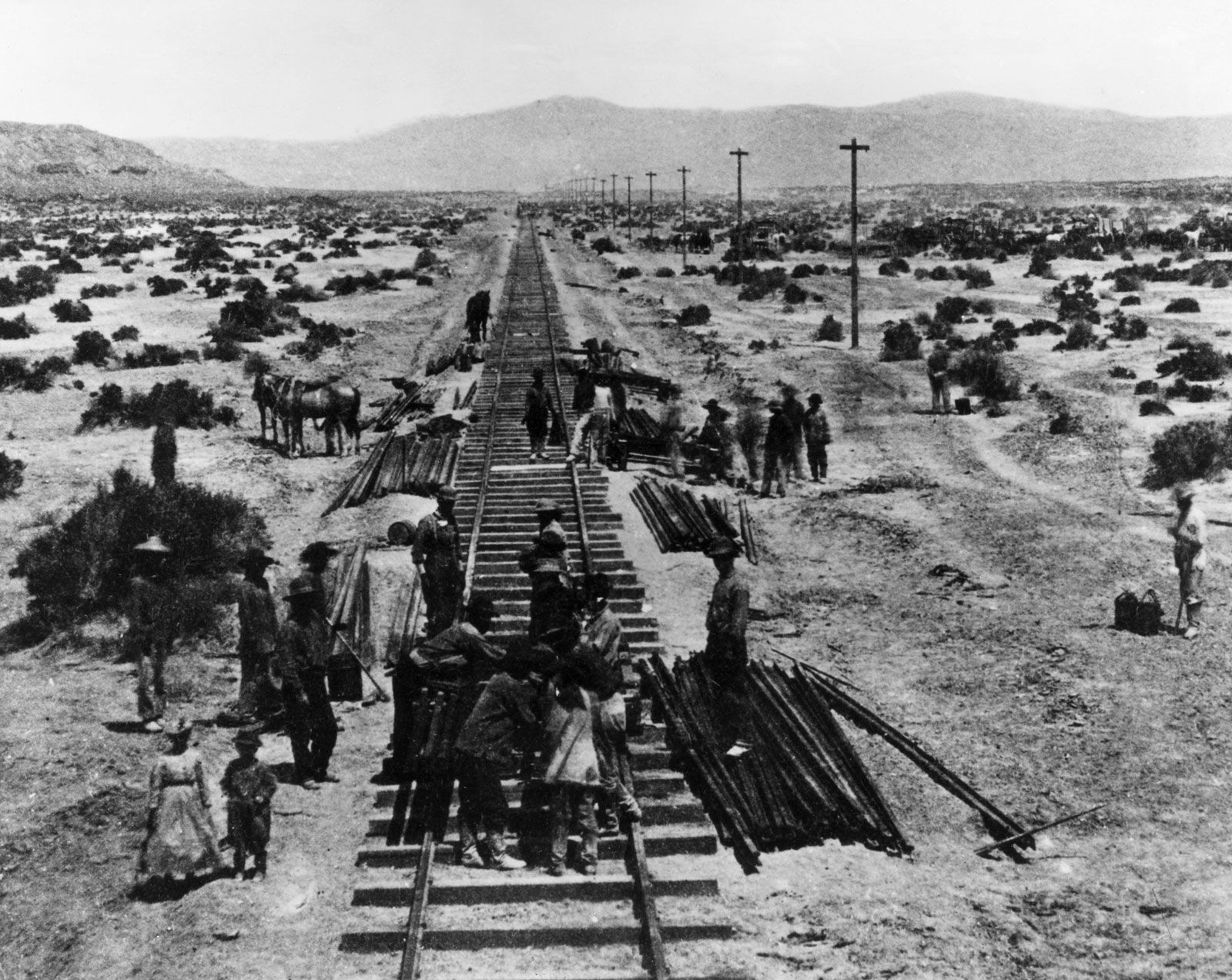
Central Pacific Railroad
Railroad companyWikipedia
47
MENTIONS
32
EPISODES
30
PODCASTS
Search complete. 47 mentions across 32 episodes found for "Central Pacific Railroad".
Sep 12, 2026

Holly MasriNARRATOR
Finally, after a half-century of horse and wagon pioneering, the first railroads spanned the continent in eighteen sixty-nine.
Holly MasriNARRATOR
But the Union Pacific and Central Pacific were more the concern of California than of Oregon, for the Northwest had no iron trail to link it with the parent East until in eighteen eighty-three the Northern Pacific Railway, under the leadership of Henry Villard, reached Portland.
Holly MasriNARRATOR
So Oregon was discovered by sea and land, and finally, as highways of steel replaced the dusty trails of the emigrants, she has come into her own.
Holly MasriNARRATOR
From within and without, she has builded, and what she has done for her sons and offers to her settlers has established a place for her in the respectful attention of the world.

Simon WhistlerHOST
Those men were banker Charles Crocker, merchant Mark Hopkins, and Leland Stanford.
Simon WhistlerHOST
Together with Huntington, they were known as the Big Four, the main investors behind what became the Central Pacific Railroad, or CPRR, with Stanford serving as president of the new company.
Simon WhistlerHOST
U.S. Congress chartered the rail company in 1862.
Simon WhistlerHOST
That same year, Congress also passed the Pacific Railroad Acts in order to promote the construction of the Transcontinental Railroad.
Simon WhistlerHOST
Although he rallied against immigrants as a politician, Stanford changed his tune when he saw the savings, since he didn't have to pay them as much as American workers or provide them with living accommodations.
Simon WhistlerHOST
A similar thing was happening with the eastern railways, except that they mainly relied on Irish labor.
Simon WhistlerHOST
The Central Pacific Railroad was completed on May 10, 1869, when it was connected to the Union Pacific Railroad to form the first transcontinental railroad.
Simon WhistlerHOST
This happened in Promontory, Utah, and has been hailed as the first mass media event in the United States.

Peter EastmanNARRATOR
The three days' voyage by boat and rail was irksome.
Peter EastmanNARRATOR
I bought my kit at St. Croix on the Central Pacific Railroad, and on June first I began the last stage of my journey via the Son of Sol Broad Gauge, arriving in the wilderness by daylight.
Peter EastmanNARRATOR
A tedious forced march by blazed trail, freshly spotted on the wrong side, of course, brought me to the northern terminus of the rusty narrow-gauge lumber railway which runs from the heart of the hushed pine wilderness to the sea.
Peter EastmanNARRATOR
Already a long train of battered flatcars piled with sluice props and roughly hewn sleepers was moving slowly off into the brooding forest gloom when I came in sight of the track.

Peter EastmanNARRATOR
The three days' voyage by boat and rail was irksome.
Peter EastmanNARRATOR
I bought my kit at St. Croix on the Central Pacific Railroad, and on June first I began the last stage of my journey via the Son of Sol broad gauge, arriving in the wilderness by daylight.
Peter EastmanNARRATOR
A tedious forced march by blazed trail, freshly spotted on the wrong side, of course, brought me to the northern terminus of the rusty narrow-gauge lumber railway which runs from the heart of the hushed pine wilderness to the sea.
Peter EastmanNARRATOR
Already a long train of battered flat cars piled with sluice props and roughly hewn sleepers was moving slowly off into the brooding forest gloom when I came in sight of the track.

Matt HarrisHOST
One is called the Union Pacific.
Matt HarrisHOST
They're building a railroad from Nebraska to Utah, where the plan is to connect with another one of the transcontinental railroads called the Central Pacific building to Utah from California.
Matt HarrisHOST
Construction on these had started a few years earlier.
Matt HarrisHOST
And their CapEx needs were enormous in the second half of the 1860s when they approached Cook about being their banker.
Matt HarrisHOST
Now Jake Cook's starting to feel like he might be running out of time.
Matt HarrisHOST
And then he picks up the newspaper in the spring of 1869 and he sees the headline.
Matt HarrisHOST
The Union Pacific and the Central Pacific had connected in Utah.
Matt HarrisHOST
The golden spike.

Doug FajardoNARRATOR
will secure the traffic in wheat and lumber from the pacific coast to the countries of europe or to other countries and islands on the eastern side of the american continent is subject to serious question wheat lumber and coal transported on long voyages are essentially sailing vessel cargoes but as before shown it will for all time be impracticable to navigate sailing vessels through any american interoceanic canal for the same reason that no sailing vessel ever passes through the suez canal the records of commerce across the isthmus of panama during the last fifty years served to throw light upon the question as to the practicability of an american interoceanic canal the construction of the panama railroad was begun in the month of may eighteen fifty and it was opened for traffic january twenty eighth eighteen fifty five the length of the road is forty seven and a half miles The cost of its construction was $8 million.
Doug FajardoNARRATOR
It continued to be the principal avenue for commerce between the Atlantic and Pacific coasts of the United States until the completion of the first transcontinental railroad, the Union and Central Pacific, on May 10, 1869.
Doug FajardoNARRATOR
During the year ended June 30, 1869, The total value of merchandise shipped from New York to San Francisco and from San Francisco to New York via Panama amounted to $70,202,029.
Doug FajardoNARRATOR
As a result of the Transcontinental Railroad competition, it fell in the following year to $18,594,255.
Doug FajardoNARRATOR
during the year ended june thirtieth eighteen ninety eight it amounted to only four million eight hundred and eighty seven thousand two hundred and eighty nine dollars upon completion of the union and central pacific railroad line in eighteen sixty nine the carriage of passengers, the mail, coin and bullion, express goods, perishable goods, and all the more valuable fast freights, was at once deflected to the transcontinental railroad, never more to be transferred to any possible trans-ismian rail or water route.
Doug FajardoNARRATOR
Since the year 1869, eight other transcontinental lines and parts of lines have been constructed, and direct connections have been formed with lines reaching to every center of trade and of production in this country from the Atlantic to the Pacific and from Canada to the Gulf.
Doug FajardoNARRATOR
Thus, an enormous internal and transcontinental traffic has sprung up, the total freight traffic of the panama railroad through and local embracing freights to and from the entire western coast of north america central america and south america amounted during the year eighteen ninety seven to only two hundred and ninety thousand six hundred and fifty one tons whereas the tonnage carried across the continental divide by rail according to the best means of information amounted to over three million tons and included freights of every class from highest to lowest besides an enormous local traffic has sprung up along the transcontinental lines and their branches a vast area has thus been reclaimed to the arts of civilization the seventy-ton steel locomotive and the eighty-pound steel rail have become the chief instrumentalities of the grandest and most efficient system of transportation ever seen on this globe and the demand for still larger achievements is imperative the one hundred ton steel locomotive has been built the 100-pound steel rail has been laid, and the practicability of the 110-pound steel rail is affirmed.

Lola JanieNARRATOR
Recording by Lola Janie.
Lola JanieNARRATOR
Chapter number four, Central Pacific Railroad.
Lola JanieNARRATOR
We are perhaps justified in speaking of the great achievement of the age, the Pacific Railroad, its undertaking and completion, the adverse and trying circumstances.
Lola JanieNARRATOR
Its success is due to ex-Governor Stanford, Hopkins Charles Crocker combined with the united efforts of many people of the Pacific Coast and the Congress of the United States.

speaker_14NARRATOR
CHAPTER XVIII.
speaker_14NARRATOR
history of the united states by charles a beard and mary ritter beard part six national growth and world politics chapter eighteen the development of the great west at the close of the civil war kansas and texas were sentinel states on the middle border beyond the rockies california oregon and nevada stood guard the last of them having been just admitted to furnish another vote for the fifteenth amendment abolishing slavery between the near and far frontiers lay a vast reach of plain desert plateau and mountain almost wholly undeveloped a broad domain extending from canada to mexico and embracing the regions now included in washington idaho wyoming montana utah arizona new mexico the dakotas and oklahoma had fewer than half a million inhabitants it was laid out into territories each administered under a governor appointed by the president and senate and as soon as there was the requisite number of inhabitants a legislature elected by the voters no railway line stretched across the desert st joseph on the missouri was the terminus of the eastern lines it required twenty-five days for a passenger to make the overland journey to california by the stage-coach system established in eighteen fifty eight and more than ten days for the swift pony express organized in eighteen sixty to carry a letter to san francisco indians still roamed the plain and desert and more than one powerful tribe disputed the white man's title to the soil the railways as trailblazers opening railways to the pacific a decade before the civil war the importance of rail connection between the east and the pacific coast had been recognized pressure had already been brought to bear on congress to authorize the construction of a line and to grant land and money in its aid both the democrats and republicans approved the idea but it was involved in the slavery controversy indeed it was submerged in it southern statesmen wanted connections between the gulf and the pacific through texas while northerners stood out for a central route the north had its way during the war congress by legislation initiated in eighteen sixty two provided for the immediate organization of companies to build a line from the missouri river to california and made grants of land and loans of money to aid in the enterprise the western end the central pacific was laid out under the supervision of leland stanford it was heavily financed by the mormons of utah and also by the state government the ranchmen miners and business men of california and it was built principally by chinese labor the eastern end the union pacific starting at omaha was constructed mainly by veterans of the civil war and immigrants from ireland and germany in eighteen sixty nine the two companies met near ogden in utah and the driving of the last spike uniting the atlantic and the pacific was the occasion of a great demonstration other lines to the pacific were projected at the same time but the panic of eighteen seventy three checked railway enterprise for a while with the revival of prosperity at the end of that decade construction was renewed with vigor and the year eighteen eighty three marked a series of railway triumphs in february trains were running from new orleans through houston san antonio and yuma to san francisco as a result of a union of the texas pacific with the southern pacific and its subsidiary corporations in september the last spike was driven in the northern pacific at helena montana lake superior was connected with puget sound the waters explored by joliet and marquette were joined to the waters plowed by sir francis drake while he was searching for a route around the world that same year also a third line was opened to the pacific by way of the atchison topeka and santa fe making connections through albuquerque and needles with san francisco the fondest hopes of railway promoters seemed to be realized western railways precede settlement in the old world and on our atlantic seaboard railways followed population and markets in the far west railways usually preceded the people railway builders planned cities on paper before they laid tracks connecting them they sent missionaries to spread the gospel of western opportunity to people in the middle west in the eastern cities and in southern states then they carried their enthusiastic converts bag and baggage in long trains to the distant dakotas and still farther afield so the development of the far west was not left to the tedious processes of time it was pushed by men of imagination adventurers who made a romance of money-making and who had dreams of empire unequalled by many kings of the past these empire builders bought railway lands in huge tracts they got more from the government they overcame every obstacle of canyon mountain and stream with the aid of science they built cities according to the plans made by the engineers having the towns ready and railway and steamboat connections formed with the rest of the world they carried out the people to use the railways the steamships the houses and the land it was in this way that the frontier speculator paved the way for the frontier agriculturalist who had to be near a market before he could farm the spirit of this imaginative enterprise which laid out railways and towns in advance of the people is seen in an advertisement of that day this extension will run forty two miles from york northeast through the island lake country and will have five good north dakota towns the stations on the line will be well equipped with elevators and will be constructed and ready for operation at the commencement of the grain season prospective merchants have been active in securing desirable locations at the different towns on the line there are still opportunities for hotels general merchandise hardware furniture and drug stores c among the railway promoters and builders in the west james j hill of the great northern and allied lines was one of the most forceful figures He knew that tracks and trains were useless without passengers and freight, without a population of farmers and town dwellers.
speaker_14NARRATOR
He therefore organized publicity in the Virginias, Iowa, Ohio, Indiana, Illinois, Wisconsin, and Nebraska especially.
speaker_14NARRATOR
He sent out agents to tell the story of western opportunity in this vein, quote, you see your children come out of school with no chance to get farms of their own because the cost of land in your older part of the country is so high that you can't afford to buy land to start your sons out in life around you they have to go to the cities to make a living or become laborers in the mills or hire out as farm hands there is no future for them there if you are doing well where you are and can safeguard the future of your children and see them prosper around you don't leave here but if you want independence if you are renting your land if the money-lender is carrying you along and you are running behind year after year you can do no worse by moving you farmers talk of free trade and protection and what this or that political party will do for you why don't you vote a homestead for yourself That is the only thing Uncle Sam will ever give you.

speaker_16NARRATOR
CHAPTER XVIII.
speaker_16NARRATOR
history of the united states by charles a beard and mary ritter beard part six national growth and world politics chapter eighteen the development of the great west at the close of the civil war kansas and texas were sentinel states on the middle border beyond the rockies california oregon and nevada stood guard the last of them having been just admitted to furnish another vote for the fifteenth amendment abolishing slavery between the near and far frontiers lay a vast reach of plain desert plateau and mountain almost wholly undeveloped a broad domain extending from canada to mexico and embracing the regions now included in washington idaho wyoming montana utah arizona new mexico the dakotas and oklahoma had fewer than half a million inhabitants it was laid out into territories each administered under a governor appointed by the president and senate and as soon as there was the requisite number of inhabitants a legislature elected by the voters no railway line stretched across the desert st joseph on the missouri was the terminus of the eastern lines it required twenty-five days for a passenger to make the overland journey to california by the stage-coach system established in eighteen fifty eight and more than ten days for the swift pony express organized in eighteen sixty to carry a letter to san francisco indians still roamed the plain and desert and more than one powerful tribe disputed the white man's title to the soil the railways as trailblazers opening railways to the pacific a decade before the civil war the importance of rail connection between the east and the pacific coast had been recognized pressure had already been brought to bear on congress to authorize the construction of a line and to grant land and money in its aid both the democrats and republicans approved the idea but it was involved in the slavery controversy indeed it was submerged in it southern statesmen wanted connections between the gulf and the pacific through texas while northerners stood out for a central route the north had its way during the war congress by legislation initiated in eighteen sixty two provided for the immediate organization of companies to build a line from the missouri river to california and made grants of land and loans of money to aid in the enterprise the western end the central pacific was laid out under the supervision of leland stanford it was heavily financed by the mormons of utah and also by the state government the ranchmen miners and business men of california and it was built principally by chinese labor the eastern end the union pacific starting at omaha was constructed mainly by veterans of the civil war and immigrants from ireland and germany in eighteen sixty nine the two companies met near ogden in utah and the driving of the last spike uniting the atlantic and the pacific was the occasion of a great demonstration other lines to the pacific were projected at the same time but the panic of eighteen seventy three checked railway enterprise for a while with the revival of prosperity at the end of that decade construction was renewed with vigor and the year eighteen eighty three marked a series of railway triumphs in february trains were running from new orleans through houston san antonio and yuma to san francisco as a result of a union of the texas pacific with the southern pacific and its subsidiary corporations in september the last spike was driven in the northern pacific at helena montana lake superior was connected with puget sound the waters explored by joliet and marquette were joined to the waters plowed by sir francis drake while he was searching for a route around the world that same year also a third line was opened to the pacific by way of the atchison topeka and santa fe making connections through albuquerque and needles with san francisco the fondest hopes of railway promoters seemed to be realized western railways precede settlement in the old world and on our atlantic seaboard railways followed population and markets in the far west railways usually preceded the people railway builders planned cities on paper before they laid tracks connecting them they sent missionaries to spread the gospel of western opportunity to people in the middle west in the eastern cities and in southern states then they carried their enthusiastic converts bag and baggage in long trains to the distant dakotas and still farther afield so the development of the far west was not left to the tedious processes of time it was pushed by men of imagination adventurers who made a romance of money-making and who had dreams of empire unequalled by many kings of the past these empire builders bought railway lands in huge tracts they got more from the government they overcame every obstacle of canyon mountain and stream with the aid of science they built cities according to the plans made by the engineers having the towns ready and railway and steamboat connections formed with the rest of the world they carried out the people to use the railways the steamships the houses and the land it was in this way that the frontier speculator paved the way for the frontier agriculturalist who had to be near a market before he could farm the the spirit of this imaginative enterprise which laid out railways and towns in advance of the people is seen in an advertisement of that day this extension will run forty-two miles from york northeast through the island lake country and will have five good north dakota towns the stations on the line will be well equipped with elevators and will be constructed and ready for operation at the commencement of the grain season prospective merchants have been active in securing desirable locations at the different towns on the line there are still opportunities for hotels general merchandise hardware furniture and drug stores c Among the railway promoters and builders in the West, James J. Hill of the Great Northern and Allied Lines was one of the most forceful figures.
speaker_16NARRATOR
He knew that tracks and trains were useless without passengers and freight, without a population of farmers and town dwellers.
speaker_16NARRATOR
He therefore organized publicity in the Virginias, Iowa, Ohio, Indiana, Illinois, Wisconsin, and Nebraska especially.

TimVOICE_ACTOR
Another mile and you're through for the day.
TimVOICE_ACTOR
Now keep up the good work and we'll show them toilemen on the Central Pacific what it takes to build a railroad.
TimVOICE_ACTOR
Come on now, lay your weight against them hammers.
WolfpawVOICE_ACTOR
Come on.
Fred FoyNARRATOR
Yes, the hostile Indians of the far west were a constant menace to the sturdy pioneers who helped to build the first railroad across the open plains.
Fred FoyNARRATOR
It was a historic period when two great railroads began their race across the continent, one of the greatest engineering projects in history.
Fred FoyNARRATOR
Two groups of men representing the Central Pacific and the Union Pacific Railroad started from opposite directions across plains, mountains, and deserts in a great race against time.
Fred FoyNARRATOR
Assisting the government troopers and local peace officers to maintain and establish law and order in those pioneer days were the fearless and courageous United States Marshals.
22 more episodes mention Central Pacific Railroad.
Create an account to see the whole feed, search across every transcript, and follow the entities you care about.