Celtic Sea
SeaWikipedia
22
MENTIONS
10
EPISODES
9
PODCASTS
Search complete. 22 mentions across 10 episodes found for "Celtic Sea".
Sep 11, 2026

Doug MetzgerHOST
The Roman Empire was the Mediterranean and not Italy.
Doug MetzgerHOST
Just so, when we approach the earliest European vernacular literature that has made it down to us today, we see the products of two different seas at work, the North Sea and the Celtic Sea, both of them during late antiquity and the early medieval period, connected cultural systems that gave rise to the earliest surviving literature in Old and Middle Irish, Old Welsh, Anglo-Saxon, Old High German, and Old Saxon.
Doug MetzgerHOST
Let's start with the first of the two regions, the North Sea, the one on the right.
Doug MetzgerHOST
The North Sea is the oceanic basin east of Britain, north of the Netherlands and Germany, and west of Denmark and Norway.
Doug MetzgerHOST
The Anglo-Saxons who settled in Britain predominantly disembarked generation after generation on the eastern and southern coasts of the island, bringing with them the dialects and cultural traces of many different vicinities of the North Sea basin.
Doug MetzgerHOST
Anglo-Saxon literature, often called Old English literature, is associated with England, but the languages and peoples that produced it came over from the larger and more globally connected expanses of the North Sea.
Doug MetzgerHOST
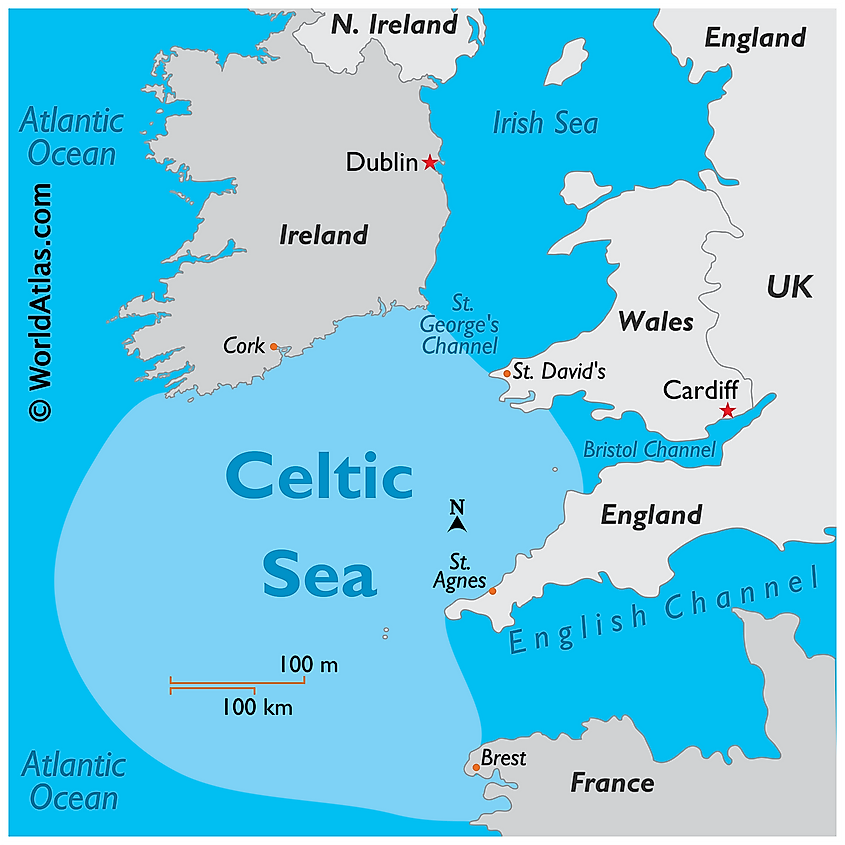
Then to the left, there was the Celtic Sea, south of Ireland and west of France and southern England.
Doug MetzgerHOST
The Celtic Sea as well was its own cultural ecosystem all the way back during the Iron Age.

Doug MetzgerHOST
The Roman Empire was the Mediterranean and not Italy.
Doug MetzgerHOST
Just so, when we approach the earliest European vernacular literature that has made it down to us today, we see the products of two different seas at work, the North Sea and the Celtic Sea.
Doug MetzgerHOST
Both of them during late antiquity and the early medieval period connected cultural systems that gave rise to the earliest surviving literature in Old and Middle Irish, Old Welsh, Anglo-Saxon, Old High German, and Old Saxon.
Doug MetzgerHOST
Let's start with the first of the two regions, the North Sea, the one on the right.
Doug MetzgerHOST
bringing with them the dialects and cultural traces of many different vicinities of the North Sea basin.
Doug MetzgerHOST
Anglo-Saxon literature, often called Old English literature, is associated with England, but the languages and peoples that produced it came over from the larger and more globally connected expanses of the North Sea.
Doug MetzgerHOST
Then, to the left, there was the Celtic Sea, south of Ireland and west of France and southern England.
Doug MetzgerHOST
The Celtic Sea, as well, was its own cultural ecosystem all the way back during the Iron Age.

Jonathan ColeGUEST
I mean, firstly, there's a huge volume of sites already out there under leases in that section.
Jonathan ColeGUEST
In the UK, Scotland and the Celtic Sea, for example, there's more than 14 gigawatts of sites which are in the, you know, this kind of sub 90 metre range, the 60 to 90 range.
Jonathan ColeGUEST
meter range so in the sweet spot of this so there's actually quite a lot of money being invested in projects already out there which were probably initially earmarked for floating projects but for a lot of reasons some of them are economic some of them are industrial some of them are to do with infrastructure some to do with logistics floating isn't quite coming through as quickly as expected.
Jonathan ColeGUEST
So a lot of these projects are out there with an expectation that they would have been deployed by a certain timeline and that's now slipping.

Philip ToveyGUEST
So this paper presents an autoethnographic research I conducted, uh, walking completely barefoot the River Tone in Somerset, England, uh, down that way.
Philip ToveyGUEST
In two legs, one between the 21st of July and the other the morning of the 21st, I completed a total distance of 54 miles walking or running from my home in Lydeard St Lawrence up to the second source at Holcombe Waters in Elworthy, down to the mouth of the Tone where it joins the River Parrot at Burrow's Mount and heads on the Somerset levels and heads out to the Celtic Sea.
Philip ToveyGUEST
This research is part of a broader, uh, PhD research inquiry into human augmentation, specifically focusing on the ecophenomenological implications of bodily modifications on temporal dimensions of river ecologies.
Philip ToveyGUEST
Bare feet, my bare feet in this study serve as an unaugmented control for further research into these riverine environments whilst modified.

Lindsay GrahamHOST
Pisces III is dangling from it like a pendulum beneath the support ship, but the strain soon becomes too much for the cable to bear, [cable snaps] and it snaps.
Lindsay GrahamHOST
With another sickening lurch, the submersible plunges into the darkness, free-falling toward the bottom of the Celtic Sea.
Lindsay GrahamHOST
Less than a minute later, Pisces III crashes onto the sea floor.
Lindsay GrahamHOST
The impact damages the submersible and leaves it stranded on the bottom, trapping pilots Roger Mallinson and Roger Chapman over fifteen hundred feet beneath the surface.
Lindsay GrahamHOST
On this podcast, every day, we tell the true stories of the people and events that shaped our world.
Lindsay GrahamHOST
Today is September 1st, 1973, the deepest underwater rescue.
Lindsay GrahamHOST
It's ten AM on August twenty-ninth, nineteen seventy-three inside Pisces III, only moments after it sank to the bottom of the Celtic Sea.
Lindsay GrahamHOST
Roger Mallinson sits motionless in complete darkness, his ears ringing.
Lindsay GrahamHOST
[instrumental music plays] Next on History Daily, September 1st, 1973.
Lindsay GrahamHOST
After a three-day rescue operation, two submersible pilots are rescued from the bottom of the Celtic Sea.
Lindsay GrahamHOST
From Noiser and Airship, this is History Daily, hosted, edited, and executive produced by me, Lindsay Graham.
Lindsay GrahamHOST
Audio editing by Molly Bock.

Jane GarveyHOST
Redruth's and Ives, and we still didn't touch the sides of everything there is to see and do there.
Jane GarveyHOST
The scenery across the county and the wild, frothy, turquoise s-- Celtic Sea and English Channel crashing onto the beautiful white sandy beaches and against the black rocky coastline is stunning and unforgettable.
Eve SalusburyHOST
Wow.
Jane GarveyHOST
Angela does work for the Cornish Tourist Board.

Elwyn VaughanGUEST
Well, I certainly would agree we don't need a nimby attitude.
Elwyn VaughanGUEST
And the actual fact I'd highlight, what is going to follow on from Hugh, the fact that only a couple of weeks ago, the minister responsible for planning approved a floating offshore wind farm development in the Celtic Sea with a number of important Welsh companies, a crucial part of that project.
Elwyn VaughanGUEST
despite the fact that the planning inspector had recommended refusal.
Elwyn VaughanGUEST
So that shows ambition, that shows commitment and being ready to take decisions against perhaps the advice.

Jonathan ThomasHOST
He spent his career studying coastlines and how people remember them changing, work that produced The Edge of Memory and Words in Shadow.
Jonathan ThomasHOST
His new book, published this month by Reaction Books, is Whispers from the Celtic Seas: The True Meanings of Ancient Stories from Northwest Europe, and it will change how you look at the map of Britain.
Jonathan ThomasHOST
Patrick, welcome to the Anglotopia Podcast.
Patrick NunnGUEST
Jonathan, it's a real pleasure to be here.
8 MINS LATER
Jonathan ThomasHOST
So the obvious objection from, from skeptics would be that oral tradition is can be a game of telephone, that stories degrade beyond recognition over time and over the repeated tellings, uh, over m- millennia.
Jonathan ThomasHOST
So what's the evidence that they don't? How does this knowledge survive without writing through the oral tradition?
Patrick NunnGUEST
I think we make a, an error sometimes, Jonathan, by judging the past through our understanding of the present, and this is a theme that, that reoccurs in my new book, uh, Whispers from Celtic Seas.
Patrick NunnGUEST
The, the idea is that when we play these kinds of parlor games, the whole fun is how the stories degrade as you go around the, the circle.

Alan HallHOST
Either way, the load is coming, which brings us to the people building the energy supply.
Alan HallHOST
Let's start in the Celtic Sea, about forty kilometers off the British coast.
Alan HallHOST
There's a floating wind project out there called Gwynt Glas.
Alan HallHOST
That is Welsh for blue wind.
Alan HallHOST
Commercial operation is targeted for late twenty thirties.
Alan HallHOST
That is a Japanese trading house writing a check today for electricity that shows up in about fifteen years.
Alan HallHOST
The deal sits under a memorandum signed with the British government last year, and Britain wants the Celtic Sea built, and Japan just helped volunteer to pay for it.
Alan HallHOST
Now up to Scotland, Vestas has installed the most powerful onshore wind turbine in Britain.