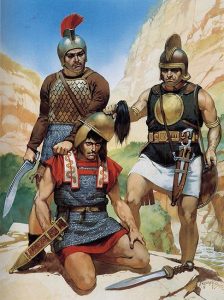
Celtiberians
PeopleWikipedia
12
MENTIONS
8
EPISODES
8
PODCASTS
Search complete. 12 mentions across 8 episodes found for "Celtiberians".
Sep 1, 2026

ChrisHOST
That's precisely what one man did in the 19th century.
ChrisHOST
Francisco Martín Sarmento, a Portuguese archaeologist, began in the 1870s to excavate the great Celtiberian hilltop settlements of the north.
ChrisHOST
Above all, the Chitania de Breteros, a city of stone with 2,000 years of history in its back.
ChrisHOST
And Sarmento used something remarkable as his guide, the folktales.

Geoffrey EdwardsNARRATOR
With the rival it is a struggle for office and position, with the enemy for life and honor.
Geoffrey EdwardsNARRATOR
So with the Celtiberians and the Cimbrians we fought as with deadly enemies, not to determine which should be supreme, but which should survive.
Geoffrey EdwardsNARRATOR
But with the Latins, Sabines, Samnites, Carthaginians, and Pyrrhus we fought for supremacy.
Geoffrey EdwardsNARRATOR
The Carthaginians violated treaties.

Jake MaliziaVOICE_ACTOR
Well, though I set out with few soldiers for Spain, at first being subordinate to my brother, I was judged to be the most skilful in war, and was deemed fit for the highest employments.
Jake MaliziaVOICE_ACTOR
And I subdued the Celtiberians, and conquered the Gauls of the West; and crossing the vast mountains, I overran all the plains of the Padus, and laid in ruins so many cities, and subjected to my power the whole plain of Italy, and advanced as far as the suburbs of its capital city, and slew such numbers on one day that I measured off their rings by bushels, and bridged their rivers with the dead.
Jake MaliziaVOICE_ACTOR
And all this I accomplished without either getting myself called the son of Ammon, or making claim to divinity, or recounting my mother's dreams; but acknowledging myself to be human, and putting myself in competition with the most skilful generals, and engaging with the most warlike soldiers in the world; not contending against Medes and Armenians, who seek refuge in flight before anyone pursues, and yield the victory at once to the bold aggressor.
Jake MaliziaVOICE_ACTOR
Alexander, on the other hand, enlarged the dominion which he had received from his father, and extended it considerably by availing himself of the start given him by fortune.

Leslie BrownNARRATOR
Long before Spain was Spain, it was just a peninsula full of tribes trying to work out whose goat was whose.
Leslie BrownNARRATOR
You had the Iberians along the Mediterranean coast, the Celts up in the north and west, the Celtiberians, who frankly sound like they couldn't decide whether they were one thing or the other.
Leslie BrownNARRATOR
Then along came the Phoenicians and Greeks, setting up little seaside trading colonies.
Leslie BrownNARRATOR
Think Marbella, but with more amphorae and fewer Instagram influencers.

Geoffrey EdwardsNARRATOR
With the rival it is a struggle for office and position, with the enemy for life and honor.
Geoffrey EdwardsNARRATOR
So with the Celtiberians and the Cimbrians we fought as with deadly enemies, not to determine which should be supreme, but which should survive.
Geoffrey EdwardsNARRATOR
But with the Latins, Sabines, Samnites, Carthaginians, and Pyrrhus we fought for supremacy.
Geoffrey EdwardsNARRATOR
The Carthaginians violated treaties.

speaker_7NARRATOR
Ancient Greek and Roman writers give us a few of the labels those shards wore.
speaker_7NARRATOR
Iberians along much of the eastern and southern coasts, Celtiberians in the interior highlands, Lusitanians further west, Turditani in the south, Cantabrians and Asturians and Vascones in the north, Aquitani just over the Pyrenees on what is now the French side.
speaker_7NARRATOR
These names feel solid on the page.
speaker_7NARRATOR
they sound like distinct nations but they're not self-descriptions recorded by the people themselves they're outsider categories the view from a ship or from a marching army iberian for example doesn't refer to everyone on the iberian peninsula in greek and roman usage it usually means the non indo-european peoples of the eastern and south-eastern coasts who built cities minted coins and used their own writing system teltiberian is even messier it is what romans called inland groups whose material culture and personal names looked celtic to them but who lived in Iberia and had clearly been mixing and merging with local traditions for centuries.
speaker_7NARRATOR
That little throwaway line will become very important later.
speaker_7NARRATOR
But we have to be careful.
speaker_7NARRATOR
It's tempting to take these ancient ethnonyms and stretch them onto modern maps, to say Celtiberians were the ancestors of X, or this tribe became that nation, Reality was more fluid.
speaker_7NARRATOR
Populations shifted, intermarried, split, fused, names expanded or shrank depending on who was doing the naming.

Aidan MattisHOST
They instead had various local deities and a few higher level deities who actually were common throughout all of the different Celtic tribes across Europe.
Aidan MattisHOST
For example, you have Lugas, Taranis, Cateburdwa, Ogumios, and, you know, Caranunnos, Epona, some of these deities have cognate versions within the Laevacala and the Ered, who seem to just be the, perhaps, the Celtiberian version of these gods, because what we generally believe now is that the Gaels, as we know them, did in fact come from Iberia, and they were Celtiberian peoples who inhabited the island directly west of Britain, and that's why their language, their deities, their practices are all more similar to continental Celtic practices than to insular Celtic practices like the Britons and the Picts.
Aidan MattisHOST
So the Tuatha Dé Danann, who have essentially superpowers, arrive back in Ireland, they battle the Fir Bolg, they battle the Fomorians, and they actually end up beating both of these people and establishing their own rule over Ireland.
Aidan MattisHOST
But it's not long before the arrival of the Milesians.
Aidan MattisHOST
Now, the first attestation we have for people in Ireland is as late as 500 AD, so we don't actually know for a fact when people arrived in Ireland.
Aidan MattisHOST
We don't know the origin of the Gaels in Ireland.
Aidan MattisHOST
All we can do is look at the similarities between them and their Celtiberian ancestors, and the people across the Sea of Ireland in Britain.
Aidan MattisHOST
So, at the beginning of this video, I asked you the question, where did the Irish come from? And then I told you you were wrong, because truth of the matter is, we don't fucking know.

Raffaello UrbaniGUEST
until Roman troops go there and take it.
Raffaello UrbaniGUEST
When the Romans take it, one of the settlements that they take, which is a Celtiberian, the Celtic people, is full of blacksmiths.
Raffaello UrbaniGUEST
These are the blacksmiths that invent the Gladius.
Raffaello UrbaniGUEST
In fact, the first iteration is the Gladius Hispaniensis from Hispania, the Iberian Peninsula.