Cellular senescence
109
MENTIONS
11
EPISODES
10
PODCASTS
Search complete. 109 mentions across 11 episodes found for "Cellular senescence".
Sep 15, 2026

Carolina Reis de OliveiraGUEST
Well, so there are two ways that we can do that.
Carolina Reis de OliveiraGUEST
W- we know that part of what's happening that's causing this loss of hydration, it's, one is the accumulation of the senescent cells.
Carolina Reis de OliveiraGUEST
So as you have more senescent cells in your skin, you are gonna have less cells producing collagen, producing the, the structure that holds the water together.
Carolina Reis de OliveiraGUEST
You're gonna have more inflammation that is basically leading to protein, to enzymes, that will degrade collagen.
Carolina Reis de OliveiraGUEST
So you have collagen, you have hyaluronic acid, and so you are losing this, this system that's working well inside the skin.
Carolina Reis de OliveiraGUEST
It's all been compromised.
Carolina Reis de OliveiraGUEST
So the way that we're doing h- we're solving this problem is primarily with our peptide.
Carolina Reis de OliveiraGUEST
That is gonna help, like, reducing the amount of senescent cells, reduce the inflammation, and we created the peptide in a formula that's now supporting collagen production, is supporting elastin production, hyaluronic acid production.

Rafael GonzalezGUEST
It's a killer.
Ben AzadiHOST
I wanna, I wanna transition into senescent cells, right? And some people call them zombie cells because they have the ability to kinda, uh, infect other cells into this-
Rafael GonzalezGUEST
Yeah
Ben AzadiHOST
... zombie-like status.

Yuan ZhaoHOST
Evidence for cellular senescence as a driver of aging stronger than for somatic mutations.
Yuan ZhaoHOST
Buffalo, New York, the fourteenth of September, twenty twenty-six.
Yuan ZhaoHOST
A new review was published in volume eighteen of Aging on the twenty-sixth of August, twenty twenty-six, titled Assessing Mechanisms and Evidence of a Causal Role for Cellular Senescence and Somatic Mutations in Aging.
Yuan ZhaoHOST
The review examines two biological processes strongly associated with aging: cellular senescence and somatic DNA mutations, and evaluates whether the evidence supports their causal contribution to age-related functional decline.
Yuan ZhaoHOST
The review was authored by Lucrezia A. Trastas and Fabrizio D'Adda di Fagagna from IFOM-ETS, the AICR Institute of Molecular Oncology in Milan, Italy.
Yuan ZhaoHOST
D'Adda di Fagagna is also affiliated with the Istituto di Genetica Molecolare, Consiglio Nazionale delle Ricerche, IGM-CNR in Pavia, Italy.
Yuan ZhaoHOST
Both authors are corresponding authors.
Yuan ZhaoHOST
Aging involves many interconnected molecular and cellular changes, making it difficult to distinguish processes that actively drive deterioration from those that simply accompany it.

Daniel J. GuerraHOST
But now we're going to get directly into the basic research, like we did yesterday and I think the last two or three lectures.
Daniel J. GuerraHOST
So cellular senescence, something we've been discussing, because you know this is a primary fate of cells.
Daniel J. GuerraHOST
Physiological process with genetic determinants and epigenetic regulations.
Daniel J. GuerraHOST
That epigenetic regulation moves through external modification, which includes stress.
Daniel J. GuerraHOST
And Aging isn't something that only occurs in the advanced elderly.
Daniel J. GuerraHOST
It is a lifelong teleological biochemical process.
Daniel J. GuerraHOST
That includes specifics of cellular senescence, plus a very, very, very deep discussion of of how the terminus of the living system is relatively uncertain.
Daniel J. GuerraHOST
That is, how the living system will ultimately track to mortality and whether or not any of the aging processes will specifically contribute to not just the rate, but to the quality of the morbidity leading to death.

James O'DellHOST
Next, I'd like to talk about a fascinating feature of aging involving cells that essentially retire, but don't leave.
James O'DellHOST
These are called senescent cells.
James O'DellHOST
A senescent cell remains alive, but permanently stops dividing.
James O'DellHOST
This can happen because of DNA damage, telomere dysfunction, or other cellular threats.
James O'DellHOST
And cellular senescence isn't inherently bad.
James O'DellHOST
If a severely damaged cell is at risk of becoming cancerous, preventing that cell from continuing to divide can be protective.
James O'DellHOST
Senescent cells can also play useful roles in processes such as wound healing.
James O'DellHOST
The problem occurs when too many of these cells accumulate.

Mike AdamsHOST
It was published in Nature Cell Biology.
Mike AdamsHOST
The title is SARS-CoV-2 Infection Induces DNA Damage Through CHK1 Degradation and Impaired 53BP1 Recruitment and Cellular Senescence.
Mike AdamsHOST
So this study found that there are three mechanisms through which the presence of the spike protein, in this case they're calling it a SARS-CoV-2 infection, interferes with DNA repair mechanisms.
Mike AdamsHOST
Those three are, number one, ORF6 and NSP13.
Mike AdamsHOST
That's one.
Mike AdamsHOST
The second mechanism, N-protein, it competes with 5,3-BP1 for binding to damage-induced long non-coding RNAs, reducing 5,3-BP1 focal recruitment at the double-strand breaks.
Mike AdamsHOST
Overall, what it's caused are impaired S-phase progression, DNA damage, inflammation, cellular senescence, which is cells going into a little coma, and premature aging.
Mike AdamsHOST
So there's another study that supports all of this.
Daniel J. GuerraHOST
So keep that kind of understanding in mind.
Daniel J. GuerraHOST
Now, I wanna talk to you about the senescent cells, because that's what we see in the elderly, but we also see in many pathological states in humans, which has nothing to do with age.
Daniel J. GuerraHOST
So senescent cells are not chronologically always associated.
Daniel J. GuerraHOST
Cells can become senescent when they have a reprogramming of the transcriptome.
Daniel J. GuerraHOST
And the reprogramming is basically directly involved in alteration in lipid metabolism.
Daniel J. GuerraHOST
at one of the first founding features in senescent cells.
Daniel J. GuerraHOST
They no longer have a robust fatty acid synthesis cholesterologenesis.
Daniel J. GuerraHOST
So cell cycle then becomes interrupted.

Sanjiv LalGUEST
I want to be able to be functional, living happy, and excited about it.
Sanjiv LalGUEST
That's my real key, and I think if we can slow down aging... or stop cellular aging and just chronologically age over time, we could do this, right? We've seen ourselves become a society of, we live in a 77, but really our health span is at 65.
Sanjiv LalGUEST
We have 12 years of...
Sanjiv LalGUEST
I mean, let's just be honest.

John OssipinskyHOST
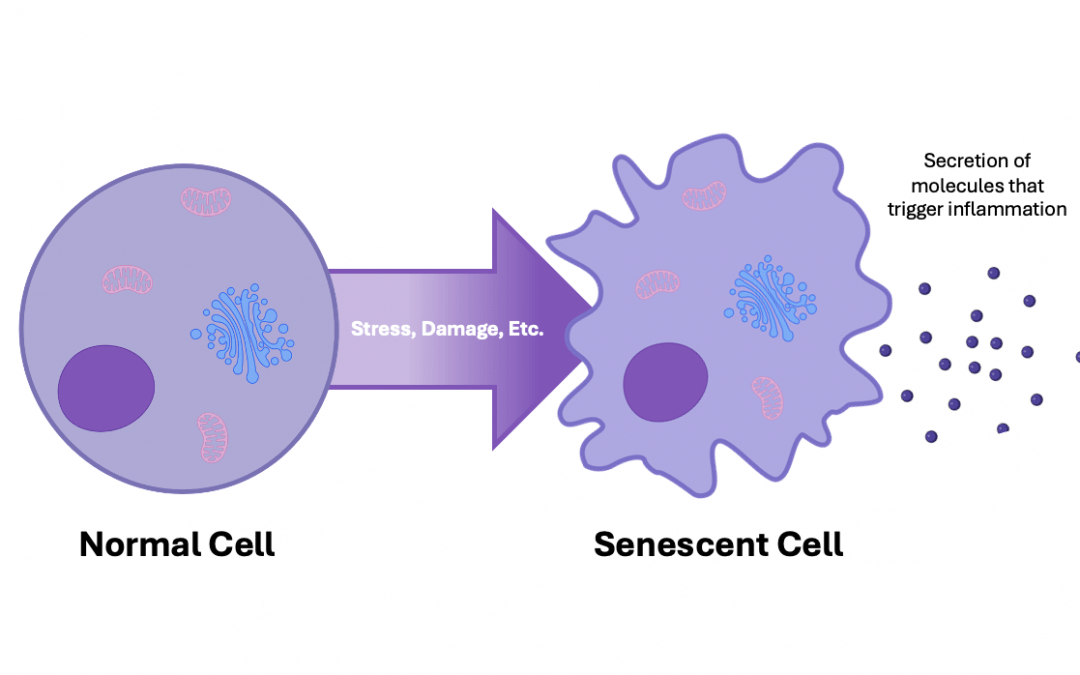
Instead, it enters a state called senescence.
John OssipinskyHOST
You may have heard senescent cells described as zombie cells.
John OssipinskyHOST
The cell is still alive but has stopped performing many of its normal functions.
John OssipinskyHOST
Even more importantly, some senescent cells begin releasing signals like cytokines that can change what is happening in the surrounding tissue.
John OssipinskyHOST
Researchers call this collection of signals a senescence-associated secretory phenotype, or SASP.
John OssipinskyHOST
You do not need to remember the term.
John OssipinskyHOST
What I want you to remember is that a damaged aging cell can remain in the tissue and release signals that promote inflammation and affect neighboring cells.
John OssipinskyHOST
Imagine an employee who stops doing the job they were hired to do but continues showing up every day and sending disruptive messages throughout the company.

speaker_2HOST
It remains metabolically active, but it's fundamentally broken.
speaker_2HOST
And as you age, these senescent cells just begin to accumulate all over your body.
speaker_2HOST
We find them building up in your skin, your kidneys, your blood vessels, muscle tissue, and even visceral fat.
speaker_1HOST
OK, let's unpack this, because if they are just sitting there not dividing, you might logically think they're just, I don't know, taking up dead space.
speaker_2HOST
But to understand the weapon, you first have to understand the zombie's armor.
speaker_1HOST
Okay, lay it on me.
speaker_2HOST
In these damaged senescent cells, there is a very specific survival mechanism that's keeping them alive against all odds.
speaker_2HOST
There is a protein called FOXO4.
1 more episode mentions Cellular senescence.
Create an account to see the whole feed, search across every transcript, and follow the entities you care about.