CD8
ProteinWikipedia
41
MENTIONS
9
EPISODES
6
PODCASTS
Search complete. 41 mentions across 9 episodes found for "CD8".
Sep 8, 2026

Mumtaz BalkhiGUEST
So it will be really important to further investigate those cell types.
Vincent RacanielloHOST
Also, the CD8-Temra findings are pretty striking.
Vincent RacanielloHOST
Right.
Vincent RacanielloHOST
And you talk about whether that's cytokine-driven or TCR engagement.
Mumtaz BalkhiGUEST
Yes, absolutely.
Mumtaz BalkhiGUEST
Again, I am glad you brought this point.
Mumtaz BalkhiGUEST
So we found this, there's a memory popular, there's a CD8 memory, there are different types.
Mumtaz BalkhiGUEST
There's an effector memory, there's a central memory, and there are these Tamra populations.

Daniel J. GuerraHOST
Now, these are going to be phenotypic markers on T-cells.
Daniel J. GuerraHOST
CD8 positive, CD45RA positive, CD57 positive cells.
Daniel J. GuerraHOST
And that's about what they had an elevation of is about an elevation associated with a percent increase of about 42% compared to the controls where the elevation was only about 24%.
Daniel J. GuerraHOST
So they doubled that phenotype.
Daniel J. GuerraHOST
Now these are CD8 positive cells, which are component of cytotoxic T lymphocytes.
Daniel J. GuerraHOST
Okay? So the TCS exhibited a trend toward an increment in CD28 minus cells.
Daniel J. GuerraHOST
And that's a group of pro-inflammatory cells that increase gradually with age.
Daniel J. GuerraHOST
It's a very complex Gordian knot and you have to Put yourself in the literature.

Yuan ZhaoHOST
What we observed was that in the spleen of older mice, these cells on the CD4 compartment were high.
Yuan ZhaoHOST
and also on the CD8 compartment were high, which led us to ask that it could be because of a functionality defect in the T follicular helper cells that led to the delayed mycobacterial clearance.
Yuan ZhaoHOST
which led us to do a proteomics experiment on the splenic CD4 T cells, which led us to capture MTB infection-induced alterations as well as treatment-induced alterations in old mice.
Yuan ZhaoHOST
We found two enzymes, 4-hydroxy-2-oxyglutarate aldolase and aspartate aminotransferase to be deregulated in older mice.

Christine BezombesonGUEST
And we are able first to characterize the sample, as we showed in the paper, that these models are mimicking the sample of origin.
Christine BezombesonGUEST
in terms of subtypes constitutions, so B, T, CD4, CD8, but also minor subtypes such as NK or even gamma delta T cells.
Christine BezombesonGUEST
We also showed that the immune checkpoint profile also mimics the sample of origin.
Christine BezombesonGUEST
we showed that they are reconstituting the immune microenvironment of the pathology.

Eric BalcavageGUEST
It's small possibility that it's TPO antibodies.
Eric BalcavageGUEST
The bigger driver of damage to the thyroid gland tissue is CD8 cells and the particles they release that damage the cells.
Eric BalcavageGUEST
TH1 cells, TH17 cells, and the cytokines they release.
Eric BalcavageGUEST
Those are the things that drive most of the damage to the tissue.
Eric BalcavageGUEST
As far as I'm aware, they're not going through the bloodstream, penetrate penetrating through the cell wall, getting inside the follicle and actually penetrating.
Eric BalcavageGUEST
binding to things there and actually creating the damage.
Eric BalcavageGUEST
More likely what's happening is there's inflammatory damage by the CD8 cells, the Th1 cells, the Th17 cells, the thyroid cells themselves, and we could talk about that mechanism if you want, And then when you have the destruction and now TPO and thyroglobulin start entering the bloodstream, now the antibodies are binding to those things more like a cleanup crew than they're actually creating the damage.
Eric BalcavageGUEST
So when you look at lymphocyte map panels, you can see in somebody who's got a thyroid condition, there may be TH1, TH17, CD8 dominant, one or a combination of those.
Daniel J. GuerraHOST
But you also have inducible T regs.
Daniel J. GuerraHOST
Now, what do they do? You'll recall they're all coming from a CD4 positive T cell population, not the s- not the CD8.
Daniel J. GuerraHOST
Well, they're gonna regulate.
Daniel J. GuerraHOST
That is, they're gonna suppress, these are suppressor cells for the entire lymphoid response.
Daniel J. GuerraHOST
So we didn't leave that kind of technology.
Daniel J. GuerraHOST
So that means, remember, the pharmaceutical companies, along with the biomedical community, have come up with strategies to kill cancer, and one of them is to process in vitro T cells, perhaps CD8 positive, perhaps CD4 positive, such a way that they have chimeric T cell receptors, which will then allow them to react to multiple neoantigens from cancers and evade the cancer's production of, for example, programmed death ligands and other molecules which would turn down the T cell activation proliferation.
Daniel J. GuerraHOST
Remember all of that, I'm sure.
Daniel J. GuerraHOST
And that goes all the way back to low-density lipoprotein receptor.
11 MINS LATER
Daniel J. GuerraHOST
And the metabolic reprogramming has to do with lipid metabolism.
Daniel J. GuerraHOST
In the tumor and micro, uh, microenvironment, myeloid cells have been detected to alter carbon source for ATP synthesis, so for example, and also lipid biosynthetic and lipid degrading pathways.
Daniel J. GuerraHOST
Okay? So an antigen-specific CD8 positive T cell that is introduced either into vaccinated or tumor-bearing mice receiving adequate equivalent amount of antigen stimulation.
Daniel J. GuerraHOST
When you study the CD8 positive T cells, your C- CTLs, your cytotoxic T lymphocytes, that are isolated from those tumors, what do you see? You see significantly lower cholesterol than those from vaccinated mice.

Sam SmithHOST
So you can kind of think of the CD4 or helper T cell as what its name says, as a helper, right? It's got all these different functions that kind of tie together different bits of the immune system.
Sam SmithHOST
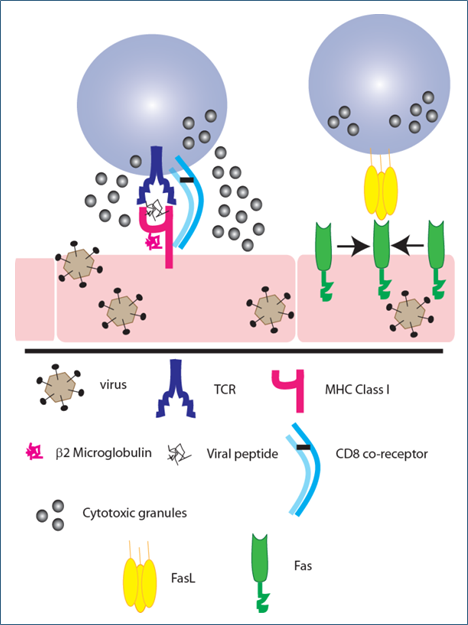
On the other hand, you have what are known as CD8 positive T cells or cytotoxic T cells.
Sam SmithHOST
And this is the second kind of T cell I want to talk about.
Sam SmithHOST
And these CD8 T cells bind to MHC class 1 molecules.
Sam SmithHOST
And remember, these are the glycoproteins that are able to bind to intracellular antigens.
Sam SmithHOST
And essentially their role is to bring these antigens to the surface of the cell and kind of let the cell say, hey, I'm infected with this bad pathogen.
Sam SmithHOST
You know, come help me take care of this pathogen.
Sam SmithHOST
Come kill me, whatever this T cell has to do to get rid of this pathogen.
Daniel J. GuerraHOST
So what I'm saying basically is if you come to Authentic Biochemistry Podcast, that as a biochemist, I acknowledge what I just stated there as fundamental truth, and that's what science, research science, is hopefully completely devoted toward.
Daniel J. GuerraHOST
When we think about cholesterol metabolic programming in tumor-infiltrating CD8 T cells, remember that we were asking a question from the papers that were published.
Daniel J. GuerraHOST
Is there adequate amounts of cholesterol genesis in these cells? Because we know cholesterol is necessary universally for these particular T lymphocytes to function to kill tumors.
Daniel J. GuerraHOST
Or do they require, do these cells require cholesterol coming trafficked from LDL, low-density lipoprotein, docking to its specific receptor and unloading cargo, including amongst other lipids and protein, cholesterol itself.
Daniel J. GuerraHOST
So that paper that we basically finished last lecture, which was Saturday, discovered that low-density lipoprotein receptor transcription level was decreased in cytotoxic T lymphocytes.
Daniel J. GuerraHOST
Those are CD8 positive T cell specificity there, a terminal differentiation therein, when they infiltrate into tumor microenvironments.
Daniel J. GuerraHOST
Do you understand? The tumor microenvironment alters the transcription of the low-density lipoprotein receptor in the cytotoxic T lymphocytes that are there to kill the tumor.
Daniel J. GuerraHOST
And so the reduced surface level of the receptor in those tumor-infiltrated cytotoxic T lymphocytes was evaluated via a several cytometric analyses.