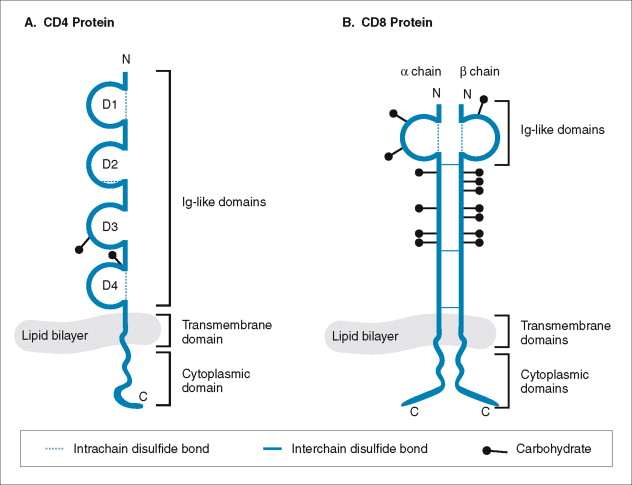
CD4
ProteinWikipedia
87
MENTIONS
22
EPISODES
20
PODCASTS
Search complete. 87 mentions across 22 episodes found for "CD4".
Sep 18, 2026

Jordan GauthierGUEST
But it is somewhat still possible.
Jordan GauthierGUEST
So a lot of research looks like CD4 CAR T cells may be involved.
Jordan GauthierGUEST
There could be some trafficking and expression of specific integrin receptors or chemokine receptors that might also influence trafficking to the central nervous system or the peripheral nervous system.
Robin FoàHOST
The reality is that the management of hematological malignancies has changed completely.

Klaus LeyGUEST
You have more T-cells.
Klaus LeyGUEST
And we have for years studied CD4 T-cells.
Klaus LeyGUEST
But let me back off.
Klaus LeyGUEST
From the clinical perspective, we talk about residual risk.
Cindy St. HilaireHOST
What do we know about what's causing the immune system to break tolerance and see this protein as a bit of an enemy? Do we know what's going on there?
Klaus LeyGUEST
That's a really great question.
Klaus LeyGUEST
So when you look in healthy people, and this was a paper in Circulation 2018, first author Kimura, in healthy people, most ApoB reactive T cells, CD4 T cells are regulatory T cells.
Klaus LeyGUEST
So regulatory T cells are cells that keep the peace.

Linda WespGUEST
And so a lot of the patients in my care, and I was doing the nursing care for them, were still struggling having just not a lot of options because with the previous HIV medication regimens, there were not... fully, you know, they were not fully suppressing their virus.
Linda WespGUEST
So they had a lot of mutations and a lot of side effects and handfuls of pills that they'd have to take every day to keep their viral loads relatively suppressed and their CD4 counts somewhat stable.
Linda WespGUEST
And there was a new medication that was out that was literally a lifesaver for a lot of people called Fuseon, which was an injectable medication.
Linda WespGUEST
And so I ran the the patient education groups to teach them how to do these injections that they have to do every day.
Linda WespGUEST
And we were starting to see the guidelines shift.
Linda WespGUEST
You could treat everybody now.
Linda WespGUEST
You didn't have to wait for their CD4 count for their immune system to get worse.
Linda WespGUEST
And then fast forward even more, we started to have HIV prevention medication available.

Peter Chin-HongPANELIST
So that still holds.
Peter Chin-HongPANELIST
I think for HIV, as we all know, for CD4 count over 200 undetectable viral load, it's kind of an exception rather than a rule.
Peter Chin-HongPANELIST
So I think people are still very wary about giving MMR to patients you know, immune-compromised individuals.
Peter Chin-HongPANELIST
Bonnie, I don't know if you have any other thoughts about that.

Michael BalecaHOST
Mm-hmm.
Molly KiltyHOST
Very specifically, HIV is gonna target CD4 receptors that are found on our helper T cells, okay?
Michael BalecaHOST
Mm-hmm.
Molly KiltyHOST
Now, these are critical, critical cells within our adaptive immune system, okay? Very, very important.
Molly KiltyHOST
[laughs] Um, very, very important cell types to our immune response.
Molly KiltyHOST
Um, again, that adaptive immunity, so fighting specific pathogens, not, you know, just generalized, um, you know, issues.
Molly KiltyHOST
So it will target our CD4 receptors on our helper T cells, um, in a highly specific way.
Michael BalecaHOST
Mm-hmm.

Michael DadzieHOST
And that's why all Ghanaian prophets are killing the nation.
Michael DadzieHOST
I see CD4.
Michael DadzieHOST
I see this.
Michael DadzieHOST
I see this.

Robert WhitfieldHOST
That similarity can be biologically informative while still leaving open what initiated the response, how long it has been present, and whether it is actually driving contracture or just accompanying the contracture.
Robert WhitfieldHOST
The study also reported signatures consistent with several immune cell populations, including B cells, plasma cells, CD4 T cells, and macrophages.
Robert WhitfieldHOST
Now, B cells participate in the adaptive immunity and can develop into plasma cells, which produce antibodies, which is important.
Robert WhitfieldHOST
CD4 T-cells help coordinate immune responses.
Robert WhitfieldHOST
Macrophages can participate in inflammation, debris clearance, wound healing, and fibrosis.
Robert WhitfieldHOST
And if you all remember from the last talk I gave, Dr. Muthun Sinha showed that there's macrophage polarization due to changes in the TBET and TH1 pathway.
Robert WhitfieldHOST
We'd need additional evidence showing relevant targets.
Robert WhitfieldHOST
reproducible clinical associations, and obviously more appropriate ways to validate it in independent populations.

Brenda RaudHOST
Like I will get them, I have mixed cultures and I just put IL-2.
Brenda RaudHOST
they will proliferate, but the CD4 cells will not.
Brenda RaudHOST
Unless I'm really stimulating them with their TCR or putting the right peptide, they don't move at all.
Brenda RaudHOST
But the CD8s, they actually respond to the CD4s being activated, making IL-2, and then they proliferate even if they don't have no antigen to recognize.
Brenda RaudHOST
So I wonder whether, yeah, it's, yeah, but that's not what you're seeing in your, at least in this context.
Brenda RaudHOST
Mm-hmm.

Henry MasurGUEST
So the hospitals are adopting and saying that for cryptococcal meningitis, this should be the therapy of choice.
Henry MasurGUEST
How many people are doing that? for pneumocysts, prophylaxis, the CD4 count under 200 should be on trimethylamine sulfate.
Henry MasurGUEST
We know that people are beginning to adopt these.
Henry MasurGUEST
And when you do granular assessments of patients who are admitted with AIDS, you can see whether the patients are following the guidelines for other things.
12 MINS LATER
Henry MasurGUEST
So I guess my point is there's some situations where you can use GRADE, but a lot of situations where you really don't need it.
Henry MasurGUEST
So what's another problem with the guidelines? Sometimes data is not binary.
Henry MasurGUEST
And when we say, for instance, start pneumocystis prophylaxis at a CD4 count of 200, that seems pretty clear cut.
Henry MasurGUEST
But if you look at the data, here's the data.

Daniel J. GuerraHOST
And also the fact that it's one of the main dehydrogenases to generate NADH, which will also be, of course, reoxidized to generate ATP in the mitochondria.
Daniel J. GuerraHOST
So this ABHD11 as a hydrolase, controlling the alpha-ketoglutarate dehydrogenase is important in CD4 positive T cells.
Daniel J. GuerraHOST
And what's interesting about this, that protein, the alpha-beta hydrolase containing protein, while it maintains the catalytic function of the alpha-ketoglutarate dehydrogenase and therefore expression in the CD4 positive T cells, It's linked to actually a remission of remitting relapsing rheumatoid arthritis, RA, which is chronic inflammatory disease.
Daniel J. GuerraHOST
So when you do a pharmacological inhibition of the ABHD11, which maintains that catalytic function, it dampens the cytokine production by T cells.
Daniel J. GuerraHOST
You see? So the anti-inflammatory effects of the alpha-beta hydrolase domain-containing protein inhibition occur because there's an increase in the 24-25 epoxy cholesterol biosynthesis from the CYP, that is the cytochrome P450 isoform 7 enzymatic activity.
12 more episodes mention CD4.
Create an account to see the whole feed, search across every transcript, and follow the entities you care about.