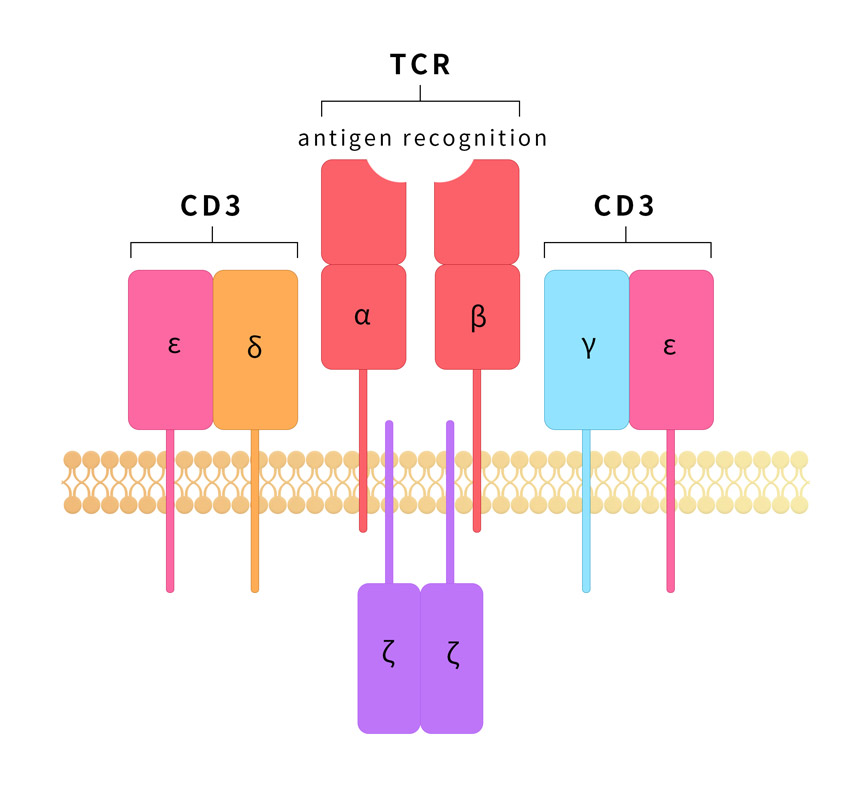
CD3
ProteinWikipedia
39
MENTIONS
13
EPISODES
12
PODCASTS
Search complete. 39 mentions across 13 episodes found for "CD3".
Sep 25, 2026

Lei FangGUEST
The 4.1BB doesn't work well.
Lei FangGUEST
So the further explorations we find, when you bring the CD3 and the 4.1BB together, we can do it.
Lei FangGUEST
So I incubate these platforms in the Liverpool Biopharma, which is likely to come back to the end of 2024.
Lei FangGUEST
We have opportunities because the Liverpool Biopharma wants to focus more on the development of ADC, and because there is one PD-1 approved in China, the second There's a EZLFR-based ADC already approved in China.
Lei FangGUEST
I know Jialun is one of IMAP, he was the first CFO of IMAP, and we bring IMAP to Nasdaq.
Lei FangGUEST
So I gave him a call, we have a hot pot dinner, and we decided to do it together.
Lei FangGUEST
We are lucky once we get the opportunity to get financing and also to bring the leading asset out and also related to CD3 platforms out.
Lei FangGUEST
And there is where we started from AccelerPoint.

Tanya SiddiqiGUEST
And we put her on a CD19 CAR-T trial, didn't respond to that, unfortunately.
Tanya SiddiqiGUEST
And then I took her to CD3, CD20 bispecific antibody, epcortimab, is what she got.
Tanya SiddiqiGUEST
And unfortunately, didn't do well with that either, but goes to show that that's sort of where I'm trying to use epcortimab and glufidamab type of bispecific antibodies in DLBCL currently.
Neil LoveHOST
So, Jeff, any comments on the use of bispecific antibodies in the community? You know, we've had this situation where a lot of times people are starting out in academic centers.
30 MINS LATER
Neil LoveHOST
Let's talk about it.
Brad S KahlGUEST
Yeah, I'm not sure I've seen phase one data look this good in a long time.
Brad S KahlGUEST
This is a bispecific that targets CD19 and CD3, so it's not targeting CD20 like our currently available bispecifics.
Brad S KahlGUEST
And this was a trial in which it was combined with rituximab for a for frontline follicular lymphoma.

Rahul GosainHOST
Maziar, just to close off, when we have different bispecific antibodies, how do you pick one over the other? Epcoritumab, glufitumab, what's your go-to here? And what can we learn from this in community settings?
Maziar ShadmanGUEST
I think the two bispecifics, again, similarly, they target the same antigen, in this case, CD20, CD3.
Maziar ShadmanGUEST
So it's mainly logistics from, you know, one with BEPCO being a sub-Q with a more complicated schedule of weekly and then every two weeks and every four weeks, and it's treated until progression, not time-limited.
Maziar ShadmanGUEST
But it's sub-Q and patients like that.

ChristopheHOST
In humans, we see a measurable increase in certain markers that tell us that the fight against cancer will probably be improved.
ChristopheHOST
So we see an increase in CD3, CD4, CD8 in natural killer activity.
ChristopheHOST
All of this in link with immunity and all those data depending on the different trials that were done.
ChristopheHOST
Number two, increase in tumor response, so a more direct and targeted action primarily through the terpenes.

Rafael GonzalezGUEST
Everybody's using that term exosome.
Rafael GonzalezGUEST
It should be called the secretome or a conditioned media, depending on how you make it, um, because the way you isolate, you know, if you look at exosomes, what we know now, and you should be asking the questions of is, uh, is it truly an exosome following when I get it, when I thaw it, when I use it? Show me that there's the particular markers you look at Outside of the, the exosome three markers, CD3, uh, I think, yeah, CD3, 63, 81.
Rafael GonzalezGUEST
You look at those three, three different things and how much of that is actually in there?
Nathalie NiddamHOST
Mm.

Ira PastorHOST
We want to sort of blind it, um, to going there.
Ira PastorHOST
We want to sort of redirect it towards T cells through this CD3- Uh, targeting, and on top of that, deliver the CAR.
Ira PastorHOST
So, you know, here we, after we targeted the T cells, then we wanted to look for whatever the cancer cell is, and in the particular case what we're discussing, it's this BCMA target in, in malignant plasma cells.
Ira PastorHOST
And then on top of all that, and I'll shut up because [laughs] I don't want you to take all the time, there's G-Link.
Luke RussellGUEST
So we're trying to harness that power.
Luke RussellGUEST
We're taking the VSVG protein and saying, "Okay, well, we no longer want to bind to the LDL receptor.
Luke RussellGUEST
We want to bind to CD3.
Luke RussellGUEST
How do we figure that problem out?" We, um, we, I think benefited a great deal from some really pioneering work that came out of France, and there's a group at CNRS that identified the receptor binding sites on VSVG for the LDL receptor and then started to mutate them and see, you know, do these mutations inhibit the ability of the virus to bind to the LDL receptor? [coughs] And so they, you know, they published on some of that work and I think gave the field a lot of new ideas about how to, uh, disrupt this interaction because those specific residues that were involved were now identified for everyone to see.

Michael RadleyHOST
Cujan, $19.
Michael RadleyHOST
CD3, $51.
Michael RadleyHOST
Vinita Rose at $51.
Michael RadleyHOST
The Wanda Waver at $16.

Kim KlacikHOST
So we will talk about that.
Kim KlacikHOST
Also, we have congressional candidate Bernie Flowers in CD3.
Kim KlacikHOST
He'll be joining us at 10 o'clock.
Kim KlacikHOST
We'll talk about his race, of course.
1 HR 2 MINS LATER
Kim KlacikHOST
And I was hoping that at least Dr. Fauci would be held responsible, but It doesn't seem like we're going to get there anytime soon.
Kim KlacikHOST
But with all that said, I wanted to talk to you again.
Kim KlacikHOST
Bernie Flowers held a line with us in CD3.
Kim KlacikHOST
I wanted to talk to you about what's currently happening in Iran.

Laurie SehnHOST
Of course, however, not all patients respond to therapy, and those that do can acquire resistance over time.
Laurie SehnHOST
Perhaps you can start by providing some background on what was previously understood about the resistance mechanisms of CD3, CD20 bispecific antibodies and the limitations of some of the standard platforms that have been used.
Christine BezombesonGUEST
Thanks a lot for this question about the mechanism of resistance, not so much known and studied.
Christine BezombesonGUEST
The major one is the low expression of the target, the CD20, and the exhaustion of T-cells.

Mike ChristelHOST
Finally, CYMSIR-Zyming licenses its tri-specific antibody CYMO660 to Roach in a deal worth $75 million up front and up to $1.53 billion in total payments plus tiered double-digit royalties.
Mike ChristelHOST
CYMO 660 targets CD79A, CD19, and CD3 simultaneously, pairing a CD3-engaging arm with two B-cell antigen-binding domains to drive T-cell-mediated cytotoxicity against B-cell malignancies and autoimmune diseases while limiting cytokine release.
Mike ChristelHOST
The agreement is SimSeer's sixth major out-licensing deal, pushing the aggregate potential value of those transactions past $6.1 billion.
Mike ChristelHOST
Thanks for listening to Pharmaceutical Executive Daily.
3 more episodes mention CD3.
Create an account to see the whole feed, search across every transcript, and follow the entities you care about.