CD28
ProteinWikipedia
10
MENTIONS
6
EPISODES
5
PODCASTS
Search complete. 10 mentions across 6 episodes found for "CD28".
Sep 14, 2026

Paolo StratiGUEST
Now for some CAR T-cell products that don't grow too quickly with what we call cost-simulatory domain called 4-1-BB, some centers are able to provide CAR T-cell infusion completely outpatient and patient will just come back on a daily basis to be monitored for complications.
Paolo StratiGUEST
But for others, those that have a co-simulatory domain called CD28, most of centers will require inpatient hospitalization up to day plus seven, and then subsequently patients, if they have no complications, and this includes cytokine release syndrome and immune cell-associated neurotoxicity syndrome, in addition to potential infections, then they can be discharged, but they're still being monitored very closely.
Paolo StratiGUEST
Now, the requirement for monitoring has changed recently.
Paolo StratiGUEST
Up to last year, there was an expectation in the patient's best interest that they would stay in the vicinity of the academic center for about four weeks after the cortisol infusion.

Michael ByrneGUEST
In the CD19, the large cell lymphoma space, AxiCell was, I think, one of the first, if not the first, CD19 CAR to come to market in large B-cell lymphoma.
Michael ByrneGUEST
The co-stimulatory domain is CD28, so it has rapid in vivo expansion.
Michael ByrneGUEST
At the peak of expansion, we see high rates of CRS and neurotoxicity.
Michael ByrneGUEST
Their second generation that's now in clinical trials, it's a different construct.
Michael ByrneGUEST
It has the CD28 for CD19, but it has a 401BB construct for the CD20 arm of it.
Michael ByrneGUEST
What they've seen so far is a significant improvement in the toxicity profile of that drug, and the responses, at least in the very early data, look at least as good as the the prior iteration.
Michael ByrneGUEST
With that, they have a little bit different, they've adjusted their manufacturing, so they've shortened the amount of time that the cells are, it's a more naive T cell population, so the cells are, the manufacturing time is reduced by a few days, and Kite already has some of the best, in my opinion anyway, the best manufacturing efficiency of anyone in the industry.

Sairah AhmedGUEST
... you know, being aggressive in terms of managing the CRS.
Sairah AhmedGUEST
We actually have an algorithm at our institution where CD28 costimulatory domain toxicity is treated differently than 4-1BB at the initial onset because we know that, you know, giving a dose of steroids with the tocilizumab for axicell CRS, you know, you, you, you're gonna potentially head off going into-
Elif YilmazHOST
Mm-hmm
Sairah AhmedGUEST
... a higher grade CRS.

Daniel J. GuerraHOST
Now these are CD8 positive cells, which are component of cytotoxic T lymphocytes.
Daniel J. GuerraHOST
Okay? So the TCS exhibited a trend toward an increment in CD28 minus cells.
Daniel J. GuerraHOST
And that's a group of pro-inflammatory cells that increase gradually with age.
Daniel J. GuerraHOST
So you see, we do see a decrease in pro-inflammatory cells in both directions.
Daniel J. GuerraHOST
And in fact, in geriatric population, CD28 cells, they will start to change and decline up to about 50% once a person reaches 70, 75 years old.
Daniel J. GuerraHOST
In fact, the percentage of CD28 cells in the control group was 1.5%, which was normally found in what you would think you would find in young adults.
Daniel J. GuerraHOST
So it means that component was not altered, even though there was an incremental decrease.
Daniel J. GuerraHOST
So The more you look at all of the evidence, the more you can then assess whether or not the patients who developed an early onset immunosenescence after chemotherapy for their testicular cancer who survived are indeed becoming immunosenescent.

Brenda RaudHOST
Um, so basically they show that, um, if you have this tethered low affinity, uh, IL-2 mutated mu-mutine tethered to its orthogonal receptor and cells that express this are actually much better at, um, yeah, activating the right pathway, STAT5 phosphorylation, for example.
Brenda RaudHOST
And in a diabetes mouse model, so in an in vivo situation, they can much better, uh, survive and protect, uh, up to five times, or they need five times less cells to protect the mice from, uh, developing, uh, diabetes in a nod, uh, m-mouse model that is lacking also CD28, and this is a well-known diabetes model.
Brenda RaudHOST
Um, so I thought it was pretty interesting because then you have this-- Yeah, it's kind of you have the receptor and its own cytokine together, and that really prevents it from, from activating other molecules or from just, like, leaving and not stimulating the receptor properly.
Jason GoldsmithHOST
That's a really interesting approach for the whole thing.
Daniel J. GuerraHOST
But you need specific molecular species of phosphoglycerolipid, sphingolipid, and cholesterol by itself to organize that membrane microvillus structure.
Daniel J. GuerraHOST
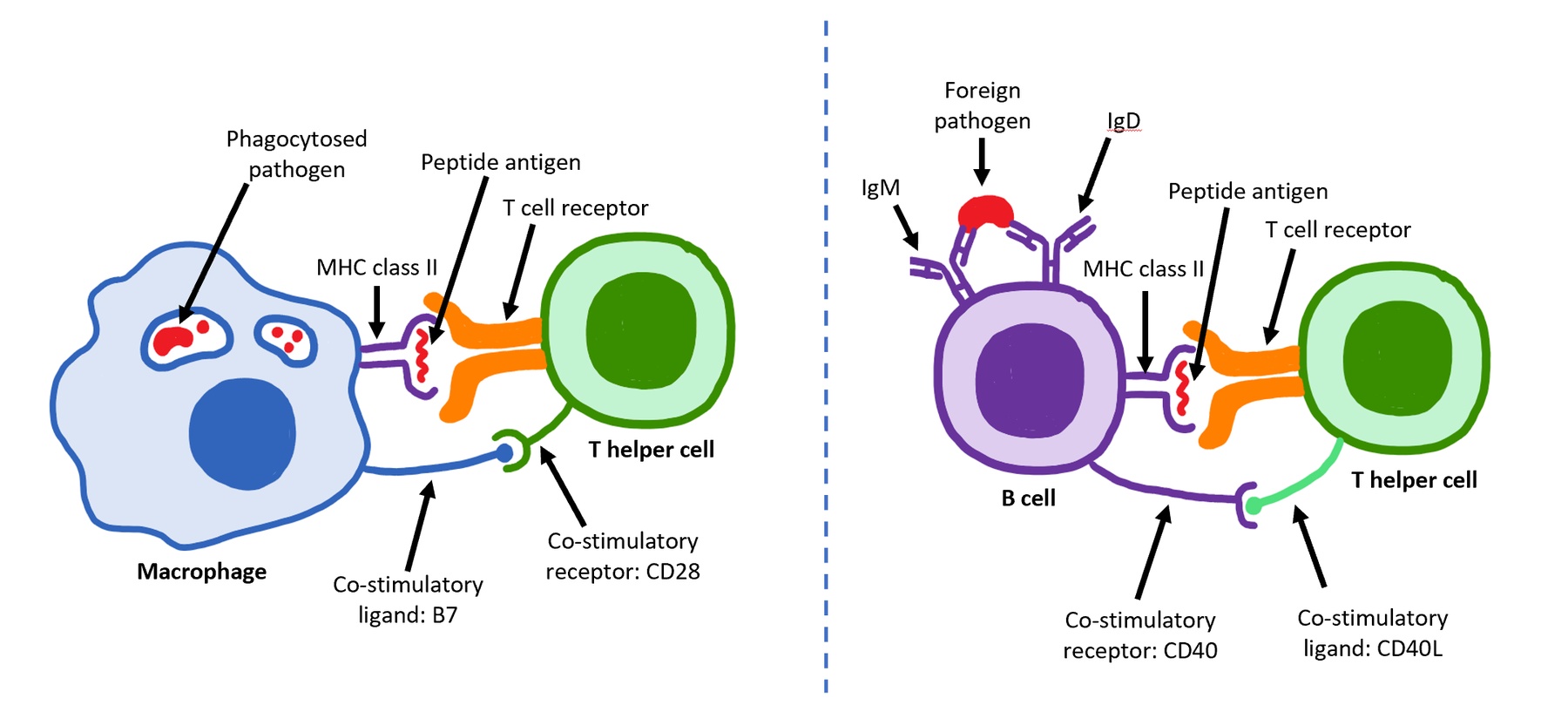
And what are the receptors we're talking about in T cells? The T cell receptor itself, CD2, CD3, CD4, CD8, CD28, CD45.
Daniel J. GuerraHOST
Those are all proteins.
Daniel J. GuerraHOST
Those are cluster differentiation proteins on the surface of the plasma membrane of T cells that organize around the T cell's function.