CD16
25
MENTIONS
5
EPISODES
4
PODCASTS
Search complete. 25 mentions across 5 episodes found for "CD16".
Oct 23, 2026

Cynthia DunbarGUEST
So, you know, they've become very interesting cell types over time.
Cynthia DunbarGUEST
And this dogma has been that NK cells are continuously produced and that they're very short-lived from hematopoietic stem and progenitor cells with a series of maturation steps going from CD56 bright to CD56 dim and gaining CD16 and the ability to be cytotoxic.
Cynthia DunbarGUEST
But, you know, that makes it more difficult to imagine using these cells as adoptive cell therapies that are going to stick around for very long.
Cynthia DunbarGUEST
So rhesus macaque and K cells, I won't spend a lot of time on this, but they have a few differences in terms of cell surface expression from human in that they lose CD56 expression almost completely when they gain CD16, unlike human cells that stay dim.
Cynthia DunbarGUEST
But otherwise, you know, they're very similar, and I won't go more into that right now.
Cynthia DunbarGUEST
But basically we were really surprised on these heat maps and clonal mapping when we started looking and we saw, okay, we saw these multipotent clones that were contributing to all lineages stably over time.
Cynthia DunbarGUEST
And then we saw, you know, the T cell clones, you know, here that I already pointed out, but then we saw these massive clonal expansions of NK cells, specifically in mature NK cells, quote unquote, mature NK cells, the CD16 positive, CD56 dimmer negative NK cells.
Cynthia DunbarGUEST
And this was, you know, really a surprise.

Cynthia DunbarGUEST
So they've become very interesting cell types over time.
Cynthia DunbarGUEST
And this dogma has been that NK cells are continuously produced and that they're very short-lived from hematopoietic stem and progenitor cells with a series of maturation steps going from CD56 bright to CD56 dim and gaining CD16 and the ability to be cytotoxic.
Cynthia DunbarGUEST
But, you know, that makes it more difficult to imagine using these cells as adoptive cell therapies that are going to stick around for very long.
Cynthia DunbarGUEST
So rhesus macaque and K cells, I won't spend a lot of time on this, but they have a few differences in terms of cell surface expression from human in that they lose CD56 expression almost completely when they gain CD16, unlike human cells that stay dim.
Cynthia DunbarGUEST
But otherwise, they're very similar, and I won't go more into that right now.
Cynthia DunbarGUEST
But basically we were really surprised on these heat maps and clonal mapping when we started looking and we saw, okay, we saw these multipotent clones that were contributing to all lineages stably over time.
Cynthia DunbarGUEST
And then we saw, you know, the T cell clones, you know, here that I already pointed out, but then we saw these massive clonal expansions of NK cells, specifically a mature NK cells, quote unquote, mature NK cells, the CD16 positive, CD56 dimmer negative NK cells.
Cynthia DunbarGUEST
And this was, you know, really a surprise.

Daniel J. GuerraHOST
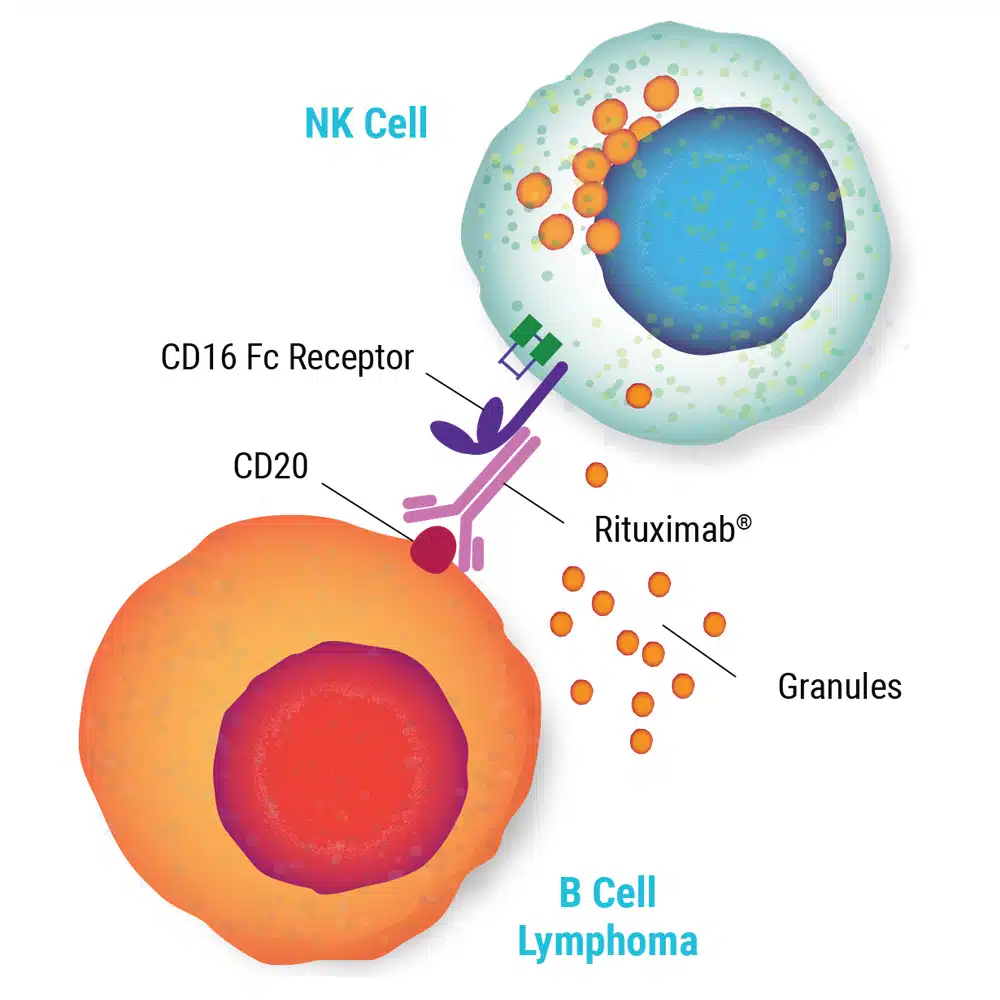
So working through the ADCC, what happens is there's a recognition and killing of the cells that are essentially already opsonized with immunoglobulin.
Daniel J. GuerraHOST
So if you have immunoglobulin one or three antibodies, And they're functioning through the CD16A because there's a polymorphism in CD16 where there's either a phenylalanine, like a phenylalanine 158 low affinity or a valine 158 high affinity.
Daniel J. GuerraHOST
That precisely seems to affect the affinity for the FC portion of the antibody, and that influences the natural killer cell-mediated ADCC.
Daniel J. GuerraHOST
Okay? Which, again, antibody-assisted, basically, destruction of the target cell, tumor cell, for example.
Daniel J. GuerraHOST
For example, the glycocalyx associated with the FC region of specific cytotoxic antibodies.
Daniel J. GuerraHOST
Now, why is that? Because I told you that these carbohydrates will bind to proteins that act as lectins.
Daniel J. GuerraHOST
And so a certain glyco modification of the FC region can promote cytotoxicity of antibodies by improving their binding to that CD16A.
Daniel J. GuerraHOST
And of course, I've already talked to you about swapping out phenylalanine for valine, so amino acid substitutions.

SamHOST
So will you just hit on that real quick?
CorrineHOST
Yes, it's an anti-HER2 antibody engineered for elevated affinity to both allelic variants of CD16A, enhancing the antibody-dependent cell-mediated cytotoxicity.
SamHOST
Definitely.
SamHOST
And so finally, let's think about our triple-negative metastatic breast cancer patients.
Daniel J. GuerraHOST
These include CD56, which is encoded by the NCAM gene, and then CD16A, which is encoded by the FCGR3A gene in the human genome.
Daniel J. GuerraHOST
Now, discussing phenotypically, when you have a CD56 bright CD16 minus NK cell, That particular phenotype exhibits low cytotoxicity, but high productivity of cytokines, growth factors, and chemokines.
Daniel J. GuerraHOST
Now, by contrast, When you see a CD56 DIM, now again, these are clusters of differentiation proteins on the surface of the cell, and DIM would mean a diminished amount, right? But CD16 positive NK cells, well, what do you think they're going to be? Well, they're going to be the adverse.
Daniel J. GuerraHOST
They're highly cytotoxic due to the expression of grandsons, specifically GZMA and GZMB.
Daniel J. GuerraHOST
plus the perforin protein, which is PRF1.
Daniel J. GuerraHOST
So don't be confused by the fact when we talk about various NK cell lines, you're going to see more than three being discussed in the literature.
Daniel J. GuerraHOST
So type 1 NK, the NK1s, are abundant in the blood.
Daniel J. GuerraHOST
and they correspond to that phenotype I've already been covering, CD56 dim, CD16 positive, which means they're mostly cytolytic.