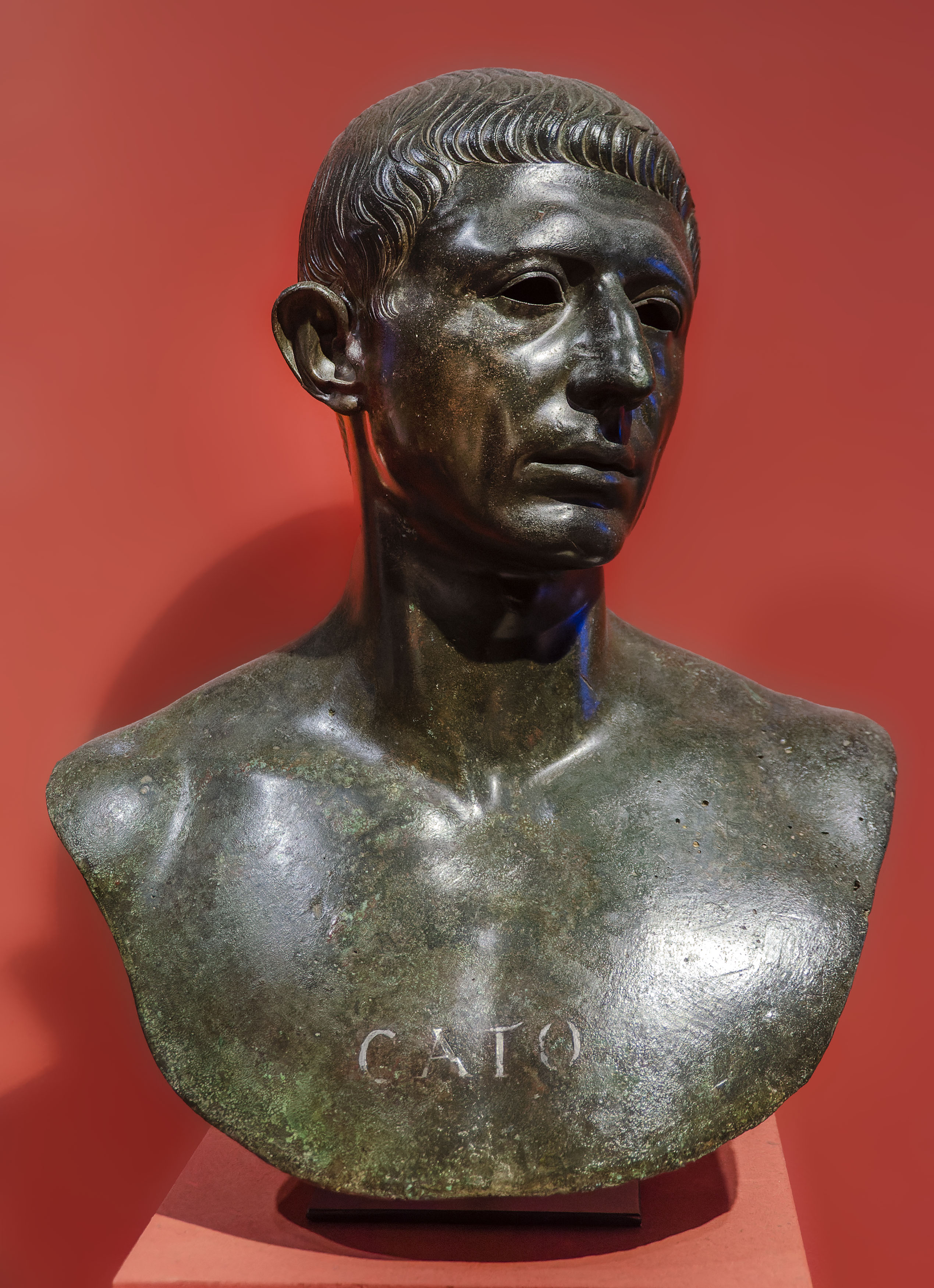
Cato the Younger
Roman oratorWikipedia
246
MENTIONS
24
EPISODES
23
PODCASTS
Search complete. 246 mentions across 24 episodes found for "Cato the Younger".
Sep 16, 2026

Mark HarringtonNARRATOR
There is a wrong and a right side in politics, as in everything else, and in the struggle which brought the Roman Republic to an end the partisans of Caesar, as we now see, were in the right.
Mark HarringtonNARRATOR
It need not greatly alter our estimation of Cicero and Cato as men, or even as statesmen, that in that struggle they did battle for a constitution whose continuance would have been Rome's ruin.
Mark HarringtonNARRATOR
Their position was intelligible, consistent, justifiable, as it appeared in the heat of the contest even noble, for they were fighting for an idea, and Caesar for his personal gain.
Mark HarringtonNARRATOR
But despite Cicero's literary power and Cato's force of character, a history of Rome for the century which followed the fall of Carthage, if written by either the one or the other, would have been a very lamentable production.
Mark HarringtonNARRATOR
They would have misunderstood everything, and consequently misexplained everything.
Mark HarringtonNARRATOR
The way in which Cicero alludes to the men and the events of the period of the Gracchi should be sufficient to convince us of this.
Mark HarringtonNARRATOR
The chapters on politics in Rome in the year which succeeded the Gracchan revolution, and again after the consulship of Pompey and Crassus in B.C. 70, can hardly be too highly praised, especially when we consider how soon after the events narrated they were written.
Mark HarringtonNARRATOR
Sallust, indeed, except when speaking of the dictator himself, never allowed his Caesarean sympathies to carry him away, and it is difficult to understand how Professor Mommsen could permit himself to speak of the Catiline and Jugurtha as partisan pamphlets.

Catharine EdwardsGUEST
Other times, he seems to be ready to accommodate some flexibility in relation to someone like Pompey or Julius Caesar when he's actually gonna get a favor from them.
Catharine EdwardsGUEST
So that could be a, a kind of critical view of Cicero, but I think Cicero himself was very critical of his contemporary Marcus Cato for being so inflexible, and Cato died fighting against Julius Caesar and Julius Caesar's forces in, in North Africa at the end of the civil war, and Cicero felt a bit embarrassed almost to have lived, to have carried on.
Catharine EdwardsGUEST
You know, Cato took his own life 'cause he didn't want to live under Caesar's tyranny, and Cicero lived on.
Catharine EdwardsGUEST
He tried to find other ways of perhaps doing something to mitigate Caesar's new system.

Mark HarringtonNARRATOR
There is a wrong and a right side in politics, as in everything else, and in the struggle which brought the Roman Republic to an end the partisans of Caesar, as we now see, were in the right.
Mark HarringtonNARRATOR
It need not greatly alter our estimation of Cicero and Cato as men, or even as statesmen, that in that struggle they did battle for a constitution whose continuance would have been Rome's ruin.
Mark HarringtonNARRATOR
Their position was intelligible, consistent, justifiable, as it appeared in the heat of the contest even noble, for they were fighting for an idea, and Caesar for his personal gain.
Mark HarringtonNARRATOR
But despite Cicero's literary power and Cato's force of character, a history of Rome for the century which followed the fall of Carthage, if written by either the one or the other, would have been a very lamentable production.
Mark HarringtonNARRATOR
They would have misunderstood everything, and consequently misexplained everything.
Mark HarringtonNARRATOR
The way in which Cicero alludes to the men and the events of the period of the Gracchi should be sufficient to convince us of this.
Mark HarringtonNARRATOR
The chapters on politics in Rome in the year which succeeded the Gracan Revolution, and again after the consulship of Pompey and Crassus in B.C. 70, can hardly be too highly praised, especially when we consider how soon after the events narrated they were written.
Mark HarringtonNARRATOR
Sallust indeed, except when speaking of the dictator himself, never allowed his Caesarean sympathies to carry him away, and it is difficult to understand how Professor Mommsen could permit himself to speak of the Catiline and Jugurtha as partisan pamphlets.

Mark HarringtonNARRATOR
There is a wrong and a right side in politics, as in everything else, and in the struggle which brought the Roman Republic to an end, the partisans of Caesar, as we now see, were in the right.
Mark HarringtonNARRATOR
It need not greatly alter our estimation of Cicero and Cato as men, or even as statesmen, that in that struggle they did battle for a constitution whose continuance would have been Rome's ruin.
Mark HarringtonNARRATOR
Their position was intelligible, consistent, justifiable, as it appeared in the heat of the contest even noble, for they were fighting for an idea, and Caesar for his personal gain.
Mark HarringtonNARRATOR
But despite Cicero's literary power and Cato's force of character, a history of Rome for the century which followed the fall of Carthage, if written by either the one or the other, would have been a very lamentable production.
Mark HarringtonNARRATOR
They would have misunderstood everything, and consequently misexplained everything.
Mark HarringtonNARRATOR
The way in which Cicero alludes to the men and the events of the period of the Gracchi should be sufficient to convince us of this.
Mark HarringtonNARRATOR
The chapters on politics in Rome in the year which succeeded the Gracchian Revolution, and again after the consulship of Pompey and Crassus in BC 70, can hardly be too highly praised, especially when we consider how soon after the events narrated they were written.
Mark HarringtonNARRATOR
Sallust, indeed, except when speaking of the dictator himself, never allowed his Caesarian sympathies to carry him away, and it is difficult to understand how Professor Mommsen could permit himself to speak of the Catiline and Jugurtha as partisan pamphlets.

speaker_3NARRATOR
It was approved of by the two Lucullai, by Marcus Crassus, by Quintus Hortensius, by Gaius Curio, by Gaius Piso, by Marcus Glabrio, by Marcus Lepidus, by Lucius Volcatius, by Gaius Figulus, by Decimus Silanus, by Lucius Marena, who at that time were the consuls elect.
speaker_3NARRATOR
The same consulship which was also approved of by those men of consular rank was approved of by Marcus Cato, who escaped many evils by departing from this life, and especially the evil of seeing you consul.
speaker_3NARRATOR
But above all, my consulship was approved of by Gnaeus Pompeius, who, when he first saw me as he was leaving Syria, embracing me and congratulating me, said that it was owing to my services that he was about to see his country again.
speaker_3NARRATOR
But why should I mention individuals? It was approved of by the Senate, in a very full house, so completely that there was no one who did not thank me as if I had been his parent, who did not attribute to me the salvation of his life, of his fortunes, of his children, and of the republic.
7 HRS 44 MINS LATER
speaker_3NARRATOR
But if fortune had not taken from us not only Servius Sopiccius, and before him his colleague Marcus Marcellus, what citizens, what men! If the republic had been able to retain the two consuls, men most devoted to their country, who were driven together out of Italy, and Lucius Afranius, that consummate general, and Publius Lentulus, a citizen who displayed his extraordinary virtue on other occasions, and especially in securing my safe return, and Bibulus, whose constant and firm attachment to the republic has at all times been deservedly praised, and Lucius Domitius, that most excellent citizen, and Appius Claudius, a man equally distinguished for nobleness of birth and for attachment to the senate, and Publius Scipio, a most illustrious man, closely resembling his ancestors.
speaker_3NARRATOR
Certainly with these men of consular rank the senate which supported Pompeius was not to be despised.
speaker_3NARRATOR
Which, then, was more just, which was more advantageous for the republic, that Gnaeus Pompeius, or that Antonius, the brother who bought all Pompeius' property, should live? And then what men of praetorian rank were there with us, the chief of whom was Marcus Cato, being indeed the chief men of any nation in the world for virtue.
speaker_3NARRATOR
Why need I speak of the other most illustrious men? You know them all.

speaker_3NARRATOR
Footnote.
speaker_3NARRATOR
The name of the author should be pronounced with the T sounding like s and rhyming with poesy accented on the last syllable.
speaker_3NARRATOR
End footnote.
speaker_3NARRATOR
was born at sarla southwestern france on november first fifteen thirty he came from the provincial nobility his father being an assistant to the governor of perigord his uncle a priest gave him his early training and prepared him for entrance to the school of law at the university of toulouse where in fifteen fifty three he received his degree with special honors During these years of study, he steeped himself also in the classics, so that later he translated from the Greek and composed poetry in Latin.
speaker_3NARRATOR
Early in this period, he wrote his immortal essay, presumably in 1548.
speaker_3NARRATOR
His reputation as a scholar procured for him at graduation, although he was underage, appointment as a judge attached to the court of Bordeaux.
speaker_3NARRATOR
he was named to a post vacated by an illustrious predecessor longa footnote william de sur known as longa among his associates at bordeaux mention is made here of this judge because la boissy revered him and refers to him by name twice in the course of his essay who was summoned as justice to paris during the next ten years we find la boissy's name on the official records of the court in connection with a number of difficult cases a justice of that day had to perform a wide variety of duties la boissy was called in as literary critic and censor when the collge de guienne wanted official sanction for the presentation of some plays A little later, he was entrusted with the delicate mission of traveling to Paris to petition the king, Henry II, for special financial arrangements for the regular payment of the salaries of the court.
speaker_3NARRATOR
He was successful in this quest and brought back also a personal message from the great chancellor of France, Michel de l'Hospital, who was trying to pacify Catholics and Protestants and prevent fratricidal bloodshed.

Ryan HolidayGUEST
There have been many resurgences here and there.
Ryan HolidayGUEST
Right around 250 years ago, the founding Stoicism was undergoing this resurgence because of this play called Cato by Joseph Addison about Cato the Younger, the Stoic philosopher and Roman statesman.
Ryan HolidayGUEST
So the founders all knew who the Stoics were and loved to quote them and adopt them as their pseudonyms.
Ryan HolidayGUEST
In the 1960s, Stoicism, 60s, 70s, 80s, Stoicism has this little bit of a resurgence due to Admiral James Stockdale, who used it as a prisoner of war.
26 MINS LATER
Ryan HolidayGUEST
So he thanks his philosophy teacher, He says, to love my family, truth and justice.
Ryan HolidayGUEST
This is what he learned from him.
Ryan HolidayGUEST
And he says, it was through him that I encountered Thrasia, Helvidius, Cato and Brutus.
Ryan HolidayGUEST
These are all famous politically active Stoics.

speaker_4NARRATOR
It was approved of by the two Lucullai, by Marcus Crassus, by Quintus Hortensius, by Gaius Curio, by Gaius Piso, by Marcus Glabrio, by Marcus Lepidus, by Lucius Volcatius, by Gaius Figulus, by Decimus Silanus, by Lucius Marena, who at that time were the consuls elect.
speaker_4NARRATOR
The same consulship, which was also approved of by those men of consular rank, was approved of by Marcus Cato, who escaped many evils by departing from this life, and especially the evil of seeing you consul.
speaker_4NARRATOR
But above all, my consulship was approved of by Gnaeus Pompeius, who, when he first saw me, as he was leaving Syria, embracing me and congratulating me, said that it was owing to my services that he was about to see his country again.
speaker_4NARRATOR
But why should I mention individuals? It was approved of by the Senate, in a very full house, so completely that there was no one who did not thank me as if I had been his parent, who did not attribute to me the salvation of his life, of his fortunes, of his children, and of the republic.
7 HRS 52 MINS LATER
speaker_4NARRATOR
But if fortune had not taken from us not only Servius Sopicius, and before him his colleague Marcus Marcellus, what citizens, what men, if the republic had been able to retain the two consuls, men most devoted to their country, who were driven together out of Italy, and Lucius Afranius, that consummate general, and Publius Lentulus, a citizen who displayed his extraordinary virtue on other occasions, and especially in securing my safe return, and Bibulus, whose constant and firm attachment to the republic has at all times been deservedly praised, and Lucius Domitius, that most excellent citizen, and Appius Claudius, a man equally distinguished for nobleness of birth and for attachment to the senate, and Publius Scipio, a most illustrious man, closely resembling his ancestors.
speaker_4NARRATOR
Certainly with these men of consular rank the senate which supported Pompeius was not to be despised.
speaker_4NARRATOR
Which, then, was more just, which was more advantageous for the republic, that Gnaeus Pompeius, or that Antonius, the brother who bought all Pompeius' property, should live? And then what men of praetorian rank were there with us, the chief of whom was Marcus Cato, being indeed the chief men of any nation in the world for virtue.
speaker_4NARRATOR
Why need I speak of the other most illustrious men? You know them all.

speaker_1NARRATOR
Apollo, unable to recall his rash gift, yet enraged to be outwitted by a girl, annexed this penalty to it.
speaker_1NARRATOR
that though she should always prophesy true she should never be believed whence her divinations were always slighted even when she again and again predicted the ruin of her country explanation this fable seems invented to express the insignificance of unseasonable advice for they who are conceited stubborn and intractable and listen not to the instructions of apollo the god of harmony so as to learn and observe the modulations and measures of affairs the sharps and flats of discourse the difference between judicious and vulgar ears and the proper times of speech and silence let them be ever so intelligent and ever so frank of their advice or their counsels ever so good and just yet all their endeavours either of persuasion or force are of little significance and rather hasten the ruin of those they advise but at last when the calamitous event has made the sufferers feel the effect of their neglect they too late reverence their advisers as deep foreseeing and faithful prophets of this we have a remarkable instance in cato of utica who discovered afar off and long foretold the approaching ruin of his country both in the first conspiracy and as it was prosecuted in the civil war between caesar and pompey yet did no good the while but rather hurt the commonwealth and hurried on its destruction which cicero wisely observed with these words cato indeed judges excellently but prejudices the state for he speaks as in the commonwealth of plato and not as in the dregs of Romulus.
speaker_1NARRATOR
the wisdom of the ancients a series of mythological fables by francis bacon typhon or the rebel explained of rebellion the fable runs that juno enraged at jupiter's bringing forth pallas without her assistance incessantly solicited all the gods and goddesses that she might produce without jupiter and having by violence and importunity obtained the grant she struck the earth and thence immediately sprung up typhon a huge and dreadful monster whom she committed to the nursing of a serpent as soon as he was grown up this monster waged war on jupiter and taking him prisoner in the battle carried him away on his shoulders into a remote and obscure quarter and there cutting out the sinews of his hands and feet he bore them off leaving jupiter behind miserably maimed and mangled but mercury afterwards stole these sinews from typhon and restored them to jupiter hence recovering his strength jupiter again pursues the monster first wounds him with the stroke of his thunder when serpents arose from the blood of the wound and now the monster being dismayed and taken to flight jupiter next darted mount etna upon him and crushed him with the weight explanation this fable seems designed to express the various fates of kings and the turns that rebellion sometimes take in kingdoms for princes may be justly esteemed married to their states as jupiter to juno but it sometimes happens that being depraved by long wielding of the sceptre and growing tyrannical they would engross all to themselves and slighting the counsel of their senators and nobles conceived by themselves that is govern according to their own arbitrary will and pleasure this inflames the people and makes them endeavour to create and set up some head of their own such designs are generally set on foot by the secret motion and instigation of the peers and nobles under whose connivance the common sort are prepared for rising whence proceeds a swell in the state which is appositely denoted by the nursing of typhon this growing posture of affairs is fed by the natural depravity and malignant dispositions of the vulgar which to kings is an envenomed serpent and now the disaffected uniting their force at length break out into open rebellion which producing infinite mischiefs both to prince and people is represented by the horrid and multiplied deformity of typhon with his hundred heads denoting the divided powers his flaming mouths denoting fire and devastation his girdles of snakes denoting sieges and destruction his iron hands slaughter and cruelty his eagle talons rapine and plunder his plumed body perpetual rumors contradictory accounts c and sometimes these rebellions grow so high that kings are obliged, as if carried on the backs of the rebels, to quit the throne and retire to some remote and obscure part of their dominions, with the loss of their sinews, both of money and majesty.
speaker_1NARRATOR
But if now they prudently bear this reverse of fortune, they may in a short time by the assistance of Mercury recover their sinews again, that is by becoming moderate and affable reconciling the minds and affections of the people to them by gracious speeches and prudent proclamations which will win over the subject cheerfully to afford new aids and supplies and add fresh vigor to authority but prudent and wary princes here seldom incline to try fortune by a war yet to their utmost by some grand exploit to crush the reputation of the rebels and if the attempt succeeds the rebels conscious of the wound received and distrustful of their cause first betake themselves to broken and empty threats like the hissings of serpents and next when matters are grown desperate to flight and now when they thus begin to shrink, it is safe and seasonable for kings to pursue them with their forces, and the whole strength of the kingdom, thus effectually quashing and suppressing them, as if it were by the weight of a mountain.
14 more episodes mention Cato the Younger.
Create an account to see the whole feed, search across every transcript, and follow the entities you care about.