Çatalhöyük
Archaeological museum in TurkeyWikipedia
44
MENTIONS
13
EPISODES
11
PODCASTS
Search complete. 44 mentions across 13 episodes found for "Çatalhöyük".
Sep 12, 2026

Lucy WyattGUEST
I know.
Lucy WyattGUEST
Well, I, my sort of feeling about those places, like Çatalhöyük as well, you know, which is the other really well-known, much better excavated site in, in southern Turkey.
Lucy WyattGUEST
Um, my, my, my feeling about those places is that, uh, to take a Graham Hancock, uh, phrase, there's fingerprints of, of these, of these civilizers all over these things.
Lucy WyattGUEST
But I think a lot of the local style and local character of them is down to the indigenous people.
Hugh NewmanHOST
Mm.
Lucy WyattGUEST
And that's, that for me is the thing that really makes sense.
Lucy WyattGUEST
You k- because you know that Çatalhöyük is part of a whole line of Halafian, um, settlements, don't you? It's just one of many.
Hugh NewmanHOST
Mm.

speaker_0NARRATOR
These people weren't just protecting themselves as individuals or families, they were protecting the settlement itself, the permanent place they had created.
speaker_0NARRATOR
Then there's Çatalhöyük.
speaker_0NARRATOR
Located in what's now Turkey, this settlement emerged around seven thousand five hundred BCE and became one of the largest and most sophisticated Neolithic communities in the world.
speaker_0NARRATOR
At its height, it housed between three thousand and eight thousand people.
speaker_0NARRATOR
But what makes Çatalhöyük truly weird, truly fascinating, is how it was designed.
speaker_0NARRATOR
There were no streets.
speaker_0NARRATOR
None.
speaker_0NARRATOR
It meant security.

Theo WrenfieldNARRATOR
Each region's builders learned to work with their local materials, adjusting techniques to suit the earth they had available.
Theo WrenfieldNARRATOR
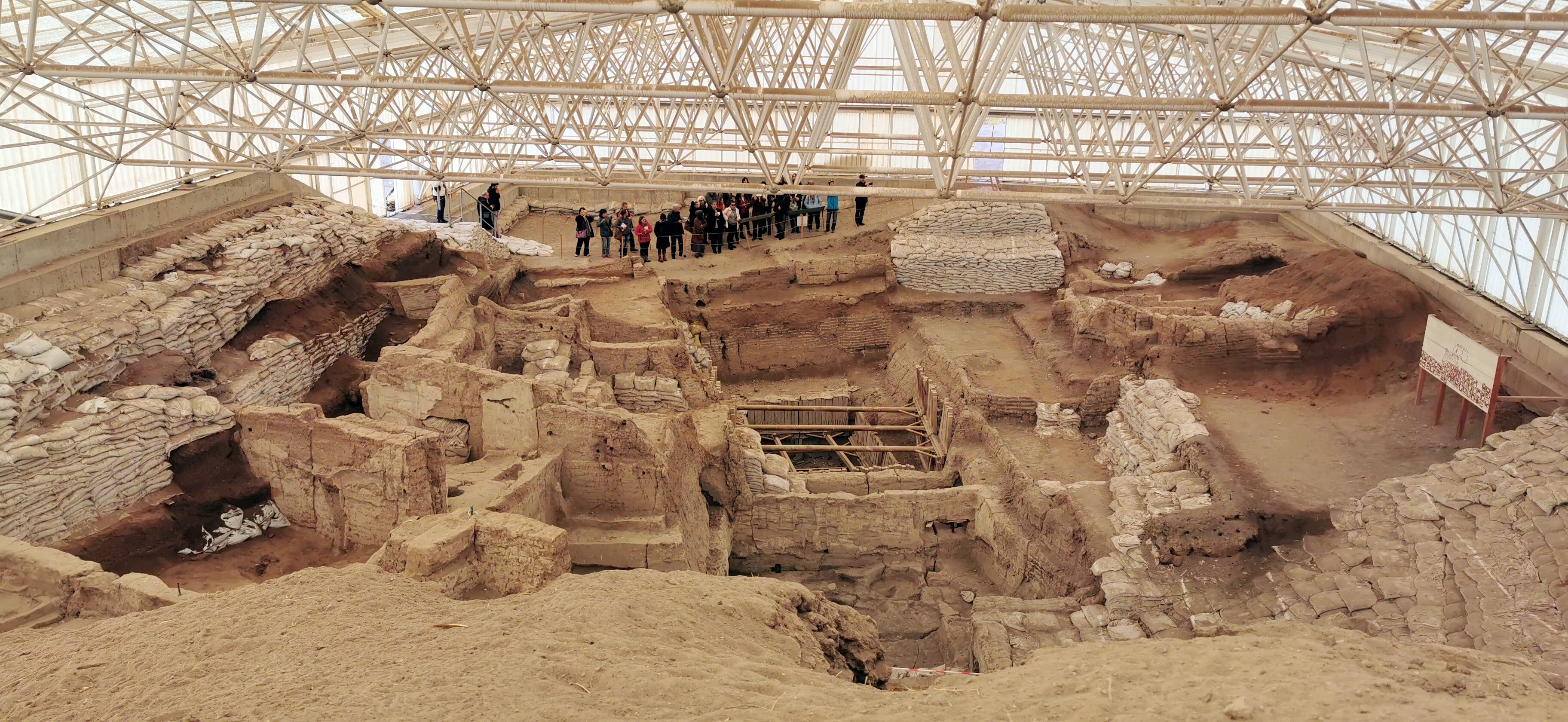
At Çatalhöyük in modern-day Turkey, one of the most remarkable Neolithic settlements yet discovered, mud construction reached impressive sophistication by 7500 BCE.
Theo WrenfieldNARRATOR
This densely packed community of perhaps 8,000 people lived in houses built entirely of mud, with walls plastered smooth and often decorated with paintings and reliefs.
Theo WrenfieldNARRATOR
The houses were built so closely together that there were no streets.

speaker_1UNKNOWN
But in a permanent settlement fed on soft grain gruels that can actually be used to wean infants way earlier, the birth rate skyrockets.
DavidHOST
Packing 8,000 people into a dense urban environment like Catalhoyuk, I mean, that brings massive logistical problems.
DavidHOST
You can't run a society of that size as a loose, egalitarian band of foragers.
speaker_1UNKNOWN
No, it falls apart immediately.

Stephen DaltonHOST
At places such as Jericho, people are living in permanent communities thousands of years before the great ancient cities we usually learn about.
Stephen DaltonHOST
And at Catalhoyuk, in what is now Turkey, from roughly nine thousand years ago, people live in tightly packed mud brick houses.
Stephen DaltonHOST
Very tightly packed.
Stephen DaltonHOST
There aren't conventional streets running between many of these houses.
Stephen DaltonHOST
Your neighbor may literally walk across your house.
Stephen DaltonHOST
Modern apartment living has at least established the principle that the upstairs neighbor should remain inside their apartment while making inexplicable noises.
Stephen DaltonHOST
At Catalhoyuk, they're on your roof.
Stephen DaltonHOST
Again.
speaker_0NARRATOR
surplus food that can be protected, controlled, traded, and whoever controls the surplus controls everything.
speaker_0NARRATOR
By 7,500 BCE, settlements like Çatalhöyük in modern Turkey had reached 8,000 people, 8,000 individuals living in densely packed mud-brick houses built so close together that people entered through holes in the roof.
speaker_0NARRATOR
the whole settlement was like a honeycomb of humanity pressed together in ways that would have seemed insane to their hunter-gatherer ancestors and the social complexity had exploded chattel hoyuk had specialized craftspeople not everyone was farming any more Some people spent their days making pottery, others weaving textiles, others creating elaborate artwork for the ritual buildings scattered throughout the settlement.
speaker_0NARRATOR
These specialists weren't producing their own food.

Aaron JudkinsGUEST
Nevalı Çori was one of the very first ones.
Aaron JudkinsGUEST
Uh, Karahan Tepe, um, uh, Ca- uh, Çatalhüyük was another one.
Aaron JudkinsGUEST
And, um, although this was a little bit in conventional, on the conventional timeline, it's, it's, it's post-Göbekli Tepe, but this Çatalhüyük is very well documented.
Aaron JudkinsGUEST
It's excavated.
Aaron JudkinsGUEST
It's, it's been published.

TitusHOST
Yeah.
TitusHOST
You, basically what we've seen is that, uh, apparently the first ever find of, like, leavened bread was a fermented bread-like mass found in Çatalhöyük, which is the city governed by the fat women.
DuneHOST
Ah.
TitusHOST
You know the one I'm talking about?
DuneHOST
They found a fat woman figurine there, which is a very Jungian archetype of an earth mother goddess.
DuneHOST
It's not-
TitusHOST
Yeah, no, Çatalhöyük was, was, Çatalhöyük was the, the Yannick ideal of a devouring-
DuneHOST
Oh, gosh

Michael ButtonGUEST
Yeah, I mean, I think it undoubtedly is.
Michael ButtonGUEST
I think Çatalhöyük, which is in modern-day Turkey, is the earliest evidence in my view of something akin to civilization.
Michael ButtonGUEST
And now archeologists will say it's not civilization because it doesn't quite tick off every ch- check- part of the checklist.
Michael ButtonGUEST
But I, I think that's n- neither here nor there.
Michael ButtonGUEST
Very impressive architecture.
Michael ButtonGUEST
Clearly organized labor.
Michael ButtonGUEST
Stra- stratified society because how do you achieve that without someone at, at the top and someone below? And these are all things that we used to think were civilization, right? And yet people aren't happy with us calling, uh, Çatalhöyük a civilization, but I think it will get there to be-
Joe RoganHOST
But don't you think that's just because of them trying to protect their timeline that they've been teaching?

Andrew M. HenryHOST
... sanctuary.
Andrew M. HenryHOST
Uh, there's this other very old site, mu- much younger than Göbekli Tepe but Çatalhöyük in, uh, central Turkey, which people call like a proto city 'cause it's pretty obvious-
Jens NotroffGUEST
Yeah
Andrew M. HenryHOST
... it's a bunch of, you know, an agglomeration of people's dwelling spaces.
20 MINS LATER
Jens NotroffGUEST
I mean, it's, it's a difficult story, but, uh, we can at least partly try to piece it together.
Jens NotroffGUEST
As I said, they have these, uh, depictions of, uh, separated human heads and, and vultures or headless bodies and vultures.
Jens NotroffGUEST
Um, Çatalhöyük is also quite, uh, quite famous for these depictions.
Jens NotroffGUEST
And there is a cultural connection between, even if it's much, much later, between, uh, Göbekli Tepe and, and, uh, Çatalhöyük because they were belonging to the same development just in a, in a long-term perspective.
3 more episodes mention Çatalhöyük.
Create an account to see the whole feed, search across every transcript, and follow the entities you care about.