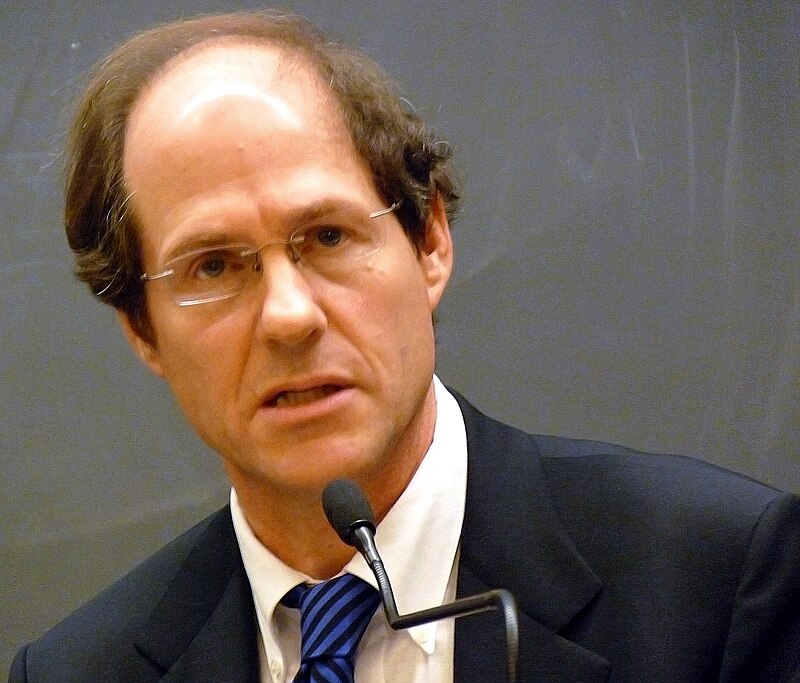
Cass Sunstein
American legal scholar
13
APPEARANCES
11
PODCASTS
Jun 9, 2026


John TomasiHOST
Would you mind for our audience just saying a bit about the love story, about what it was you saw at Chicago in those days before we dive into the more conceptual questions?

Cass SunsteinGUEST
So as a young Harvard grad, I went to Chicago and there was Richard Posner, who was awe-inspiring and definitely right of center.
Cass SunsteinGUEST
and a law and economics kind of guy who was skeptical about rent control and maximum hour laws and didn't much like an active Supreme Court.
Cass SunsteinGUEST
And left of center shibboleths were to him, you know, embarrassing and kind of...
Cass SunsteinGUEST
Then there was Richard Epstein, who was like a volcano, and he was a libertarian.
26 MINS LATER


Jesse MulliganHOST
So what would escaping the product trap actually look like in the case of social media? Is it design changes, regulatory changes, or just good old self-discipline?
Cass SunsteinGUEST
Self-discipline's tough, isn't it? So if everyone in your group has a party, let's say on a Thursday night, and you think, "I wish there weren't a party, but if there's gonna be a party, I don't wanna look to my friends like someone who doesn't like them or don't like parties." And it's really hard for individuals to solve this.
Cass SunsteinGUEST
Um, what has been done in Australia is there's a law, and the law was responsive in part to the data showing that young people would like to get off.
Cass SunsteinGUEST
And if there's a law that says you're not supposed to be on, the hope is that people will just get off.
Cass SunsteinGUEST
Let's say we're the, uh, Only 16 Club," and that means people who are under the 16, our kids aren't going to get cell phones, or they're gonna have time limits, or they're not gonna be on.


Jacke WilsonHOST
You can either choose one that exists or describe one that has not yet been written.
Cass SunsteinGUEST
Uh, it's Possession by A.S. Byatt, which is my favorite novel e-ever, and I've read it six times, but I'd love to read it a seventh time.
Cass SunsteinGUEST
It has all the world in it, heightened, the best romance you could imagine, a lot about aspirations and connections and missed connections and reconnections and what matters most in human life.
Cass SunsteinGUEST
And I think something, The Time Traveler's Wife is more like a book I was waiting for, and I really love it, and I'm thrilled it, by its existence.
Cass SunsteinGUEST
Forgive me, uh, Andre Nickenburger, your book is fantastic, but Possession is the one I choose.


Laurie SantosHOST
But was Cass' hypothesis right? Well, researchers recruited a new group of participants and asked them a different willingness to pay question.
Cass SunsteinGUEST
How much would you demand to be off contingent on everyone in your community being off? That's the product trap question, and what they found was if you ask people how much would you demand to be off, you got the standard answers, as in my study.
Cass SunsteinGUEST
So people say, "I will require you to pay a lot to be off these platforms," in this case TikTok and Instagram.
Cass SunsteinGUEST
But then if people, and these are college students, are asked how much would you demand to be off contingent on everyone in your community being off, then they say, "If everyone in the community is off, then I will pay you.
5 MINS LATER
Laurie SantosHOST
So given that most people aren't leaving these platforms anytime soon, how do we break free? Cass says that behavioral science suggests at least three different paths forward.

Prakhar GuptaHOST
What are the kind of things that would go on in the head of an average individual while making a choice? Okay,
Cass SunsteinGUEST
it's useful to think, and this is an idea that's been pioneered in social science and publicized by Daniel Kahneman and Dick Thaler and I do a lot with it.
Cass SunsteinGUEST
It's useful to think that there are two families of thinking in the human mind.
Cass SunsteinGUEST
And system one is intuitive and automatic, sometimes emotional and really rapid.
9 MINS LATER
Prakhar GuptaHOST
So first, tell me about the idea of nudge and how that influences decision making overall.
Lynn ThomanHOST
In plain terms, what does separation of power actually mean, and what does it do for ordinary people?
Cass SunsteinGUEST
Let's get at the six, shall we? Courts can't make law, and that, for ordinary people, means that we get to govern ourselves, and that people with life tenure and guarantees of independence, they don't tell us what the law is.
Cass SunsteinGUEST
That's extremely important because we have an executor of the laws, that is the executive branch, which has incentives and safeguards if things are working well, and independence, which means if the judge is mad at you, the judge can't go putting you in jail.
7 MINS LATER
Lynn ThomanHOST
If separation of powers slows things down, what's the danger of speeding things up?


Cass SunsteinGUEST
Uh, courts can't exercise legislative authority, no lawmaking, and that's associated, let's say, with elections, and that's really fundamental.
Cass SunsteinGUEST
We don't want our judges-- Some people like powerful judges, some people less so, but whatever you like, you ought not to want them to be able to execute the laws or to make the laws.
Cass SunsteinGUEST
The Congress can't execute the laws, and that's really fundamental because Congress might make a law, and then the executive might say, "Okay, people who violated or arguably violated aren't going to be arrested." And that's a safeguard of freedom, that we need two branches to get together to decide that people will be arrested.
Cass SunsteinGUEST
The legislature can't interpret the law, or at least it's not the fundamental authority on the meaning of law.
29 MINS LATER


Tyler CowenHOST
So if I ask myself, "How brutal does immigration policy have to get in the bulldozer kind of sense to stop that from happening?" what is your answer?
Cass SunsteinGUEST
I worked with Republicans a bit in Washington and the sentence that we agreed was the right one was "lawful pathways." So that has one implication, which is if people wanna come in and do work, and let's s- start with waiters, seafood processing in Alaska, various forms of-...
Cass SunsteinGUEST
construction work and they wanna come in and there aren't American workers there who will do the jobs, this is a fantastic thing.
Cass SunsteinGUEST
It's a fantastic thing for America and it's a fantastic thing for those people.
Cass SunsteinGUEST
We actually have a program called H-2B, which both the right and the left have been enthusiastic about.
58 MINS LATER

Cass SunsteinGUEST
So if AI knows that what you're really interested in are books about behavioral economics and Labrador retrievers, and you're not really interested in books about particle physics or about Chihuahuas, then you can get information that is relevant to your interests or maybe offerings that are connected with your......
Cass SunsteinGUEST
If AI knows that certain people, let's say, have self-control problems, that they are addictive personalities, or that they are reckless purchasers, then AI can really get resources from them and maybe put their economic situation into a very bad state.
Cass SunsteinGUEST
If AI knows that certain people are very parsimonious and they don't really wanna spend much money and they are very careful, AI might know that people like that are vulnerable only to this, and then it can work on you.
12 MINS LATER


Jon FavreauHOST
Do you think there are values that underpin illiberal thinking in, in some of these authoritarian societies? Like, what is the philosophical basis for illiberalism or autocracy or, or whatever you wanna call it?
Cass SunsteinGUEST
Um, Roosevelt said during World War and Hitler's rise, he said, "They call it a new order.
Cass SunsteinGUEST
It is not new, and it is not order." But there's in every human soul, I think, an appreciation at least of the value of order in the face of fear.1984 Orwell's, uh, great novel of-- great liberal novel of liberalism.
Cass SunsteinGUEST
I reread it recently, and what makes it so powerful is that Orwell was actually in his soul ambivalent.
Cass SunsteinGUEST
It, uh, he ultimately came out, of course, on the liberal side, but the appeal of Big Brother, it's manifest on the page, and it's order and submission.
18 MINS LATER
Jon FavreauHOST
How much of the rise of, of post liberalism do you prescribe to the rise of social media and our... or in just in general, beyond that, just our shifting media and information environment? Like, has, has the-- Is the way that we interact with one an-another and get information, has that highlighted a specific illiberal impulse that was always there, or did it perhaps destroy something or weaken something that was holding up our liberal democracy? What, what do you think about that?


Yascha MounkHOST
Why do you think that that doesn't cut the mustard? In what ways is that blaming, uh, you know, any worrying aspect of our society for liberalism, um, without liberalism actually being the cause of it?
Cass SunsteinGUEST
That was beautifully put, and that I think is a worthy, uh, set of objections to something, whether it's a set of objections to liberalism is a different point, but let's, let's talk about it.
Cass SunsteinGUEST
One is, let's say secularism as a thing, where if there's, you know, uh, contempt for or a lack of, uh, respect for religious activity and religious persons, um...That's occasionally real in Western nations, and it's horrible and illiberal.
Cass SunsteinGUEST
So the objection to, uh, shutting down religious, uh, practices in the midst of COVID or to singling out religious practices for, uh, regulation that similar, uh, gatherings were facing, that's a liberal objection.
10 MINS LATER
Yascha MounkHOST
But, but to start more broadly, you know, now that we've defined the negative space, now we've seen, uh, what liberalism isn't and where some of the boundaries are, why some of it's, the critiques of liberalism are wrong, uh, what is the affirmative sort of description of what this tradition actually consists of?

Cass SunsteinGUEST
So there are people on the left who associate liberalism with progressivism, and there's nothing wrong with that.
Cass SunsteinGUEST
So we might say that there's American liberalism, which Barack Obama was part of, and then there's American conservatism, which Ronald Reagan is part of, and that's not exactly wrong.
Cass SunsteinGUEST
Or you could think that there are, uh, people who are liberal in the historical sense who like free markets and who are, uh, classical liberals, as you say, like Friedrich Hayek, who won a Nobel Prize, and they think government regulation is terrible, terrible, terrible, and so are high taxes, and that's liberalism, and progressives are, on that, uh, definition, illiberal.
20 MINS LATER

Sean CarrollHOST
How, how easy is it to say, "Okay, we can disagree about all these things, but we can still agree that we should live in a liberal democratic society"?
Cass SunsteinGUEST
George Washington used that word in a way that connected with the old tradition.
Cass SunsteinGUEST
And you can almost get it even now in 2025, almost 2026, the notion of being... having a liberal disposition.
Cass SunsteinGUEST
You can kind of politicize that in a way, but it might mean, you know, you're committed to your community and, uh, you know, you might think Christ was a liberal God or son of God or whatever your preferred formulation.
35 MINS LATER