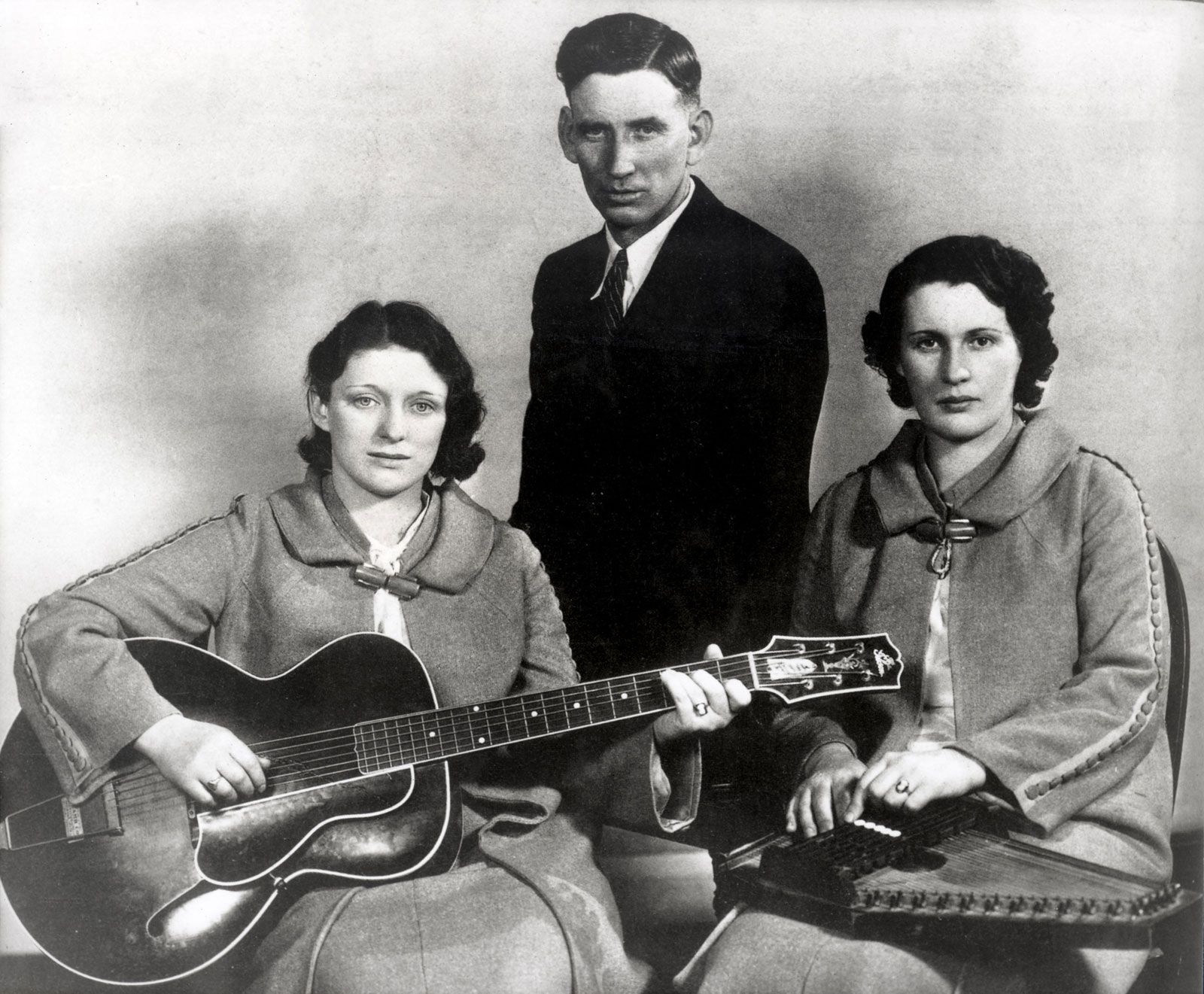
Carter Family
Musical groupWikipedia
72
MENTIONS
21
EPISODES
21
PODCASTS
Search complete. 72 mentions across 21 episodes found for "Carter Family".
Sep 19, 2026

Dave StroudHOST
That is, of course, the one of John Hardy.
Dave StroudHOST
We'll hear how the tale changes from the early recordings of Lead Belly and the Carter family to a haunting interpretation some 70 years later from Bill Frizzell and Petra Hayden.
Dave StroudHOST
Three versions of an old story, and plenty of room for a few stretchers along the way.
Lead BellySOUNDBITE_SPEAKER
John Hardy was a Negro, and he was a desperate man, and he carried two six-shooters.
14 MINS LATER
Dave StroudHOST
And there you have it.
Dave StroudHOST
That's the joke.
Dave StroudHOST
And that short set opened with the story of John Hardy, opening with Lead Belly's narrative from 1945, and then a pair, one contemporary and one from the Big Bang of country music, from the Carter family.
Dave StroudHOST
Bill Frizzell and Petra Hayden's John Hardy Was a Desperate Little Man comes from the 2003 album Petra Hayden and Bill Frizzell.

Mike NessGUEST
You know, where I heard, first heard Buck Owens and The Dillards and Johnny Cash.
Mike NessGUEST
But there was, in the house, my mom had gotten it, the Smithsonian box set of folk, you know, music, of, like, everything from, uh, blues to The Carter Family.
Scott LippsHOST
Mm.
Mike NessGUEST
And The Carter Family was really a band that hit a chord with me.
Scott LippsHOST
Sure.
Mike NessGUEST
I know they weren't down and out [laughs] as much as-
Mike NessGUEST
It sounded down and out.
Mike NessGUEST
It sounded emotional, and it really struck a chord with me.

Nate WilcoxHOST
It didn't sound that country to me.
Nate WilcoxHOST
I was definitely much more drawn to the Carter family.
Nate WilcoxHOST
I definitely preferred Grayson and Witter's original version of the record, The Old 97.
Nate WilcoxHOST
But nonetheless, I was curious about it and a little bit informed.
Nate WilcoxHOST
And in his introduction, he talks about his excitement on October 12th, 1981, when Vernon Delhart was inducted into the Country Music Hall of Fame at the Country Music Association Awards.
Nate WilcoxHOST
And this is decades ago.
Nate WilcoxHOST
After Jimmy Rogers and the Carter family who came after Vernon Dalhart were inducted.
Nate WilcoxHOST
And Dalhart was inducted by Dolly Parton.

speaker_0HOST
After a full day of working in the fields, Johnny, his siblings, and his parents would all come inside and sit around this battery-powered radio and listen to music.
speaker_0HOST
One of the main radio channels at that time was playing a lot of folk music, which serendipitously included a little band called… drumroll, can you guess? The Carter Family.
speaker_0HOST
Johnny remembers sitting and listening to the Carter family sing for hours and hours at a time.
speaker_0HOST
The Carter family was a musical group, obviously, that started in 1927, right before the Great Depression.
speaker_0HOST
The original group was a woman named Sarah, her husband, A.P. Carter, and their sister-in-law, Mabel.
speaker_0HOST
Mabel actually married A.P.' 's brother.
speaker_0HOST
But now that we're struggling, now that most people are struggling, we've really got to dedicate our lives to this band and to our music more than ever before.
speaker_0HOST
So during the Great Depression years, A.P., Sarah, and Maybell really kicked it into high gear for their music group.

Joe HinesHOST
On XERA, Brinkley broadcast yodelers and fiddlers and Mexican orchestras and religious sermons and psychics.
Joe HinesHOST
And the Carter family, they came to Del Rio in the late 1930s, contracted by a consolidated oil company to perform live on the station.
Joe HinesHOST
Somewhere in Arkansas, a six-year-old named Johnny Cash was listening.
Joe HinesHOST
On the same frequency, in different time slots, you could hear Lydia Mendoza, La Alondra de la Frontera, The Lark of the Border, performing Norteño songs for an audience stretching from Los Angeles to the interior of Mexico.
Joe HinesHOST
tax fraud indictments, a fortune that had evaporated.
Joe HinesHOST
The man who'd exploited the regulatory frontier more aggressively than anybody in the history of American broadcasting died the way all frontier operators eventually die, without a frontier left to exploit.
Joe HinesHOST
But the music that he'd put on the air, the Carter family and Lydia Mendoza and the yodelers and the fiddlers, all of it tangled together on 500,000 watts of unregulated signal over the Chihuahuan Desert, was already inside people, already part of them.
Joe HinesHOST
The six-year-old in Arkansas carried it his whole life.

Harvey BallantyneHOST
The voice of Laura Cantrell, where the roses abloom again.
Harvey BallantyneHOST
And yes, a song written by the Carter family way, way back, even before CDs, God forbid.
Harvey BallantyneHOST
um and records almost uh not quite but uh pardon me uh yes that's from um uh laura cantrell's album of a few years back now and when did it come out doesn't have a date on it but um a great singer and uh yes but in the middle we heard uh the voice of margot price uh from the mercury revs tribute to bobby gentry's the delta suite revisited and Margot was doing sermon there which was Bobby Gentry's songs one of Bobby's yes and that's another story that we have actually covered on previous episodes of Sleep at the Wheel well touched on I should say And we opened that bracket with, goodness gracious, the one male voice of the show, I think, John Prine, but helped out from his duets album, which was entitled In Spite of Ourselves.
Harvey BallantyneHOST
And there he's singing a song that was written by, written, I think, by Kieran Cain.

Duane AllenGUEST
I wrote the background vocals for that record.
Duane AllenGUEST
The Oak Ridge Boys, the Carter family, and there was one, maybe Jan Howard, maybe.
Duane AllenGUEST
One other vocalist was singing with the Carters and us.
Duane AllenGUEST
But I wrote that background, which all we'd do is go...

Matty CHOST
No Depression magazine was first launched by Grant Alden and Peter Blackstock in 1995 as a response to the burgeoning alt-country movement happening within American music.
Matty CHOST
The magazine took its name from a Carter family tune that had been covered by seminal alt-country act Uncle Tupelo on their first LP.
Matty CHOST
For the last three decades, No Depression has been at the vanguard of American roots music combining in-depth historical features that explore the fascinating history of Americana with regular reporting on the most exciting things happening in today's world of old country.
Matty CHOST
No Depression published gorgeous print editions from 1995 until 2008 when the recession and the rising print costs forced Alden, Blackstock, and publisher Kyla Fairchild to make the magazine an online-only entity.
5 MINS LATER
Hilary SaundersGUEST
And because they too loved everything you just said, all of that kind of music.
Hilary SaundersGUEST
And, um, wanted a place where these songs and these stories could be told and understand sort of by, for, and among their peers.
Hilary SaundersGUEST
So a lot of people often ask me like, where does the name come from? And again, once I admit that I did not come up with it or think about how it would appear on the internet in the 21st century, I get to explain that it was from a Carter family song from the great depression where the chorus went and there's no depression in heaven.
Hilary SaundersGUEST
But again, Uncle Tupelo was that band that named their 1995 record, No Depression.

Bill LongGUEST
Why don't you come over there? So I go over there, tripping over there, and it turns out to be, you may not know of these guys, the Skillet Lickers.
Bill LongGUEST
Now, the Skillet Lickers were contemporaries of the Carter family and Jimmy Rogers started in the 1920s.
Bill LongGUEST
And they continued through this one family, the Tanner family.
Bill LongGUEST
And they still play today.
Tom PollardHOST
Yeah.
Bill LongGUEST
Well, I fell in with this guy who wrote a lot of songs, and we always were doing his songs, and I thought, well, I can do that.
Bill LongGUEST
one of the first songs i wrote was a song you may play a little bit later called little flowers well i i had bought this five cd set of carter family songs of 125 songs and i bet you there were not four chords among all those 125 songs right right good stuff great stuff But I listened to those 125 songs, and I wrote the song Little Flowers, which you may pick up on a little bit of the style if we get to that song.
Tom PollardHOST
Well, we'll just start that right now.

Kyle MeredithHOST
Right, right.
Valerie JuneSOUNDBITE_SPEAKER
I want Carter Family on vinyl.
Valerie JuneSOUNDBITE_SPEAKER
That's way too hardcore again.
Kyle MeredithHOST
Yeah.
11 more episodes mention Carter Family.
Create an account to see the whole feed, search across every transcript, and follow the entities you care about.