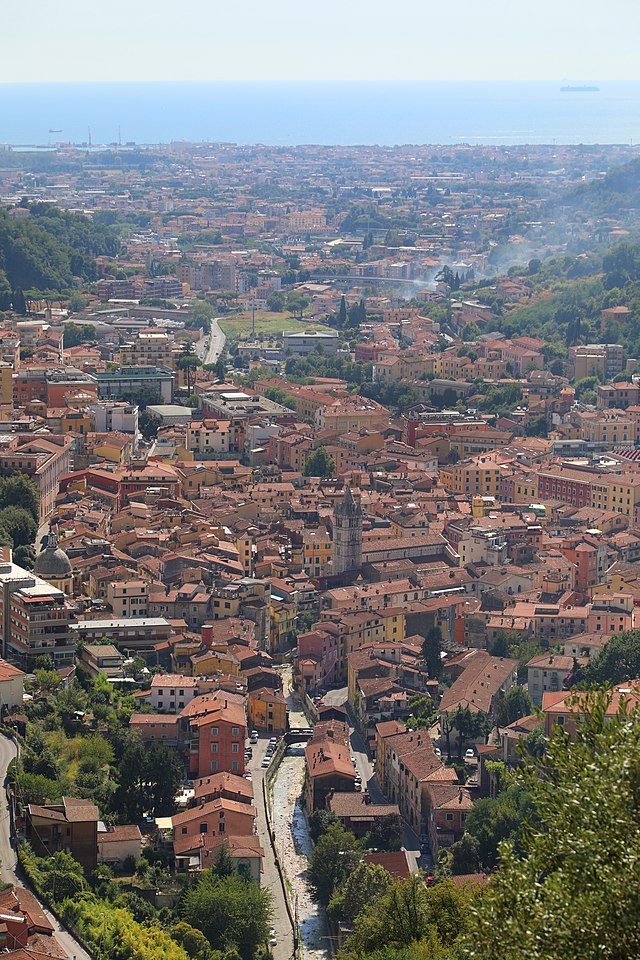
Carrara
Town in ItalyWikipedia
14
MENTIONS
9
EPISODES
8
PODCASTS
Search complete. 14 mentions across 9 episodes found for "Carrara".
Sep 24, 2026

Tembi LockeGUEST
And when you talk about Florence and sculpture, for anybody who's listening or watching, if you know Michelangelo, the sculptor, you know, he worked with marble.
Tembi LockeGUEST
He would go to Carrara, which is a city in Italy, in Tuscany, to look for blocks of marble.
Tembi LockeGUEST
And when he would see the block of marble, he didn't see a block of marble.
Tembi LockeGUEST
What he saw was the sculpt, the piece of art that was within that block of marble.

KelseyHOST
By the 1840s, small firms had begun operations, but marble quarries were, uh, only became profitable when the railroad b- came to Rutland in 1851.
KelseyHOST
At the same time, the famous quarries of Carrara in Tuscany, Italy became largely un...
KelseyHOST
Carrera.
KelseyHOST
What a dumb-dumb.

Jack Burnett StuartGUEST
Well, he loved everything about the place, I think, and, uh, you know, the marble was one thing, but he just liked, um, collecting everything, and obviously, the, the buildings were, were part of that.
Jack Burnett StuartGUEST
I mean, the stones were one thing, and we used to go on trips to, um, to Italy with him to collect marble, buy marble at Carrara.
Jack Burnett StuartGUEST
That was like a, a great adventure.
Rachel StewartHOST
And such a skill actually working that stone as well.

Jason Di RossoHOST
To make great things, though, timing is often the determinant factor, and The Great Arch is a sobering postcard of an economic transition which had disastrous effects on this architect's dream.
Jason Di RossoHOST
That transition was from the post-war mixed economy, an era in which France... had a socialist president, Mitterrand, to an era of economic liberalism where everything, including expensive Carrara marble cladding, had to suddenly make a very, very convincing case for itself in the eyes of the accountants, or it was dropped.
Jason Di RossoHOST
One of the interesting things in this film is the focus on Speckleson's marriage, his wife is played by an excellent Sidze Babette Knudsen, and the pressures that came to bear on the marriage.
Jason Di RossoHOST
The film imagines husband and wife here as very much a team.
8 MINS LATER
Stéphane DemoustierGUEST
So you have to find a good balance between compromise and resisting.
Jason Di RossoHOST
Yeah.
Jason Di RossoHOST
Um, I, there, there is a point in the film where, uh, Spreckelson goes to Carrara in Italy, the place that is, that produced so much wonderful marble, marble that has, um, been the material that artists and architects have used over, over the centuries.
Jason Di RossoHOST
And he wants to use this marble for the arch.
Tembi LockeGUEST
And when you talk about Florence and sculpture, for anybody who's listening or watching, if you know Michelangelo, the sculptor, You know, he worked with marble.
Tembi LockeGUEST
He would go to Carrara, which is a city in Italy, in Tuscany, to look for blocks of marble.
Tembi LockeGUEST
And when he would see the block of marble, he didn't see a block of marble.
Tembi LockeGUEST
What he saw was the piece of art that was within that block of marble.

Anthony CapozzoliHOST
It's the story of the seasons and how bewitching a god always has unforeseen consequences.
Anthony CapozzoliHOST
Carved between 1621 and 1622, when Bernini was just 23 years old, this life-sized Carrara marble catches a violent, dramatic climax with unprecedented emotional intensity.
Anthony CapozzoliHOST
But to fully appreciate what stands before you, we have to unravel three intertwining elements.
Anthony CapozzoliHOST
The ancient myth carved into the stone, the artistic technique, and ruthless pebble politics behind its creation.

Scott AllsopHOST
Michelangelo's David is considered to be one of the greatest examples of Renaissance sculpture.
Scott AllsopHOST
Carved from a piece of marble from a quarry near the Tuscan town of Carrara, the statue is a nude male standing 517 centimetres tall Michelangelo was not the first artist to begin carving a statue of David from this marble block.
Scott AllsopHOST
The Florentine sculptor Agostino di Duccio had been first contracted by the overseers of the Office of Works of Florence Cathedral way back in 1464, and he had been contracted to create the statue as one of twelve figures that would appear on the buttresses at the recently completed cathedral.
Scott AllsopHOST
Having begun to shape the feet and the legs, he stopped work on the statue in 1466, and work only resumed a decade later when Antonio Rossellino took over.

Elvis DuranHOST
It's interesting.
Elvis DuranHOST
If you go to Carrara, Italy, which is where they do the marble, marble mining.
Elvis DuranHOST
You've heard of Carrara Marble, right? They have these tourist shops and they have little marble statues of David.
Elvis DuranHOST
On the left side, they're David with penis.
Elvis DuranHOST
On the right side, it's David with no penis.