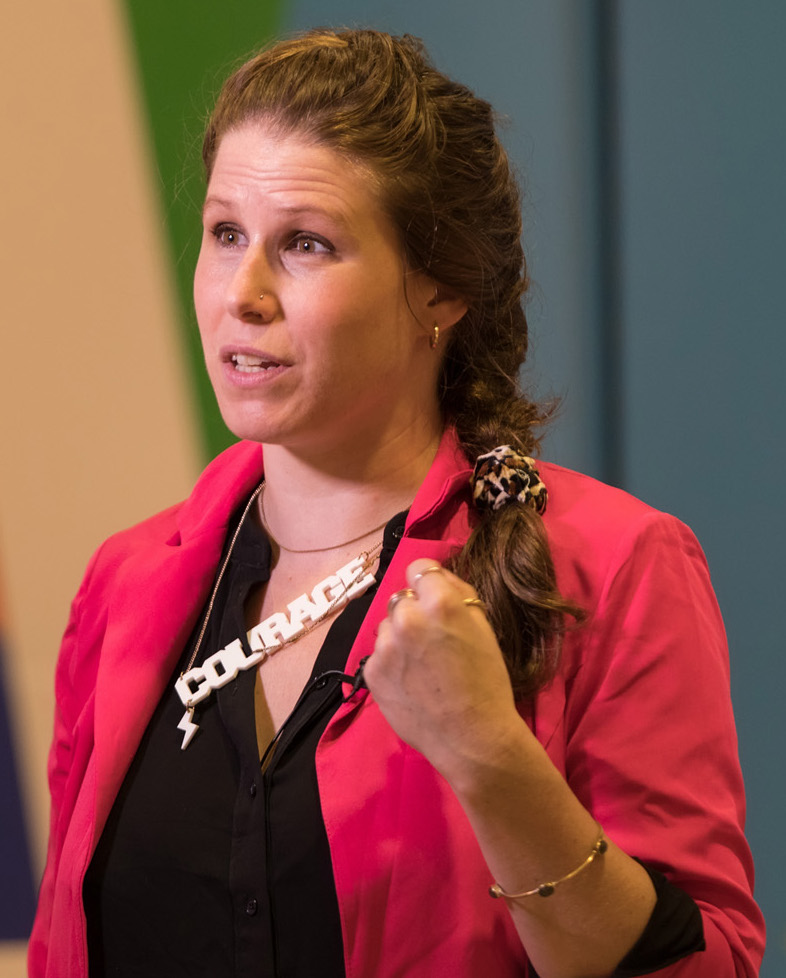
Caroline Criado-Perez
British authorWikipedia
11
MENTIONS
8
EPISODES
8
PODCASTS
Search complete. 11 mentions across 8 episodes found for "Caroline Criado-Perez".
Sep 25, 2026

Caitlin EstesHOST
We have unique gifts to offer the world, and my favorite way to discover more of those gifts is through conversation and community with others.
Caitlin EstesHOST
Well, today I'm especially grateful to speak with an author, mother, and thinker who's given a lot of attention to the gift of women to the world, Leah Sargent.
Caitlin EstesHOST
She's the author of The Dignity of Dependence and runs the substack Other Feminisms.
Caitlin EstesHOST
She lives in Maryland with her husband and three kids.
Caitlin EstesHOST
Leah, welcome to the show.
6 MINS LATER
Caitlin EstesHOST
And so I'd love for you to share how you believe that this has impacted the type of care that women receive and maybe what we can do to be a part of that change.
Caitlin EstesHOST
Yeah.
Leah SargeantGUEST
Yeah, there's an author I really love, Caroline Criado Perez, who she and I would disagree on some of these questions, but she's very good on to have medicine that works for women.

Tom WhippleHOST
Each week, we have an interview with one of the shortlisted candidates.
Tom WhippleHOST
One of them will go on to join a list of winners that include Stephen Hawking and Stephen Jay Gould, Andrea Wulf, and Caroline Criado Perez.
Tom WhippleHOST
This week, before our final interview, we spoke to another of those past winners and a former judge.
Tom WhippleHOST
We asked Bill Bryson why he holds the prize in such affection.

Dirkjan HupkesHOST
Uh-huh.
Aniek van VeldhuizenGUEST
And so I really believe, actually what really opened my eyes is the book, um, Invisible Women from, um, Caroline Criado Perez.
Dirkjan HupkesHOST
Mm-hmm.
Aniek van VeldhuizenGUEST
Uh, because she really describes the gender data gap, which is really interesting.

Ellen YapGUEST
Breaking news.
Ellen YapGUEST
Yeah, I think I started reading the book Invisible Women a few years ago when it came out by Caroline Criado Perez.
Ellen YapGUEST
And I actually had to stop reading it because it made me so angry.
Ellen YapGUEST
um it was frustrating the amount of of points in life where things have been tested on men and the data just extrapolated to women and that just can't be the case you know we have um periods we have the menopause we have pregnancy we have postpartum we have all these different stages in our lives where we have massive hormonal fluctuations and that obviously will impact us in one way or another not only that physiologically we are very different you know the i think the the crash test dummies in cars that was quite an eye-opening um frustration for me just to find out that seat belts were tested on men so women were more likely to die in a crash um and obviously you know to some regard it's not as serious as that fine but equally that's kind of where we've ended up being like the second class citizen, basically.

Elizabeth Chamblee BurchGUEST
Well, you know, I, I, I think there is a data bias in favor of, of men that is, um, kind of largely persistent.
Elizabeth Chamblee BurchGUEST
There was a, a book written by Caroline Criado Perez a number of years ago called Invisible Women, and she lays out, you know, kind of how this, this starts and how it ends.
Elizabeth Chamblee BurchGUEST
Um, you know, in med school, the, the quote, unquote "norm" is, is men.
Elizabeth Chamblee BurchGUEST
You know, when we're talking about dosing for medications, it's largely based on the male body rather than the female body.

Kate DownieGUEST
Uh, books like For Her Own Good, by Barbara Ehrenreich and Deirdre English.
Kate DownieGUEST
Caroline Criado Perez has a book.
Kate DownieGUEST
Um, essentially, science and medicine have been built around data about men, and it has just been assumed that, uh, whatever advice works for men, whatever conclusions they come to based on the data about men, just scale it down a little because women w- u- on average weigh less and, like, are smaller, and then the same thing applies.
Kate DownieGUEST
And that is why women are 30% more likely to have negative reactions to medication, 'cause it's often not tested on them before being released to the public.

Stephanie HilbornGUEST
I'm really all for them.
Nuala McGovernHOST
Yeah, it's interesting, isn't it? I'm thinking of Caroline Criado Perez.
Nuala McGovernHOST
She had that book, Invisible Women, about how the whole world was kind of made from safety belts to whatever else in a man's image, so to speak, and that women's physique had not been taken into account.
Nuala McGovernHOST
So in a lot of ways, it can be considered progress and that investment is going into it.

Sarayu NatarajanGUEST
So there's something in how technology is developed and then implemented that also excludes the participation of half the sky.
Sarayu NatarajanGUEST
So there's a very powerful piece of writing, Invisible Women, by Caroline Perez, which documents some of these instances.
Sarayu NatarajanGUEST
But to the broader provocation of, do we see this in technology? Absolutely, yes.
Sarayu NatarajanGUEST
And very much the inheritance of how systems in other domains of science.