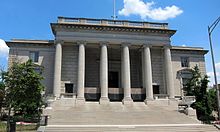
Carnegie Institution for Science
Research institute in Washington, D.C., United StatesWikipedia
20
MENTIONS
16
EPISODES
14
PODCASTS
Search complete. 20 mentions across 16 episodes found for "Carnegie Institution for Science".
Sep 20, 2026

speaker_8NARRATOR
Some authorities think that it is better to increase the size of the letters, and Huey asserts that an attempt to improve unduly small type by making wide spaces between lines is a mistake.
speaker_8NARRATOR
As to the relative legibility of different typefaces, one of the most exhaustive investigations was that made at Clark University by Miss Barbara E. Ruthlin, whose results were published in 1912. this study considers questions of form style and grouping independently of mere size and the conclusion is that legibility is a product of six factors of which size is one the others being form heaviness of face width of the margin around the letter position in the letter group and shape and size of adjoining letters for tired eyes the size factor would appear of overwhelming importance except where the other elements make the page fantastically illegible in miss rothlin's tables based upon a combination of the factors mentioned above the maximum of legibility almost always coincides with that of size These experiments seem to have influenced printers, whose organization in Boston has appointed a committee to urge upon the Carnegie Institution, the establishment of a department of research, to make scientific tests of printing types in regard to the comparative legibility and the possibility of improving some of their forms.
speaker_8NARRATOR
Their effort, so far, has met with no success, but the funds at the disposal of this body could surely be put to no better use.
speaker_8NARRATOR
With regard to the improvement of legibility by alteration of form, it has been recognized by experiments from the outset that the letters of our alphabet, especially the small or lowercase letters, are not equally legible.

speaker_3NARRATOR
Some authorities think that it is better to increase the size of the letters, and Huey asserts that an attempt to improve unduly small type by making wide spaces between lines is a mistake.
speaker_3NARRATOR
as to the relative legibility of different typefaces one of the most exhaustive investigations was that made at clark university by miss barbara e ruthlin whose results were published in this study considers questions of form style and grouping independently of mere size and the conclusion is that legibility is a product of six factors of which size is one the others being form heaviness of face width of the margin around the letter position in the letter group and shape and size of adjoining letters for tired eyes the size factor would appear of overwhelming importance except where the other elements make the page fantastically illegible in miss rothlin's tables based upon a combination of the factors mentioned above the maximum of legibility almost always coincides with that of size These experiments seem to have influenced printers, whose organization in Boston has appointed a committee to urge upon the Carnegie Institution, the establishment of a department of research, to make scientific tests of printing types in regard to the comparative legibility and the possibility of improving some of their forms.
speaker_3NARRATOR
Their effort so far has met with no success, but the funds at the disposal of this body could surely be put to no better use.
speaker_3NARRATOR
With regard to the improvement of legibility by alteration of form, it has been recognized by experiments from the outset that the letters of our alphabet, especially the small or lowercase letters, are not equally legible.

Mike WongHOST
I'm your host, Mike Wong.
Mike WongHOST
Before jumping into today's show, I want to let you know that the recording of my Carnegie Science Neighborhood lecture titled Strange New Worlds, The Science of Star Trek is now up on YouTube for you to enjoy.
Mike WongHOST
If you're not familiar with what this is, basically in celebration of Star Trek's 60th anniversary this year, My friends at work and I hosted a Star Trek-themed science outreach event on our campus at Carnegie Science's Earth and Planets Laboratory in Washington, D.C.
Mike WongHOST
Think of this as, like, the coolest episode of this podcast ever produced to date.
Mike WongHOST
Not only do you get to hear from me about the astrobiology of Star Trek, but also from fellow scientists and science communicators Phil Plait, Nicole Wallach, and Maggie Thompson about how their research relates to Star Trek.

Kenneth WillisHOST
The Carnegie System is a standardized system scientists use to classify human embryos by their actual physical development.
Kenneth WillisHOST
It grew out of the Carnegie Institution's collection and study of human embryos, and its 23 stages became an internationally recognized standard for describing early human development.
Kenneth WillisHOST
And importantly, these stages aren't based on just how many days have passed since fertilization.
Kenneth WillisHOST
Researchers look at identifiable developmental features.

speaker_0NARRATOR
When questions about Mars, life, and time collide, you get fascinating conversations like the one Brian Keating had with Michael Wong from the Carnegie Institution for Science.
speaker_0NARRATOR
And Wong opened with something designed to completely unsettle our assumptions.
speaker_1UNKNOWN
Let me guess, something about life on Mars?

Grandpa CohenHOST
Her name was Vera Rubin.
Grandpa CohenHOST
Together with her longtime collaborator Kent Ford, An instrument builder of great skill working at the Carnegie Institution of Washington, she began, in the late 1960s and through the 1970s, one of the most quietly consequential observational programs in the history of astronomy.
Grandpa CohenHOST
Ford had built a remarkable device, an image tube spectrograph, sensitive enough to record the spectrum of a single small patch of a galaxy in a reasonable exposure time.
Grandpa CohenHOST
This mattered.

Molly CongerHOST
They didn't stop using science to justify their abuse of everyone who didn't look like them, but openly identifying with Nazi Germany was getting pretty unpopular, even by the mid-1930s, years before the war actually began.
Molly CongerHOST
In 1935, the Carnegie Institution convened a panel that determined Harry Laughlin's work at the Eugenics Research Office lacked scientific merit, and they ultimately pulled their funding and closed the office altogether.
Molly CongerHOST
So now, here's one of the country's most aggressively racist race scientists, and he's out of the job.
Molly CongerHOST
He was the perfect fit for the Pioneer Fund's first president.
Mike WongHOST
Before we begin, I want to let you all know about a really cool Science of Star Trek event coming up on September 9th, 2026.
Mike WongHOST
In celebration of Star Trek's 60th anniversary, my institution, Carnegie Science, is throwing a Star Trek themed neighborhood lecture, where I'll be giving a short talk on the astrobiology of Star Trek, followed by a panel discussion featuring myself and my colleagues Nicole Wallach and Maggie Thompson.
Mike WongHOST
The panel will be moderated by the one and only Phil Plait, also known as the Internet's Bad Astronomer, who is an expert in science communication, astronomy, and a huge trackie.
Mike WongHOST
You can beam in over Zoom, or if you live in the Washington, D.C. area, join us in person for free at Carnegie Science.
Mike WongHOST
The link to register is in the show notes.
Mike WongHOST
I'd really love to see you there.
Mike WongHOST
And now, on to today's show.
Mike WongHOST
Previously on Strange New Worlds, we spoke to Abby Alling and Amelia Lee, two of Carnegie Science's 2026 Epic Interns.

speaker_0NARRATOR
Green of Brooklyn, capable of recording only such air pressures as one might expect to find above 12,000 feet.
speaker_0NARRATOR
A hypsometer loaned us by the Department of Terrestrial Magnetism of the Carnegie Institution of Washington, with thermometers especially made for us by Green.
speaker_0NARRATOR
A large mercurial barometer borrowed from the Harvard Observatory, which notwithstanding its rough treatment by Mr. Hinckley's mule was still doing good service, and one of Green's sling psychrometers.
speaker_0NARRATOR
Our most serious want was an aneroid in case the fragile mercurials should get broken.
6 more episodes mention Carnegie Institution for Science.
Create an account to see the whole feed, search across every transcript, and follow the entities you care about.