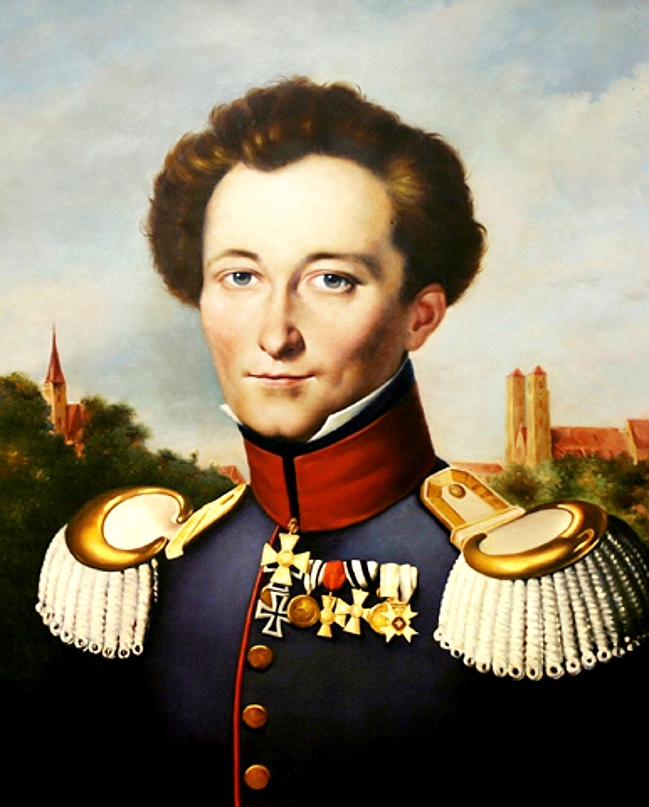
Carl von Clausewitz
Prussian army officerWikipedia
187
MENTIONS
101
EPISODES
79
PODCASTS
Search complete. 187 mentions across 101 episodes found for "Carl von Clausewitz".
Oct 28, 2026

Jesse AlexanderHOST
Yeah, you can see here that connection between military and politics that we've talked about before.
Jesse AlexanderHOST
Clausewitz, you know, war politics by other means.
Jesse AlexanderHOST
Of course, there are people who critique that idea and critique Clausewitz and all the rest of it, but...
Jesse AlexanderHOST
I think we're operating under a relatively conservative philosophical approach here.
Jesse AlexanderHOST
So that is the kind of thing that you want your very, very highest ranking military officers to also understand, to also be able to have these kinds of insights because they have to work for and with the politicians themselves.

Joseph ChapaGUEST
We and our adversaries have war reserve modes where we when we actually go to war, we'll switch to do things slightly differently from the way that we did it in training.
Joseph ChapaGUEST
And so all of this leads to this, you know, the fog and friction that Clausewitz warned about.
Joseph ChapaGUEST
That makes me skeptical that when we get to that, you know, call it the high-end fight or the near-peer fight or whatever you want to call it, that now AI is going to be able to come in and have the decisive effect that, say, network-centric warfare had in the 1990s.
Joseph ChapaGUEST
I'm just not sure.
12 MINS LATER
Nir EisikovitsHOST
Probably blow up hospitals a little bit more easily.
Nir EisikovitsHOST
And then you have...
Nir EisikovitsHOST
Then you have a machine that kind of comes into, you know, it's kind of like the machine that's Joe Biden telling the Israelis, don't make the mistake that we made after September 11th, right? So there's an interesting, apropos Clausewitz, there's an interesting political sort of element that comes into this as well, whereas in the entire history of war, the norms of war are usually relaxed in
James HughesHOST
the

Andrew FaithGUEST
And then the second thing that I learned later on is, you know, and I learned this in Australia during the Australian War College, was that war is merely a continuation of policy by other means.
Andrew FaithGUEST
Clausewitz is
Bryan MorrisonHOST
the German historian that we learned about.
Andrew FaithGUEST
And that was, I think, evident in Libya after the fact.

Pete QuiñonesHOST
Thank you very much.
Pete QuiñonesHOST
Three, the Prussian version of Napoleon's military annihilation strategy, which could easily lose to restrictions imposed by adhering to the Clausewitz theory of military strategy, and indeed finally did lose them during the First World War.
Pete QuiñonesHOST
Rightist political tendencies in the modern era and the partisans who cultivated and served these ideologies such that an articulation of annihilation therapy can be found within the pages of the relevant treaties and work product, including private correspondence, it features in an implicitly reactive context and was in no way tethered to an anti-Jewish commitment or imperative.
Pete QuiñonesHOST
There does not exist a spontaneous rightist praxis of annihilation that exists as a conceptually independent aspect of variable in lieu of a reactive and remedial countermeasure.

Robert StoneGUEST
And the same people who vote on it sign up and get in the Navy and start rowing their ships over there.
Robert StoneGUEST
There's no difference between the political decision-making body, the general population, and the military, right? You know, Clausewitz calls these like a trinity or a triangle.
Robert StoneGUEST
It's like, well, it's a dot in Thucydides.
Robert StoneGUEST
It's the same thing.

Ben Landau-TaylorGUEST
And like, I wasn't an expert on this.
Ben Landau-TaylorGUEST
I'd never trained in military tactics other than the general stuff that everyone back in college, you know, we had to read about all of the wars of like the Romans and like we had to read Clausewitz of course and of course we've studied the campaigns of Napoleon so I knew something and I could help them a bit but I wasn't really an expert and like this is not the experience of every college grad today you could not sort of like parachute them Into an act of wars and and then do them just be like alright I know the basics of military strategy because I've read enough of the classics and like thought about what it meant so it used to be this sort of You know it conveyed that the person actually had read a bunch of difficult material and understood it quite well and now that is You know, by the time I was graduating, like, you know, 20 years ago, it meant that you were like a reasonably diligent person who could do your homework.
Ben Landau-TaylorGUEST
And today, it doesn't really seem like it even means that anymore.
Ben Landau-TaylorGUEST
But it does, like, but over this time, as the knowledge component has been getting smaller, the sort of social certification component has been getting bigger and replacing that.

Ernest C. AudinoGUEST
You see, we understand war in the Western Hemisphere from a certain perspective.
Ernest C. AudinoGUEST
And Carl von Clausewitz stated it well.
Ernest C. AudinoGUEST
He's the most influential theorist on warfare in the Western Hemisphere.
Ernest C. AudinoGUEST
War is politics by extreme measure.

Pete QuiñonesHOST
Thank you very much.
Pete QuiñonesHOST
Three, the Prussian version of Napoleon's military annihilation strategy, which could easily lose to restrictions imposed by adhering to the Clausewitz theory of military strategy, and indeed finally did lose them during the First World War.
Pete QuiñonesHOST
Rightist political tendencies in the modern era and the partisans who cultivated and served these ideologies such that an articulation of annihilation therapy can be found within the pages of the relevant treaties and work product, including private correspondence, it features in an implicitly reactive context and was in no way tethered to an anti-Jewish commitment or imperative.
Pete QuiñonesHOST
There does not exist a spontaneous rightist praxis of annihilation that exists as a conceptually independent aspect of variable in lieu of a reactive and remedial countermeasure.
Thomas777GUEST
I mean, the majority is wrong in this case.
Thomas777GUEST
You know, and I think the primary obstacle to even entertaining that possibility is what I said, that anything that seems derivative of continental perspective philosophically or a historicist perspective is simply done away with I can't remember I think on our continental philosophy series we touched briefly on Clausewitz because Clausewitz's legacy is complicated but he you know he was sort of the he was sort of the German philosopher who stands out as abiding the rationalist perspective that we'd associate with, you know, the analytic and particularly like the Anglophone tradition, you know, and I, I think that that's why there's, um, that sort of lack of, uh, conceptual vocabulary in common between these perspectives, but, um, moving, uh, moving on, um, Yeah, I just wanted to say, too, something, just to clarify what I said at the top of this conversation.
Thomas777GUEST
Because I know it'll come up in the comments, and there's one guy I know specifically who still hasn't been named who is going to take issue with this, that never lost a single battle myth.
Thomas777GUEST
David Hackworth, who was a great man, I think.
33 MINS LATER
Thomas777GUEST
which was an element of the 101st Airborne Division, which was a lot more flexible than elements like the Air Cav.
Thomas777GUEST
And I'm not, I'm not taking anything away from the bravery of those guys or anything, but, uh, you know, you think of the 101st Airborne, you think of Air Assault, which they are, I mean, that's their designation, but, uh, they had a lot more of a fluid tactical orientation, at least certain elements did, you know, like that under Hackworth, you know, his Tiger Force, you know, and, um, Hackworth made the point that what the army had decided counterinsurgency was really had nothing to do with the way anybody who had a meaningful understanding of those kinds of doctrines would think of it.
Thomas777GUEST
And Hackworth invoked Clausewitz a lot, but he did so in an intelligent way.
Thomas777GUEST
And some people misunderstand me because when I criticize Clausewitz, which I have pretty vociferously, it's for ontological reasons, okay? It's not because he's always wrong or he didn't have highly developed ideas on on war fighting and things and happened made the point that the u.s army operations manual the field service regulations until world war ii they reflected a closet wits in understanding that the conduct of war you know it's it's constrained uh by economic and political factors For the purpose of, as Clausewitz phrased it, affecting a satisfactory peace.
ThomasGUEST
I mean, the majority is wrong in this case.
ThomasGUEST
You know, and I think the primary obstacle to even entertaining that possibility is what I said, that anything that seems derivative of, continental perspective philosophically or a historicist perspective is simply done away with I can't remember I think on our continental philosophy series we touched briefly on Clausewitz because Clausewitz's legacy is complicated but he you know he was sort of the he was sort of the German philosopher who stands out as abiding the rationalist perspective that we'd associate with, you know, the analytic and particularly like the Anglophone tradition, you know, and I, I think that that's why there's, um, that sort of lack of, uh, conceptual vocabulary in common between these perspectives, but, um, moving, uh, moving on, um, Yeah, I just wanted to say, too, something, just to clarify what I said at the top of this conversation.
ThomasGUEST
Because I know it'll come up in the comments.
ThomasGUEST
And there's one guy I know specifically who's still not being named who is going to take issue with this.
29 MINS LATER
ThomasGUEST
You know, like that under Hackworth, you know, his Tiger Force.
ThomasGUEST
You know, and Hackworth made the point that what the Army had decided counterinsurgency was really had nothing to do with the way anybody who had a meaningful understanding of those kinds of doctrines would think of it.
ThomasGUEST
And Hackworth invoked Clausewitz a lot, but he did so in an intelligent way.
ThomasGUEST
And some people misunderstand me because when I criticize Clausewitz, which I have pretty vociferously, It's for ontological reasons, okay? It's not because he's always wrong or he didn't have highly developed ideas on war fighting and things.
91 more episodes mention Carl von Clausewitz.
Create an account to see the whole feed, search across every transcript, and follow the entities you care about.