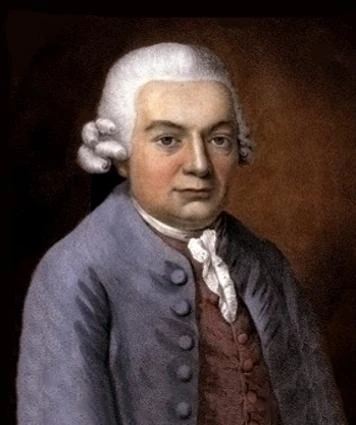
Carl Philipp Emanuel Bach
German composer ‧ Johann Sebastian Bach's sonWikipedia
60
MENTIONS
14
EPISODES
10
PODCASTS
Search complete. 60 mentions across 14 episodes found for "Carl Philipp Emanuel Bach".
Sep 19, 2026

David WalesNARRATOR
It is probable that it was played by the concertmaster Josephus Spies and the excellent violinist Johann Rose, who also played the oboe and taught fencing to the court pages, with the composer conducting the orchestral accompaniment.
David WalesNARRATOR
and prince leopold himself who not only enjoyed music but played it well doubtless took part in the sonatas for clavier and viola da gamba he could not do without his musicians apparently and when in seventeen eighteen he went to take the cure at korlsbad he had the sextet from his kapell accompany him bach was one of the retinue the following year the kapellmeister made a pilgrimage to nearby halle in an effort to meet who had come to the continent to engage singers for his operatic ventures in london but neither at this time nor on a subsequent occasion when he tried to make the acquaintance of his great contemporary was he successful handel had already returned to england seemingly far less eager to meet bach than bach was to meet him in may seventeen twenty prince leopold again went to take the carlsbad waters and once more bach was in his train the visit was somewhat longer this time and it ended grievously for the composer when he set out he left his wife in the best of health and spirits when he came back he found her dead and buried With Maria Barbara gone, there was apparently no one to look after Wilhelm Friedemann, Philipp Emanuel, and Johann Gottfried Bernhard, the eldest not more than ten.
David WalesNARRATOR
The blow seems to have struck Bach the more heavily because, engaged in worldly music-making as he now was, he lacked the spiritual consolation of churchly activities and the communion with his inner self which he enjoyed in the organ loft.
David WalesNARRATOR
an opportunity for a visit to hamburg was provided by the sudden death of the organist at st jacob's church of that city along with a number of other noted players bach was invited to pass on the qualifications of new candidates for the post this gave him a chance to renew old ties and stimulate new interests adam rankin was still alive and in his presence as well as before a number of municipal authorities bach improvised astounding variations on the chorale by the waters of babylon one of rankin's specialties till the veteran conceded in amazement to his younger colleague i thought this art was dead but i see it still lives in you the hamburg journey was but an interlude however inspiring there was no possibility of an organ position in that town and another problem was now occupying him the question of his children's education friedemann had received his first clavier lessons from his father shortly before maria barbara's death the world has been the gainer through this instruction administered the youngster by such a formidable teacher with his own hands bach wrote out a klavierbuchlein for wilhelm on the first page are set down the various clefts more important for posterity is a transliteration of the ornaments or manieren showing precisely how they are to be executed then follow exercises in fingering hand positions and much else the little book is a valuable illustration of bach's own methods of discipline and pedagogy nor are these the only things for which generations of pianists have to thank the bach of the cton period it was for teaching purposes that he composed masterpieces like the two and three part inventions to furnish practical illustration of the advantages of the system of equal temperament he advocated for tuning he composed while still in leopold's service the first book of the well-tempered that miraculous series of twenty-four preludes and fugues in all major and minor keys which is the bible of pianists to this day the second book was written in leipsic many years later it was not long before bach realized that if his children were to be brought up in the traditions of rectitude he had himself inherited they could not remain without a mother's care the more so as his many occupations left him little leisure to oversee a company of lively youngsters and so on december three seventeen twenty one bach took to himself a second wife anna magdalena wilken the daughter of a court trumpeter of weisenfeld's a gentle lovable soul musical devoted to her great husband and mother of a fresh host of children she was as ideal a helpmeet for bach as her predecessor had been a week after his kapellmeister's marriage prince leopold took a wife in his turn but the lady the prince's cousin quickly troubled the musical atmosphere of the curtain court her tastes were for masquerades dances fireworks illuminations and other forms of tinselled show not for concerts of orchestral and chamber music bach called her an amuse a person of no culture her installation at kutten was the prelude to bach's departure as so often happened in his career however a more or less inopportune incident created a situation from which he might profit leipzig and the st john passion this particular incident was the death half a year after bach's second marriage of johann kuhnau who for more than twenty years had held the cantorship of st thomas school in leipzig whether or not the post seemed to bach himself as desirable as a kapellmeistership the sudden vacancy attracted a flock of candidates some of them men of distinction most preferable in the eyes of the leipzig civic council was georg philip telemann who in bach's day ranked higher in the esteem of many musicians than bach himself another was christoph graupner of darmstadt we need not pursue in detail the complicated negotiations and the extensive intrigue the choice of kuhnau's successor involved Telemann was offered the job, and things progressed so far that the authorities debated whether the address welcoming him should be in Latin or in German.

speaker_1NARRATOR
For the entertainment of his comrades, who were never lacking, he once tied a chestnut roaster's handcart to the wheels of a fiacre, and then called to the driver of the latter to go on, while he quietly made off, followed by the curses of the two victims.
speaker_1NARRATOR
At another time he conceived the idea of inviting several musicians, at a specified hour to a pretended serenade the rendezvous was in the tiefengraben where beethoven lived for a few years after his arrival in vienna they were instructed to distribute themselves before different houses and at the street corners even in the high bridge street where mozart lived at a later period stood a kettledrummer very few of the musicians knew why they were there and each had permission to play what he pleased diaz concludes his description of this roguish trick as follows scarcely had the horrible concert begun when the astonished occupants threw open their windows and commenced to curse the infernal music in the meantime the watchmen approached the players scampered off at the right time except the drummer and one violinist who were arrested as they would not name the ringleader they were discharged after a few days imprisonment it was at this time of his early struggles that he went out one day to purchase some piano work suitable for study and acting upon the advice of the music dealer, took a volume of the sonatas of Philip Emanuel Bach, the composer, who first placed piano music upon an independent and, so to speak, poetical foundation.
speaker_1NARRATOR
It appears to me, says this gifted son of the great Bach in an autobiographical sketch, that it is the special province of music to move the heart.
speaker_1NARRATOR
To such and one the genial and imaginative nature of our genuine Austrian musician did involuntary homage from the very first.
speaker_1NARRATOR
It does not follow, however, on this account, that the marvelous gifts of native counterpoint were thrown aside.
speaker_1NARRATOR
On the other hand, Haydn, in his treatment of the so-called thematic development in the second part of the first movement, and in the finale of the sonata brings them out according to their proper intellectual value so that this music also must be heard with the understanding finally the salient points of the whole style which was called the gallant because it did not belong to the church or to the erudite but to the salon is as we may say the grand architectural gradations and building up of the whole which gives to it an arrangement of parts like the symmetry of the renaissance art and the same similarity modern music in general holds to the Gothic of the German counterpoint.
speaker_1NARRATOR
Heiden by nature, and every vital function belonged to active life with its manifold forms of thought and changing mental conditions and therefore found the sonata form the very best for the depositing of his musical wealth and for the magnifying of his own inner powers and capacities by its further development it was for this reason that he played the bach sonatas for students and amateurs with such delight and sat at his piano so gladly for it aroused in him a freer activity of fancy and heartfelt emotions of similar form philip emanuel bach's instruction book the versuch über die wahre art das klavier zu spielen published in berlin in seventeen fifty three with which haydn became acquainted shortly afterward was in his judgment the best most thorough and useful work which had ever appeared as an instruction book and Mozart as well as Beethoven expressed the same opinion.
speaker_1NARRATOR
And yet the ridiculous accusation was made after this that Haydn had copied and caricatured Bach because Bach was not on good terms with him.

speaker_0NARRATOR
It was for this event that he wrote a grandiose Ratswahlkantata, whose music exhibits the influence of Buxtehude, heightened by his own incomparable genius.
speaker_0NARRATOR
in a burst of generosity the city fathers voted to publish the work it was the only one of bach's cantatas printed in his lifetime otherwise there is no record that aside from the cantata god is my king a single such work of his was given in the mulhausen churches though from the creative standpoint he can scarcely have been idle despite the high esteem bach enjoyed in mühlhausen he remained there only a year the municipal heads and the authorities of the church of st blasius regretted his going but were unable to prevent it he conceded frankly that he wanted to improve his material position yet a deeper reason lay at the back of his departure it was at the bottom the by-product of a religious question for some time a reaction had been developing against certain dogmatic formularies in the lutheran body the dissidents known as pietists gradually came to swords points with the orthodox sect and mullhausen especially became a hotbed of pietism whose adherents strongly opposed the use of music in public worship this of course flew violently in the face of bach's ideal which was the betterment of music in the church and its heightened employment to sacred ends it became solely a question of time when such a situation would render his position at st blasius untenable the consistory was so well disposed to bach that it promptly agreed to a variety of modifications in the organ which he had recommended before these were carried out he had given notice of his departure and his employers realized they could do nothing about it he promised however to come over to mulhausen from near by weimar in order to see how the alterations were being executed weimar weimar to which he now removed became bach's home for the next ten years and here were created some of his mightiest works particularly those for organ the town was even at that period a cultural centre its duke wilhelm ernst of sachsenweimar a pious serious-minded ruler engaged bach not only as organist but also as kammermusikus i e as a member of his household orchestra a close friendship also developed between bach and the young but short-lived johann ernst son of bach's earlier weimar patron exceedingly musical the youth was a talented violinist took lessons from the kammermusikus and composed several works of conspicuous merit three of which bach later transcribed for clavier and which for a long time passed for violin concertos by vivaldi the acquaintances and close friendships bach formed at the weimar court were numerous and valuable with musicians writers and educators prominent among them the ducal capelle varied in size and constitution according to circumstances sometimes when opera was performed it included singers the instrumentalists proper seem to have numbered eleven the conductor was one johann samuel dres the concert master from seventeen fourteen on one of the concertmaster's duties was to provide cantatas for a variety of occasions and beginning in seventeen fourteen he wrote a number of them his choir consisted of twelve singers wilhelm ernst had from the first been impressed by bach's powers as an organist the musician's diverse labors were gratifyingly recompensed and in nine years he had doubled his income at its smallest it was twice as large as any at mühlhausen it is claimed that never in his life did bach have at his disposal an organ truly worthy of his powers and even at weimar the instrument was inferior to that at mühlhausen nevertheless the organ works he composed at weimar exceeded anything he had ever done before in sumptuousness of inspiration imaginative grandeur and technical exaction one hears comparatively little of maria barbara bach's wife appears however to have been a fitting helpmeet to her busy husband handling his household and his numerous pupils with tact and discretion and bearing him children with regularity some of these died early others lived till a ripe age in seventeen ten was born his oldest son wilhelm friedemann a genius in his own right and ever his father's favorite but all his life wayward and something of a black sheep at this stage one might as well mention two other musically outstanding sons of bach among the twenty children he was to beget The more prominent of these was Carl Philip Emanuel, who served Frederick the Great and whose reputation as a pianist and composer was such that whenever at the latter part of the 18th century it was a question of Bach, people usually meant Philip Emanuel.
speaker_0NARRATOR
Another, Johann Christian, Bach's son by a second wife, lived and died in London, composed operas, and became an intimate of the youthful Mozart.
speaker_0NARRATOR
during the years of his weimar residence bach made three journeys which are conspicuous among the brief ones that punctuated his life one was to cassel toward the end of seventeen fourteen presumably to examine a new organ possibly too he accompanied his ducal master on a ceremonial visit like weimar cassel had a reputation for culture and evidently the duke would have been pleased to exhibit the prowess of his own court organist a reference to bach's incredible virtuosity on this visit has come down to us his feet flying over the petals as though they were winged wrote an observer made the notes reverberate like thunder in a storm till the prince confounded with admiration pulled a ring from his finger and presented it to the player now bethink you if bach's skilful feet deserve such bounty what gift must the prince have offered to reward his hands as well end quote other stories of his miraculous playing had long circulated throughout the country people said it was a habit of his to climb into the organ loft of an inconspicuous rural church and so astound people with his improvisations that the cry would go up that must be bach or the devil the tale one can depend on it is a myth another trip was to halle birthplace of handel true he did not go there in search of his greatest contemporary though he made several sincere yet ineffectual attempts to meet him but to examine a new organ his playing created so profound an impression that the collegium musicum made an earnest effort to secure him for halle bach was flattered but because of his weimar connections unable to accept the halle council believing he was seeking higher pay was irritated nevertheless a little later it summoned bach in company with johann gunau and christian friedrich rolle to inspect the organ of the church of our lady the officials omitted nothing that might please their distinguished guests a staff of servants and coachmen was placed at their service a reception was held at which the chief musical personages of the town were summoned to meet them and after the organ had been examined in great detail the visitors were entertained at a banquet whose culinary abundance and gastronomic quality may be judged from the following bill of fare which has come down to us one piece of boeuf a la mode pike with anchovy butter sauce one smoked ham one dish of peas one dish of potatoes two dishes of spinach with sausages one quarter of roast mutton one boiled pumpkin fritters candied lemon peel preserved cherries warm asparagus salad lettuce salad radishes fresh butter roast veal as bock returned safely to weimar it may be assumed he passed up a few of the courses he was even paid a fee for the little outing it came to four dollars and fifty cents the third trip carried him to dresden there under the rule of augustus second musical life flourished in seventeen seventeen a season of italian opera was in full blast it was not opera however which fascinated bach he looked upon it with gentle condescension and even in later years was in the habit of chaffing his son friedemann with the question well shall we go over to dresden and listen to the pretty little tunes what did attract bach was the presence at the saxon court of the celebrated french clavecinist and organist louis marchand bach had studied his compositions closely and admired them a gifted but intolerably arrogant person marchand had fallen into disgrace in versailles and found it prudent to emigrate an official of augustus second conceived the idea of summoning bach from weimar and arranging on the spot a musical contest between the two such is at least the traditional story whatever the exact truth may have been bach arrived on the scene of the proposed contest at the specified hour but marchand afraid of a rival whose prowess he well knew left dgden secretly and let the match go by default bach thereupon performed alone stirring his hearers to unlimited admiration marchand returned to france where he lived apparently none the worse for his ignominious failure till seventeen thirty two things however were shaping for a change in the life of bach in seventeen sixteen the conductor of the ducal orchestra johann samuel dres died for two years bach had filled the post of concert-master and seems to have felt that he was next in line for the conductorship it went on the contrary to dres's son a man of mediocre attainment bach was hurt and further embittered by the fact that no more cantatas of his composition were being ordered and his notorious temper speedily got the better of him he had made the acquaintance of prince leopold of anhalt grtens whose sister had married a younger member of weimar's ducal family intensely musical the sovereign in the summer of seventeen seventeen had asked bach to become his kapellmeister bach shortly afterwards sent an application for his release to willem ernst apparently mincing no words the duke flew into a rage we read in the diary of one of the court secretaries on november sixth seventeen seventeen a bach till now concert-master and court organist was put under arrest in the justice room for obstinately demanding his instant dismissal The infuriated genius remained a jailbird only till December 2nd.

Maurice PowellHOST
John Christian Bach was the youngest son of Johann Sebastian Bach because he had his first music lessons with his father.
Maurice PowellHOST
But when Johann Sebastian Bach died, uh, John Christian Bach was sent to Berlin to live with his elder brother, Carl Philipp Emanuel Bach.
Maurice PowellHOST
There's a lot of Bachs out there.
Maurice PowellHOST
Um, from whom he, he, he learned a great deal.
speaker_1NARRATOR
It is probable that it was played by the concertmaster Josephus Spies and the excellent violinist Johann Rose, who also played the oboe and taught fencing to the court pages, with the composer conducting the orchestral accompaniment.
speaker_1NARRATOR
and prince leopold himself who not only enjoyed music but played it well doubtless took part in the sonatas for clavier and viola da gamba he could not do without his musicians apparently and when in seventeen eighteen he went to take the cure at carlsbad he had the sextet from his capelle accompany him bach was one of the retinue the following year the kapellmeister made a pilgrimage to nearby halle in an effort to meet handel who had come to the continent to engage singers for his operatic ventures in london but neither at this time nor on a subsequent occasion when he tried to make the acquaintance of his great contemporary was he successful handel had already returned to england seemingly far less eager to meet bach than bach was to meet him in may seventeen twenty prince leopold again went to take the carlsbad waters and once more bach was in his train the visit was somewhat longer this time and it ended grievously for the composer when he set out he left his wife in the best of health and spirits when he came back he found her dead and buried With Maria Barbara gone, there was apparently no one to look after Wilhelm Friedemann, Philipp Emanuel, and Johann Gottfried Bernhard, the eldest not more than ten.
speaker_1NARRATOR
The blow seems to have struck Bach the more heavily because, engaged in worldly music-making as he now was, he lacked the spiritual consolation of churchly activities and the communion with his inner self which he enjoyed in the organ loft.
speaker_1NARRATOR
an opportunity for a visit to hamburg was provided by the sudden death of the organist at st jacob's church of that city along with a number of other noted players bach was invited to pass on the qualifications of new candidates for the post this gave him a chance to renew old ties and stimulate new interests adam rankin was still alive and in his presence as well as before a number of municipal authorities bach improvised astounding variations on the chorale by the waters of babylon one of rankin's specialties till the veteran conceded in amazement to his younger colleague i thought this art was dead but i see it still lives in you the hamburg journey was but an interlude however inspiring there was no possibility of an organ position in that town and another problem was now occupying him the question of his children's education friedemann had received his first clavier lessons from his father shortly before maria barbara's death the world has been the gainer through this instruction administered the youngster by such a formidable teacher with his own hands bach wrote out a klavierbuchlein for wilhelm firemann bach on the first page are set down the various clefts more important for posterity is a transliteration of the ornaments or manieren showing precisely how they are to be executed then follow exercises in fingering hand positions and much else the little book is a valuable illustration of bach's own methods of discipline and pedagogy nor are these the only things for which generations of pianists have to thank the bock of the curtain period it was for teaching purposes that he composed masterpieces like the two and three part inventions to furnish practical illustration of the advantages of the system of equal temperament he advocated for tuning he composed while still in leopold's service the first book of the well-tempered that miraculous series of twenty-four preludes and fugues in all major and minor keys which is the bible of pianists to this day the second book was written in leipsic many years later It was not long before Bach realized that if his children were to be brought up in the traditions of rectitude he had himself inherited, they could not remain without a mother's care, the more so as his many occupations left him little leisure to oversee a company of lively youngsters.

speaker_2NARRATOR
Die Wolfgango Mozart, May 11, 1762, und Juli, 16, 1762.
speaker_2NARRATOR
Some of the masters given the boy to study were Wagenseil, Tellemann, Haas, and Philipp Emanuel Bach.
speaker_2NARRATOR
wolfgang's compositions include an innocent minuet and trio with very simple basses and a little allegro in three-part song form in these and other childish efforts the improving hand of leopold can be repeatedly detected it was to be so for some time to come and when the father did not have a correcting finger in the pie we become aware of it it is evident in a sketch-book wolfgang was given in london a year or two later when leopold fell ill and in order not to be disturbed by the sounds of practising asked the boy to write something and refrain from noise the book is filled with a great variety of minuets contradances rondos gis sicilianos preludes and even an unfinished sketch for a fugue.
speaker_2NARRATOR
Here one sees indisputable genius in conflict with technical lapses and other evidences of inexperience that somewhat modify the notion that Wolfgang had acquired all his skill by instinct rather than by carefully disciplined study.
speaker_3NARRATOR
Die Wolfgango Mozart, May 11, 1762, und Juli, 16, 1762.
speaker_3NARRATOR
Some of the masters given the boy to study were Wagenzeil, Telemann, Haas, and Philipp Emanuel Bach.
speaker_3NARRATOR
wolfgang's compositions include an innocent minuet and trio with very simple basses and a little allegro in three-part song form in these and other childish efforts the improving hand of leopold can be repeatedly detected it was to be so for some time to come and when the father did not have a correcting finger in the pie, we become aware of it.
speaker_3NARRATOR
It is evident in a sketch-book Wolfgang was given in London a year or two later, when Leopold fell ill, and in order not to be disturbed by the sounds of practicing, asked the boy to write something and refrain from noise.

Jordan WattsNARRATOR
In the same year in which Corelli published his Opus One, 1683, Domenico Scarlatti, the famous harpsichord player, was probably born.
Jordan WattsNARRATOR
In the history of development, his name is the principal one of importance between Corelli and Emanuel Bach.
Jordan WattsNARRATOR
In the matter of technique, he rendered signal service, but for the moment we are concerned with his contribution towards development.
Jordan WattsNARRATOR
Scarlatti does not seem to have ever considered the sonata in the sense of a work consisting of several contrasting movements.
11 MINS LATER
Jordan WattsNARRATOR
See, however, chapter on the predecessors of Beethoven.
Jordan WattsNARRATOR
End of footnote.
Jordan WattsNARRATOR
Emanuel Bach inherited some of his father's genius, and he may instinctively have felt the utter hopelessness of following directly in his footsteps.
Jordan WattsNARRATOR
J.S. Bach had exhausted the possibilities of the fugue form.

David WalesNARRATOR
Yet a deeper reason lay at the back of his departure.
David WalesNARRATOR
it was at the bottom the by-product of a religious question for some time a reaction had been developing against certain dogmatic formularies in the lutheran body the dissidents known as pietists gradually came to swords points with the orthodox sect and mullhausen especially became a hotbed of pietism whose adherents strongly opposed the use of music in public worship this of course flew violently in the face of bach's ideal which was the betterment of music in the church and its heightened employment to sacred ends it became solely a question of time when such a situation would render his position at st blasius untenable the consistory was so well disposed to bach that it promptly agreed to a variety of modifications in the organ which he had recommended before these were carried out he had given notice of his departure and his employers realized they could do nothing about it he promised however to come over to mulhausen from near by weimar in order to see how the alterations were being executed weimar weimar to which he now removed became bach's home for the next ten years and here were created some of his mightiest works particularly those for organ the town was even at that period a cultural centre its duke wilhelm ernst of sachsenweimar a pious serious-minded ruler engaged bach not only as organist but also as kammermusikus i e as a member of his household orchestra a close friendship also developed between bach and the young but short-lived johann ernst son of bach's earlier weimar patron exceedingly musical the youth was a talented violinist took lessons from the kammermusikus and composed several works of conspicuous merit three of which bach later transcribed for clavier and which for a long time passed for violin concertos by vivaldi the acquaintances and close friendships bach formed at the weimar court were numerous and valuable with musicians writers and educators prominent among them the ducal capelle varied in size and constitution according to circumstances sometimes when opera was performed it included singers the instrumentalists proper seem to have numbered eleven the conductor was one johann samuel dres the concert master from seventeen fourteen on one of the concertmaster's duties was to provide cantatas for a variety of occasions and beginning in seventeen fourteen he wrote a number of them his choir consisted of twelve singers wilhelm ernst had from the first been impressed by bach's powers as an organist the musician's diverse labors were gratifyingly recompensed and in nine years he had doubled his income at its smallest it was twice as large as any at mühlhausen it is claimed that never in his life did bach have at his disposal an organ truly worthy of his powers and even at weimar the instrument was inferior to that at mühlhausen nevertheless the organ works he composed at weimar exceeded anything he had ever done before in sumptuousness of inspiration imaginative grandeur and technical exaction one hears comparatively little of maria barbara bach's wife appears however to have been a fitting helpmeet to her busy husband handling his household and his numerous pupils with tact and discretion and bearing him children with regularity some of these died early others lived till a ripe age in seventeen ten was born his oldest son wilhelm friedemann a genius in his own right and ever his father's favorite but all his life wayward and something of a black sheep at this stage one might as well mention two other musically outstanding sons of bach among the twenty children he was to beget The more prominent of these was Carl Philip Emanuel, who served Frederick the Great and whose reputation as a pianist and composer was such that whenever at the latter part of the 18th century it was a question of Bach, people usually meant Philip Emanuel.
David WalesNARRATOR
Another, Johann Christian, Bach's son by a second wife, lived and died in London, composed operas, and became an intimate of the youthful Mozart.
David WalesNARRATOR
during the years of his weimar residence bach made three journeys which are conspicuous among the brief ones that punctuated his life one was to cassel toward the end of seventeen fourteen presumably to examine a new organ possibly too he accompanied his ducal master on a ceremonial visit like weimar cassel had a reputation for culture and evidently the duke would have been pleased to exhibit the prowess of his own court organist a reference to bach's incredible virtuosity on this visit has come down to us his feet flying over the petals as though they were winged wrote an observer made the notes reverberate like thunder in a storm till the prince confounded with admiration pulled a ring from his finger and presented it to the player now but think you of bach's skilful feet deserve such bounty what gift must the prince have offered to reward his hands as well End quote.

Jordan HoffmanHOST
Yeah.
Jordan HoffmanHOST
The other one who I love is Carl Philip Emanuel Bach.
Jordan HoffmanHOST
He is Johann Sebastian Bach's son, and he's a brilliant composer in his own right, even though his old man pretty much invented the art of the fugue.
Jordan HoffmanHOST
You popped Sam with that one.
4 more episodes mention Carl Philipp Emanuel Bach.
Create an account to see the whole feed, search across every transcript, and follow the entities you care about.