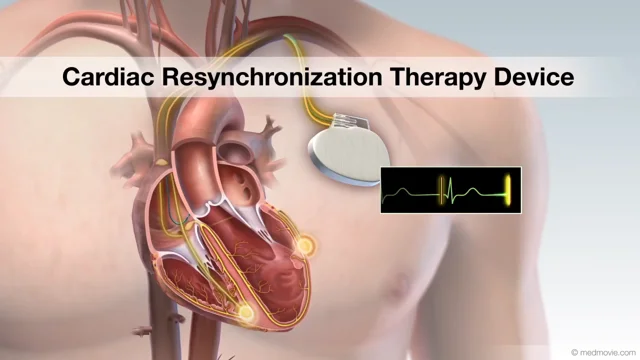
Cardiac resynchronization therapy
17
MENTIONS
6
EPISODES
6
PODCASTS
Search complete. 17 mentions across 6 episodes found for "Cardiac resynchronization therapy".
Oct 18, 2026

AloHOST
The MATIT II trial showed a 31% reduction in all-cause mortality with ICD therapy in post-heart attack patients with an ejection fraction at or below 30%.
AloHOST
Patients with a specific electrical conduction delay, seen as a wide QRS on the EKG, qualify for cardiac resynchronization therapy, or CRT, a special pacemaker that helps both sides of the heart pump together.
AloHOST
CRT improves ejection fraction in 60 to 70% of appropriate candidates.
AloHOST
The goal with all four pillars is to start them as soon as possible, ideally within three months of diagnosis, and then increase the doses over weeks to months up to the target levels that have been proven to work best in the trials.
AloHOST
Now, Hef-Pef, the stiff heart, has been a much harder problem to solve, because for years, we simply didn't have a drug that proved benefit.

Aditya MehraGUEST
So your cardiologist might recommend a defibrillator for you.
Aditya MehraGUEST
One of the other things that we do is what's called CRT, or cardiac resynchronization therapy, meaning that it's a special kind of a pacemaker defibrillator that improves the contraction of the heart muscle and kind of makes it synchronous so that it decreases your heart failure episodes and actually might improve your morbidity and mortality.
Aditya MehraGUEST
We might implant a pacemaker defibrillator depending on your heart muscle.
Aditya MehraGUEST
So that's something to keep in mind.

Sarah BirkhoelzerHOST
Because we now have new definition of heart failure with reduced ejection fraction, we have now different stages from A to E, and we have a new concept of foundational medical therapy.
Sarah BirkhoelzerHOST
We have MRAs recommended across the ejection fraction spectrum, and we have stronger recommendations around identifying causes for heart failure, structural intervention, CRT, amyloidosis, and advanced heart failure.
Sarah BirkhoelzerHOST
But none of that improves outcomes unless we actually implement it.
Sarah BirkhoelzerHOST
So today in the Beat Wise podcast, we're asking a slightly different questions.

John MandrolaHOST
Of course, we should all be open to randomizing our patients into trials.
John MandrolaHOST
I am a huge proponent of doing this, and I'm very proud of our robust commitment to the left versus left trial of CS pacing versus bivy pacing in CRT-eligible patients.
John MandrolaHOST
I'm so proud that we randomized patients into this non-industry-funded trial.
John MandrolaHOST
And I strongly believe that cardiologists are far too quick to reject equipoise.
14 MINS LATER
John MandrolaHOST
All right.
John MandrolaHOST
Next trial is very interesting.
John MandrolaHOST
This is targeting CS leads in CRT devices.
John MandrolaHOST
This is the Danish CRT trial.

Maysah SalmanGUEST
Implantable cardioverter defibrillator C.
Maysah SalmanGUEST
A dual chamber pacemaker D. CRT pacemaker Or E.
Maysah SalmanGUEST
A CRT defibrillator
Sam WilliamsHOST
Question 5
Maysah SalmanGUEST
Which of the following is class 3 antiarrhythmic medication? Is it A.
Sam WilliamsHOST
So what is the correct answer?
Maysah SalmanGUEST
I mean, it's a clear class one indication for an ICD implant.
Maysah SalmanGUEST
The patient has a reduced ejection fraction heart failure with a narrow complex, therefore no CRT indication.